
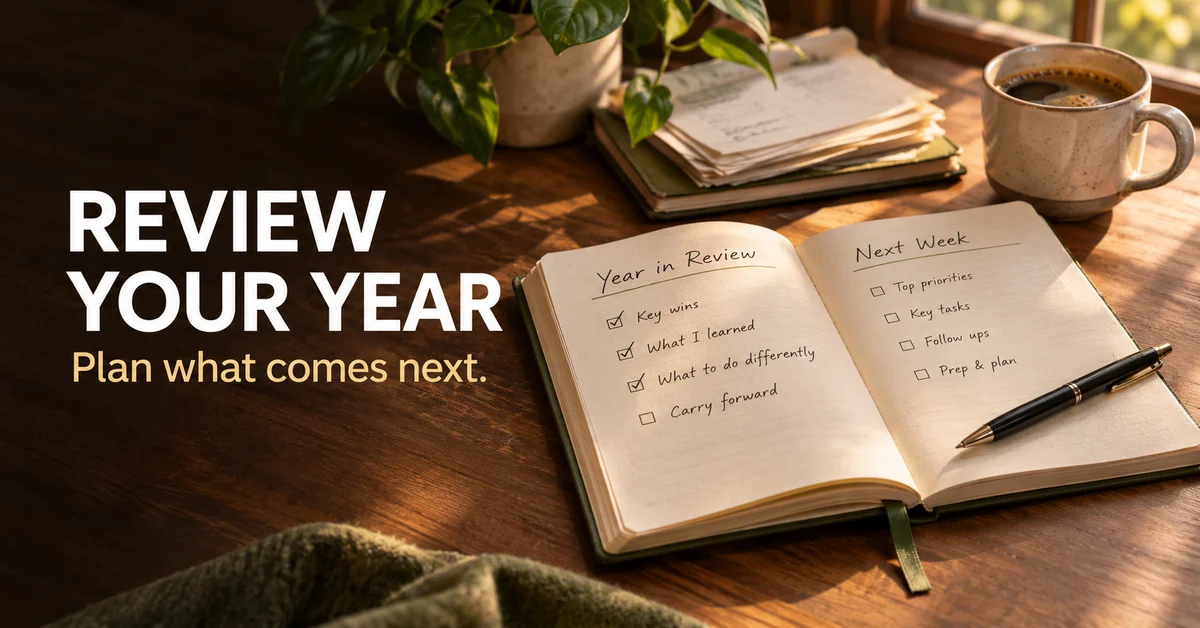
How to Do a Year-End Review and Build a Realistic January Plan
Table of Contents
You open a fresh page in December and write “next year”. Under it go the same goals as last year: exercise more, finish the course, grow the side project and stop working so late.
The problem is not a shortage of ambition. It is that you are planning another year without examining the one you already lived.
A useful year-end review needs less ceremony and more evidence. Your calendar, completed projects and abandoned commitments tell you where your time went. They also reveal what your next plan needs to change.
I recommend a 90-minute session that ends with three outputs: a short review, a stop-doing list and a first-week plan. That is a suggested time limit, not a promise that everyone’s year fits neatly into one sitting.
This guide includes a six-step process, a worked Singapore example and a template you can copy. You can use it in November, December or halfway through a year that needs a reset.
Why Most Annual Reviews Produce Another Wish List
An annual review often becomes one of two things. Either you list achievements until the page feels encouraging, or you list failures until planning feels pointless.
Neither tells you what to do on the first working Monday in January.
The missing step is a decision. If a project stalled because every evening was already occupied, a stronger resolution does not create an evening. You need to remove a commitment, reduce the project or change its schedule.
Separate three questions:
- What happened, based on records rather than your mood today?
- What conditions helped or blocked the work?
- What will you change in the calendar, commitments or scope?
Do not judge the whole year from its final month. A difficult December can hide useful progress from March. A successful launch can hide six months of avoidable overload.
For the same reason, avoid giving yourself one overall score. A year containing a promotion, caregiving and a cancelled side project cannot sensibly become “seven out of 10”. Review each area on its own terms.
The core principle: every useful lesson should lead to a decision about what you will continue, change or stop.
The Three Things You Need
You do not need a new planning app, a paid dashboard or a perfect archive.
Your existing calendar, at no extra cost. Look at the calendar you actually used. It provides prompts for deadlines, travel, busy periods and commitments you have forgotten.
One document or notebook you already own. Keep the review in a place you can reopen. A plain document is easier to maintain than an elaborate template with 40 empty sections.
A small evidence folder. Gather completed-work notes, project lists and any records relevant to your chosen areas. For a side project, this could include published work and customer feedback. For learning, use completed exercises rather than course purchases.
The additional software budget is S$0 when you use tools you already have. Keep employer documents inside approved work systems. Your personal annual review can record a general lesson without copying confidential material home.
Pick a quiet slot and decide its scope before you start. “Work and side project” is enough for a first attempt. You do not have to examine career, relationships, home and every habit in the same session.
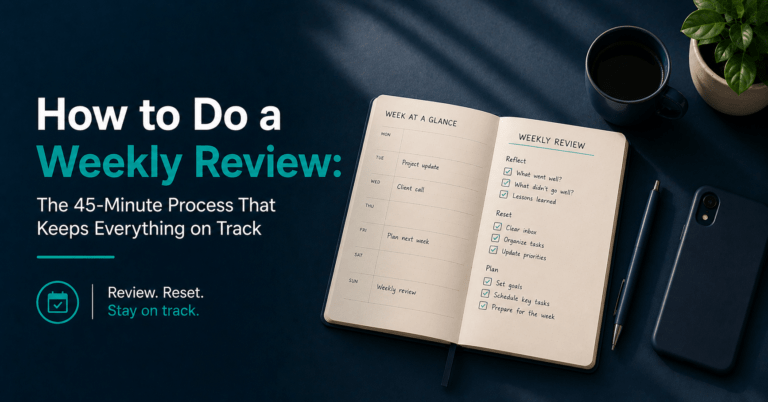
If you already have a weekly review, use those notes as the evidence source. The annual review changes direction; the weekly review maintains the system.
The Full Year-End Review: Step by Step
Step 1: Reconstruct the Year From Records (15 minutes)
Scan the calendar month by month. Write one or two factual notes for each period, keeping the level of detail deliberately rough.
Examples include “changed role”, “finished website migration”, “two weeks away”, “parent needed appointments” or “started evening classes”. You are building a timeline, not a diary.
Next, scan your completed projects and unfinished list. Add outcomes that never appeared as calendar events, such as handing over a recurring responsibility or deciding to close a project.
Use evidence labels where memory is uncertain. “Felt busy all quarter” is an impression. “Seven evening events in May” is something you can inspect.
Include maintenance work. Keeping a household running, supporting a team and dealing with disruptions consume real capacity even when they produce no launch announcement.
Stop when the timeline is useful. Do not read every email or open an entire photo library. If an important event needs more checking, mark it for later and continue.
What you end up with: A short timeline that stops your latest mood from becoming the whole story.
Time comparison: Budget 15 minutes for a record scan instead of an unbounded attempt to remember everything. These are planning limits, not measured savings.
Step 2: Identify What Worked and What Cost Too Much (15 minutes)
Choose three things that went well and three that were harder than necessary. For each, write the result, the supporting condition and the cost.
For example: “Finished certification exercises. Protected Saturday mornings helped. Cost: stopped accepting Saturday errands during the course.” That is more useful than “became disciplined”.
Then examine the difficult items without turning them into personality labels. “Failed at consistency” says little. “Scheduled writing after three consecutive evening commitments” describes a design problem you can change.
Use a simple table:
| Result | What helped or blocked it | Decision to consider |
|---|---|---|
| Finished a difficult report | Started with the data before formatting | Keep a separate analysis block |
| Abandoned an online course | Planned it for exhausted weeknights | Try a smaller weekend learning slot |
| Replied to clients during dinner | No agreed escalation route | Clarify coverage and response expectations |
Do not force a lesson out of everything. Some events were outside your control. Record the constraint, acknowledge its effect and avoid inventing a productivity solution for it.
Where evidence is thin, use “test next quarter” rather than presenting a theory as fact.
What you end up with: Six observations that connect outcomes to working conditions.
Time comparison: Spend 15 minutes explaining a few meaningful patterns rather than reviewing every completed task individually.
Step 3: Close, Continue or Park Your Commitments (15 minutes)
Open the unfinished-project list. Give each item one status: continue, complete, stop or park.
“Continue” needs a next action. “Complete” needs a clear reason it is finished. “Stop” releases the commitment. “Park” needs a review date or a condition that would justify reopening it.
Without that last rule, parked projects become a quieter version of the active backlog.
Start a stop-doing list alongside the project list. Include recurring commitments that no longer justify their cost, not only unfinished goals. An optional weekly call, duplicate reporting habit or unused content channel can consume more time than a one-off task.
You cannot unilaterally drop work other people depend on. For a shared commitment, the next action is a conversation: propose a handover, reduce the frequency or renegotiate the deadline.
If everything remains active, ask what would happen if one item waited until April. A consequence you can explain is evidence. A vague feeling of falling behind is a prompt to question the commitment.
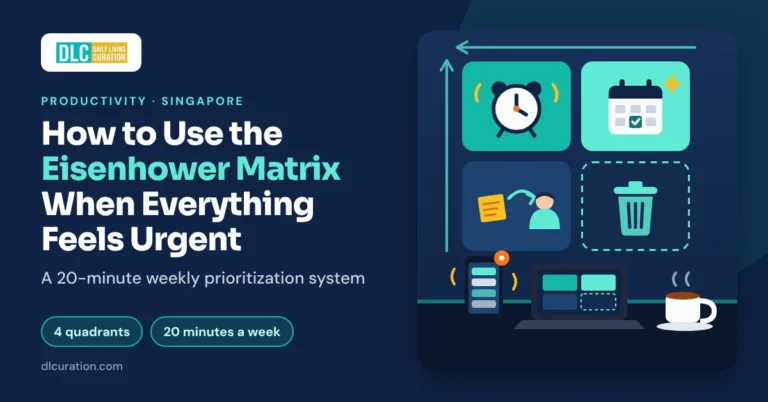
The Eisenhower Matrix can help separate important work from requests that merely feel urgent. Use it to clarify the decision, then record that decision here.
What you end up with: A smaller active list and an explicit record of what will stop.
Time comparison: Budget 15 minutes for commitment decisions now, rather than carrying every old project into another planning document.
Step 4: Choose Up to Three Priorities (15 minutes)
Choose what deserves deliberate progress next. Three is a ceiling for this exercise, not a rule that every life needs exactly three goals.
Define each priority with an outcome, a reason and a boundary. “Improve career” is too broad. “Prepare a portfolio of three relevant projects before applying for a new role” gives the work a shape.
For work with an uncertain outcome, define the experiment you control. You cannot promise five new customers. You can run a six-week test with a defined offer, a fixed outreach budget and a review point.
Then write what you will not do while pursuing it. If you are testing one service, avoid launching a second service halfway through because the first week felt slow.
Check for collisions. A demanding qualification, a job search and an ambitious side business can each look reasonable alone. Together, they may require the same Saturday morning.
Sequence them when necessary. One can be active in the first quarter while another stays parked. The annual plan provides direction; it does not require 12 months of detailed task assignments.
Keep a separate list for ordinary responsibilities. Paying bills and attending routine appointments matter, but they do not all need to become annual development goals.
What you end up with: Up to three priorities with a definition of progress and a limit on scope.
Time comparison: Use 15 minutes to make trade-offs rather than expanding a goal list until it contains everything you care about.
Step 5: Test the Plan Against January (20 minutes)
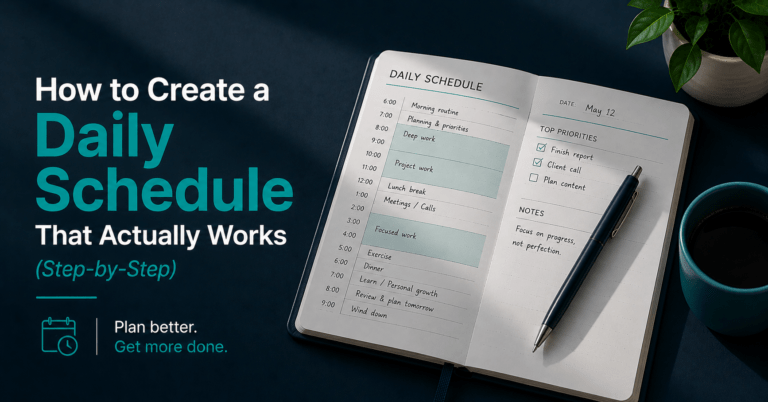
Open January in your real calendar. Add known commitments first: work deadlines, travel, family plans and any period where your availability changes.
Next, identify a realistic first-week slot for each active priority. Include the setup required to start. “Work on portfolio” is vague. “Choose three candidate projects and list missing evidence” is ready to do.
Write an if-then plan for the most vulnerable slot. For example: “If the Tuesday evening session is displaced by work, I will use Saturday’s 10am backup slot.”
Research on the psychology of planning distinguishes an intention from a plan tied to a specific situation and action. That supports being concrete. It does not mean an if-then sentence guarantees your annual goal.
For a Singapore office worker, include the journey home and existing evening responsibilities. A 7pm calendar gap is not necessarily a usable hour if you are still on the MRT.
Use a normal week as the test, not an unusually quiet holiday week. If the first actions do not fit, reduce the scope before January starts.
My recommendation is to keep spare capacity rather than allocating every remaining gap. Time blocking with a capture list gives important work a place without pretending the calendar will stay fixed.
What you end up with: A first-week plan with startable actions, actual slots and one fallback.
Time comparison: Allow 20 minutes to test capacity. This replaces speculative month-by-month scheduling, not the work itself.
Step 6: Save a One-Page Decision Record (10 minutes)
Write the decisions on one page. Keep the evidence notes elsewhere if they are longer.
Include what worked, what changes, what stops, the priorities and the first review date. Put the document link in that review event so you can open it without searching.
Choose a date after you have enough experience to judge the plan. Late January is a practical starting point for a January experiment. A quarterly review can then consider larger changes.
Do not spend the remaining time designing a cover or moving everything into another app. The review is complete when the decisions are usable.
What you end up with: A short record that can guide the next planning session.
Time comparison: Budget 10 minutes for a functional close rather than polishing a review you will never reopen.
A Worked Example: A Side Project That Never Fits
Consider an illustrative Singapore professional who wants to restart a small newsletter. Last year’s plan was to publish weekly after work.
The calendar shows two regular evening commitments, a long commute and several busy work periods. The published archive shows four editions, all completed on weekend mornings.
The lesson is not “try harder on weekdays”. It is that weekend mornings were the available production time.
The revised priority is a six-edition experiment across the first quarter. The stop-doing decision is to pause a second content channel during that experiment. The first action is to outline one edition on the first available Saturday.
A review after the first two editions asks whether the cadence fits. If it does not, the writer reduces the format before buying another scheduling tool.
This is an example, not a reported case study. Its purpose is to show what changes when the annual review produces a capacity decision rather than a motivational sentence.
Copy This Year-End Review Template
Use one short answer per line. Expand only where a decision needs explanation.
- Scope: Which parts of work or life am I reviewing?
- Evidence: Which calendars, project lists or records did I check?
- Three useful outcomes: What happened, and what helped?
- Three costly patterns: What made work harder, and what can change?
- Context: Which constraints or responsibilities affected my capacity?
- Continue: Which commitments still deserve active time?
- Stop: What will end, and who needs to know?
- Park: What will wait, and when will I reconsider it?
- Priorities: What are my one to three outcomes or experiments?
- Boundaries: What will I avoid adding while these are active?
- First week: What is the next action for each priority, and when will I do it?
- Fallback: What will I do if the most vulnerable slot disappears?
- Review date: When will I compare the plan with reality?
If you cannot answer the first-week line, the priority probably needs a smaller next action.
The Full Time Breakdown
The comparison below describes two approaches. It does not claim measured time savings.
| Task | Unstructured approach | Suggested review budget |
|---|---|---|
| Reconstruct the year | Rely on whatever comes to mind | 15 minutes using records |
| Find lessons | General praise or criticism | 15 minutes on six observations |
| Review commitments | Copy the entire backlog forward | 15 minutes to continue, close, stop or park |
| Choose direction | Add goals without trade-offs | 15 minutes for up to three priorities |
| Check capacity | Assume January will be quieter | 20 minutes in the real calendar |
| Close the review | Keep polishing the document | 10 minutes for a decision record |
| Total | No defined stopping point | 90 minutes |
If the first review reveals years of backlog, finish the decisions that matter now. Put the rest in a separate session rather than letting the review consume a whole weekend.
What an Annual Review Cannot Do
It cannot create capacity without a trade-off. If the next plan adds work, something needs to become smaller, less frequent or inactive.
It cannot predict the year. Changing jobs, family responsibilities and new information can make a sensible plan obsolete. Review the assumptions instead of defending the original document.
It cannot replace a conversation. Shared workload, unclear ownership and conflicting deadlines need agreement with the people involved. A private notebook cannot settle them.
It cannot make every disappointment instructive. Some events deserve acknowledgement rather than a lesson. Keep the review practical without requiring a positive interpretation of everything.
Five Ways to Keep the Review Useful
Write decisions with verbs. “Reduce the meeting to fortnightly” is actionable. “More focus” is not.
Keep evidence separate from interpretation. Record what happened before deciding why. This makes it easier to revise a mistaken explanation later.
Use a stop list before a new-goal list. Removing a commitment gives the next priority a chance to fit.
Give experiments an end point. A six-week test is easier to assess than an indefinite promise to keep going.
Reopen the review during weekly planning. One relevant decision is enough. You do not need to reread the whole document every Monday.
The Budget Version: A 30-Minute Reset
If 90 minutes is unrealistic, take 10 minutes to scan the calendar, 10 minutes to choose what continues or stops and 10 minutes to schedule one next action.
Use one priority instead of three. Write one lesson instead of six. Save the result in the notebook or document you already use.
The trade-off is less depth. You are more likely to miss patterns across different areas, but you still finish with a decision and a place to start.
Do not compensate by buying a template. The useful part is the honest trade-off between what matters and what fits.
Frequently Asked Questions
When should I do a personal annual review?
Choose a quiet period near the end of the year or before your next planning cycle. November works if December is crowded. You can add a short update later without repeating the full exercise.
Is this the same as an employee performance review?
No. This process supports your own planning and can include responsibilities outside work. An employer’s appraisal has its own criteria and evidence requirements, so prepare that separately using approved company records.
What if I did not achieve any of my goals?
Start with what happened rather than the original targets. Maintenance, caregiving and responding to disruptions can explain where capacity went. Choose one change you can control instead of carrying the same full list forward.
Should I set goals for all 12 months?
Set broad direction for the year and make the opening period concrete. Later months contain too much uncertainty for detailed task scheduling. A quarterly review lets you adjust the sequence when circumstances change.
Can I do a year-end review without detailed records?
Yes. Start with your calendar and a short list of memorable projects or events. Mark uncertain explanations as guesses, then begin keeping brief review notes for the next cycle.
How is this different from a weekly review?
A weekly review keeps tasks and projects current. A year-end review questions which commitments deserve to remain active and what direction comes next. Use the annual decisions to guide weekly planning rather than replacing it.
Final Thoughts
A useful year-end review produces fewer active commitments, clearer priorities and a first action that fits your actual week.
Start with the calendar you already have. Choose what will stop before deciding what to add. Then put the first action somewhere it can happen.
→ Use the weekly review to keep the plan current
→ Turn your priorities into realistic calendar blocks
Which commitment would you stop carrying into next year? Share it in the comments.
Continue reading: