
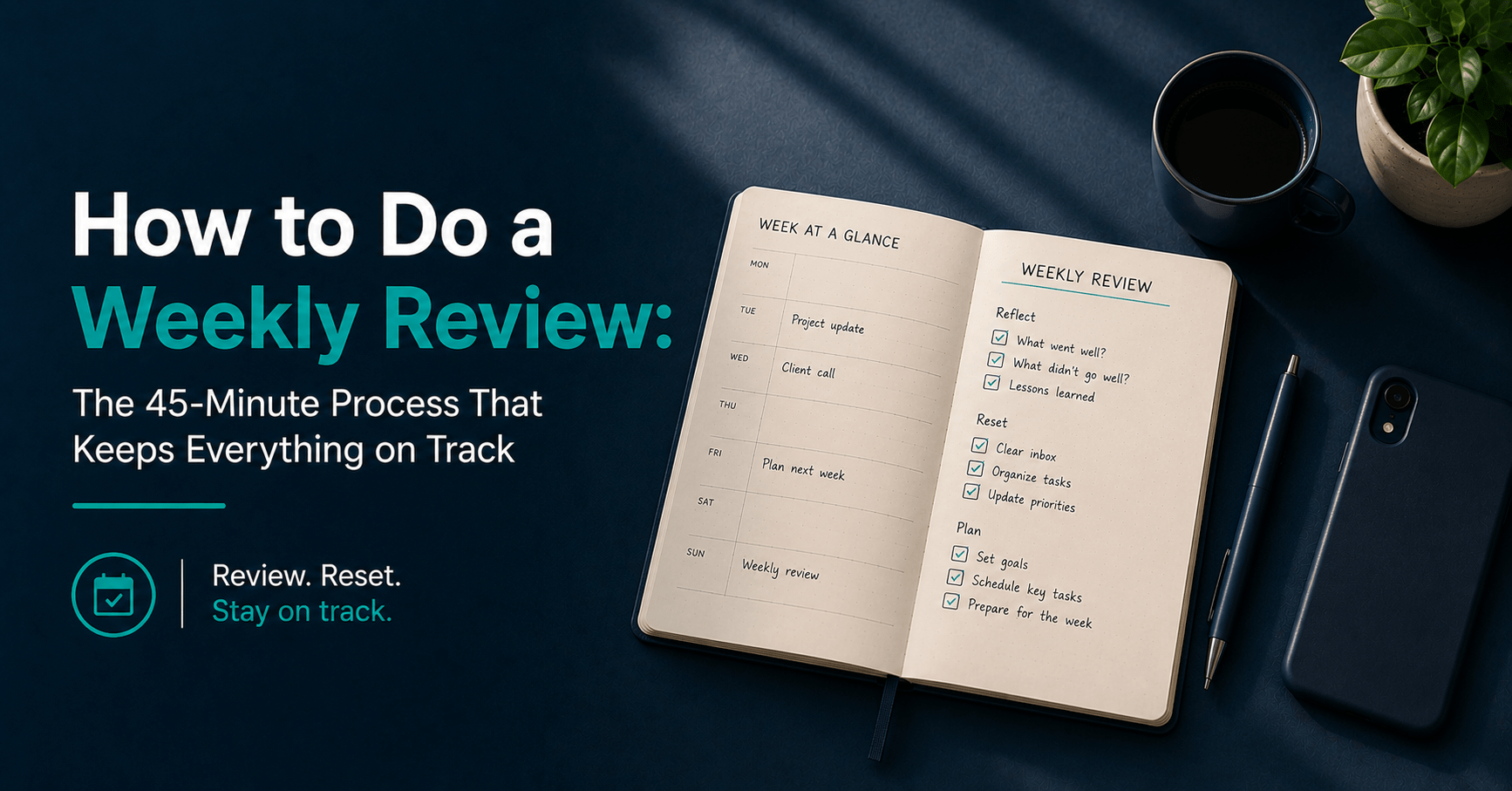
How to Do a Weekly Review: The 45-Minute Process That Keeps Everything on Track
Table of Contents
By Thursday of any given week, most people have a task list that no longer reflects reality. Two things got done that aren’t checked off. Three new commitments were made that were never captured. One deadline quietly moved. One project that was “in progress” is now done, but it’s still sitting in the active list.
By Friday, the system has drifted. By the following Monday, you’re starting the week from a position of mild uncertainty rather than clear direction — not because you’re disorganized, but because no maintenance happened.
This is the problem the weekly review solves.
The weekly review is a structured session — 45 minutes, once a week — where you close the loops from the previous week, clear out everything that’s accumulated, and set a clear direction for the week ahead. It’s the maintenance habit that keeps every other productivity system working. Without it, even the best task manager becomes a list of things you’ve stopped trusting.
The research behind it is clear. A study by Masicampo and Baumeister found that the mere act of making a plan for uncompleted tasks reduces their cognitive burden — the low-level mental load of carrying open loops — even before the tasks are executed. The weekly review is a systematic way to make plans for everything on your plate at once, clearing that load in a single session rather than carrying it diffusely all week.
Here is the exact process, with a template you can copy and use this week.
Why Most People Skip Their Weekly Review
The weekly review has been a cornerstone of David Allen’s Getting Things Done methodology since 2002. It is the most consistently recommended habit in the productivity literature. It is also the first thing people drop when they get busy.
The reasons are predictable. The review feels meta — it’s not doing work, it’s reviewing work, and the difference is hard to justify when the inbox is full and the deadline is close. It requires confronting everything you didn’t do last week, which has an emotional cost that’s easy to avoid. And unlike the immediate satisfaction of completing a task, the benefits of the review arrive the following Monday, not the moment you finish it.
The result: most people do the weekly review occasionally — after a particularly chaotic week, or when they feel the system has completely broken down. By then, the backlog is large and the review takes two hours instead of 45 minutes, which confirms the belief that reviews are time-consuming, which makes them easier to skip next time.
The core principle this process is built on: a weekly review done every week takes 45 minutes; a weekly review done monthly takes all day — the maintenance cost compounds with every week skipped.
A system you trust is one you use. The weekly review is what creates and maintains that trust.
The Tools You Need
A task manager — whatever you currently use. Todoist (free tier) is the cleanest option for digital task management with a dedicated weekly review workflow. TickTick Premium ($27.99/year) works equally well. A paper notebook and pen work fine — the review process is tool-agnostic.
A calendar — your existing calendar, digital or paper. Google Calendar, Apple Calendar, Outlook, or a physical planner. You need to be able to look at last week and next week simultaneously.
The weekly review template — provided in this guide. Print it, copy it into a notes app, or recreate it in your task manager. The template is the script for the session.
A consistent time slot — not a tool, but a non-negotiable prerequisite. The review needs a recurring protected time in your calendar. Friday afternoon (the last 45 minutes of the work week) or Sunday evening (before the week begins) are the two most effective windows. Pick one and block it now.
Total cost: $0 if you use free tools. $27.99/year if you use TickTick for both tasks and the review process.
The Full Weekly Review Process: Step by Step
Step 1 — Clear the Physical and Digital Inboxes (10 minutes)
Before reviewing anything, clear the decks. The goal of this step is to ensure that everything captured during the week has been processed — not acted on, just processed into the right place.
Work through each inbox in order:
Physical desk and notebook. Any loose paper, sticky notes, receipts, or written notes from the week. Each item is either filed, discarded, or converted into a task or calendar entry. Nothing stays on the desk as an “I’ll deal with that later” pile.
Email inbox. Not zero inbox — processed inbox. Every email is either replied to, delegated, converted to a task, archived, or deleted. Emails that require action become tasks in your task manager before you leave this step. Emails that are reference material get filed or archived.
Task manager inbox. Any task captured during the week without a project, due date, or context tag. Each one gets a project assigned, a due date if relevant, or a “someday/maybe” label if it’s not actionable this week.
Notes and voice memos. Any quick notes, ideas, or voice recordings from the week. Processed into the task manager, a reference file, or deleted.
The standard for completion: nothing is sitting in an inbox waiting to be decided. Everything has a place.
What you end up with: A clean slate — every inbox is empty or at zero actionable items, every capture from the week has been processed into the right location.
Time saved vs manual: Unprocessed inboxes generate low-level cognitive load all week. Every email you haven’t dealt with, every sticky note on the desk, every voice memo you haven’t transcribed is a micro open loop that consumes attentional resources. Clearing them in one session removes that load for the full week ahead.
Step 2 — Review Last Week (10 minutes)
With inboxes clear, look backwards before looking forward. This step takes 10 minutes and produces the most important insight of the review: an honest picture of how last week actually went.
Review your calendar day by day. Go through Monday to Friday (or Sunday to Saturday, depending on your week structure). For each day, ask: did anything happen that generated a task or commitment I haven’t captured yet? A meeting that produced an action item. A conversation that led to a decision. Something that needs to be followed up that hasn’t been logged anywhere.
Add anything uncaptured directly to your task manager inbox, to be processed in the next step.
Review your completed tasks. Look at what you actually finished. This is not a self-congratulation exercise — it’s a calibration exercise. Did you complete what you planned to? If you consistently completed less than planned, your weekly planning is overloaded and needs to be scaled back. If you consistently completed more than planned, you’re under-planning and have capacity you’re not using.
Review uncompleted tasks. Everything on last week’s list that didn’t get done. For each one, make one of three decisions: carry it forward to this week, move it to a future date, or delete it. Nothing moves forward by default — every unfinished task needs a deliberate decision.
Write one sentence about last week. Not a journal entry. One sentence: what defined last week? What was the biggest win, the biggest friction point, or the clearest lesson? This takes 60 seconds and creates a data point you’ll be glad to have when you review months from now.
What you end up with: A processed view of last week — completed tasks acknowledged, uncompleted tasks decided, any loose commitments captured, and one sentence of honest reflection.
Time saved vs manual: Most people end each week carrying unexamined open loops and unprocessed commitments forward unconsciously. This step converts that invisible accumulation into explicit decisions, which is cognitively cheaper to carry than vague unresolved items.
Step 3 — Review and Update Projects (10 minutes)
This is the step most lightweight review approaches skip — and the one that prevents the most significant drift.
Go through every active project in your task manager or project list. For each one, ask two questions:
Does this project have a clear next action? A project without a next action is a stalled project — it takes up space in your system without moving forward, and its presence creates a background sense of unease every time you see it. If there’s no next action, add one now. It can be small. “Send one email” or “spend 20 minutes on the outline” counts. The project needs to be in motion.
Is this project still active? Projects complete, get superseded, or lose relevance. A project list full of things that no longer apply is a list you’ve stopped trusting. Archive or delete anything that’s finished or no longer relevant. The smaller and more accurate the active list, the more useful it is.
Also review your “waiting for” list — things you’ve delegated or are waiting on a response for. If anything on this list has been waiting more than a week without movement, it may need a follow-up action added.
What you end up with: An active project list where every project has a next action and every item is genuinely current — the foundation of a task system you can trust.
Time saved vs manual: A project list that hasn’t been reviewed becomes a source of anxiety rather than clarity. Each stalled or irrelevant project occupies mental real estate and subtly undermines confidence in the system. Ten minutes of weekly review keeps the list clean and actionable all week.
Step 4 — Plan the Week Ahead (10 minutes)
Now look forward. Open your calendar for the coming week alongside your task list. This step is about realistic commitment — deciding what will actually happen next week, not what you hope will happen.
Review your calendar commitments. What meetings, appointments, and fixed obligations are already scheduled? Identify any that need preparation — a meeting that requires a document, a call that requires notes in advance, a deadline that requires work to be done before it arrives. Add preparation tasks to your task manager now.
Identify your three priorities for the week. Not a full task list — three things that, if completed, would make the week genuinely successful. These should be project-moving tasks, not routine work. Write them at the top of your weekly plan.
Assign tasks to days. Take the tasks you’re carrying forward from last week, plus any new tasks from the inbox review, and assign them to specific days. Be honest about capacity. A day with three hours of meetings has two hours of available work time, not eight. Most people plan as if every hour of the calendar is available, then wonder why everything carries forward at the end of the week.
Identify any preparation needed before Monday. Is there anything that needs to happen before the week starts — a file to download, a message to send, a document to locate? Handle it now, while you’re already in the review.
What you end up with: A realistic week plan with three clear priorities, tasks assigned to specific days based on actual available capacity, and any necessary preparation already handled.
Time saved vs manual: Planning the week during the review — when you have the full picture of what’s on your plate — takes 10 minutes. Planning it on Monday morning, with partial information and an already-filling inbox, takes longer and produces a less accurate plan.
Step 5 — Close the Session (5 minutes)
The final five minutes serve two functions: capturing anything generated during the review itself, and marking the session as complete.
Process any tasks generated during the review. The review often surfaces ideas, commitments, or tasks that weren’t on any list before you started. Add them to your task manager with appropriate projects and dates.
Write next week’s headline. One sentence: what would make next week a success? Not a full vision statement — one sentence. “Finish the first draft” or “clear the backlog before Thursday” or “have one real conversation with each direct report.” This takes 30 seconds and gives the week a clear north star.
Close all tabs and inboxes you opened during the review. The review should end with everything closed, not with 11 browser tabs open and two half-processed email threads. Clean close.
Mark it done. Check it off. Add an X to the tracker. The review is a habit, and habits benefit from a clear completion signal.
What you end up with: A fully closed review session — all review-generated tasks captured, a one-sentence north star for the week, and a clean system ready for Monday.
Time saved vs manual: Reviews that don’t have a defined close step tend to trail into indefinite processing. A five-minute close creates a clear boundary and ensures the review ends in a state of clarity rather than mid-process.
The Full Time Breakdown
| Step | Task | Without review | With weekly review |
|---|---|---|---|
| 1 | Clear inboxes | Never systematically — accumulates all week | 10 mins, once a week |
| 2 | Review last week | Not done — loose commitments carry forward unchecked | 10 mins — all open loops closed |
| 3 | Review projects | Stalled projects sit unnoticed for weeks | 10 mins — every project has a next action |
| 4 | Plan the week | Monday morning scramble with partial information | 10 mins Sunday — full picture, realistic plan |
| 5 | Close session | Rarely done — review trails into Monday | 5 mins — clean close, north star set |
| Total | Drift accumulates, system loses trust | 45 mins weekly — system stays reliable |
The Weekly Review Template
Copy this into your notes app, print it, or recreate it in your task manager. Use it as the script for every session.
WEEKLY REVIEW TEMPLATE Week of: ___________ Review date: ___________ | Start time: ___________ | End time: ___________
STEP 1 — CLEAR INBOXES (10 mins)
- Physical desk and paper notes cleared
- Email inbox processed to zero actionable items
- Task manager inbox cleared — all tasks assigned to a project
- Notes and voice memos processed
STEP 2 — REVIEW LAST WEEK (10 mins)
- Calendar reviewed day by day — any uncaptured tasks added
- Completed tasks reviewed — calibration noted
- Uncompleted tasks decided: carry forward / reschedule / delete
- One sentence about last week: ___________________________________________
STEP 3 — REVIEW PROJECTS (10 mins)
- Every active project has a next action
- Completed or irrelevant projects archived
- Waiting-for list reviewed — follow-ups added where needed
STEP 4 — PLAN NEXT WEEK (10 mins)
- Calendar commitments reviewed — preparation tasks added
- Three priorities for the week identified:
- Tasks assigned to specific days based on realistic capacity
- Any pre-Monday preparation completed
STEP 5 — CLOSE (5 mins)
- Review-generated tasks added to task manager
- Next week’s headline: ___________________________________________
- All tabs and inboxes closed
- Review marked complete
Total time: 45 minutes
What the Weekly Review Cannot Do
It cannot fix a broken task system. The review assumes a task manager that captures everything — tasks, projects, waiting-for items — in one place. If you’re working across scattered lists, multiple apps, and paper notes without a unified system, the review has nothing reliable to maintain. Sort the capture system first, then add the review.
It cannot replace daily planning. The weekly review sets direction for the week. It doesn’t replace the two minutes each morning of deciding which task to start first. Both operate at different levels and both are necessary — the weekly review for direction, the daily review for execution.
It cannot compress a month of backlog into 45 minutes. The 45-minute estimate assumes reviews happening weekly. If you’ve skipped four weeks, the first review back will take significantly longer. The time cost of irregular reviews is real — which is the strongest argument for protecting the weekly slot even when it’s inconvenient.
It cannot make decisions you’re avoiding. The review will surface tasks and projects you’ve been putting off precisely because they require a difficult decision. The review gives you the moment to make the decision — but it can’t make it for you. Projects that consistently survive review without a next action being assigned are usually avoidance problems, not planning problems.
Tips to Get Better Results From the Weekly Review
Schedule it as a recurring calendar event, not a to-do item. A to-do item competes with every other item on your list and gets bumped when the week gets busy. A calendar block is a commitment with a specific time. Block 45 minutes, protect it, and treat it with the same seriousness as a meeting.
Friday afternoon beats Sunday evening for most people. Friday afternoon closes the work week cleanly — you process the week while it’s still fresh, and you arrive at the weekend with nothing unresolved. Sunday evening works if you genuinely have the mental energy for it and prefer starting Monday with a plan already made. Friday is lower-friction for most people because the review is part of the work week rather than an encroachment on personal time.
Start with the template, customize after eight weeks. The template in this guide covers the essential steps. After running it for eight weeks, you’ll know which steps take longer than average for your work, which prompts you skip because they’re not relevant, and which questions you want to add. Customize based on evidence, not assumption.
Do a shorter version when the full review isn’t possible. A 15-minute minimum viable review — clear the inbox, review last week’s uncompleted tasks, identify three priorities for next week — is significantly better than no review. If Friday is too busy for 45 minutes, the 15-minute version keeps the system running until you have time for the full session.
Review your three priorities on Wednesday. A mid-week check — just two minutes, no formal process — of whether the three weekly priorities are on track prevents the end-of-week discovery that all three got crowded out by reactive work. Not a second review. A two-minute glance.
Use the one-sentence weekly reflection over time. A year of one-sentence weekly reflections is a remarkably useful record. Which weeks felt productive and why? Which periods were consistently difficult? What patterns show up? The data accumulates without effort and becomes meaningful over months.
The Budget Version of This Process
The weekly review is entirely free to run. Every step requires only the tools you already have.
Free task manager: Todoist free tier, Apple Reminders, Google Tasks, or a paper notebook. The review process works identically across all of them.
Free calendar: Google Calendar or Apple Calendar. Any calendar that shows last week and next week simultaneously.
Free template: The template in this guide — copy it into Apple Notes, Google Docs, Notion, or print it. No purchase required.
The only paid upgrade worth considering is → Todoist Pro at $4/month if you want reminders, filters, and recurring review tasks built into your task manager. Or → TickTick Premium at $27.99/year if you want tasks, habits, and the weekly review all in one place.
The review’s value comes from doing it consistently — not from the sophistication of the tools used to run it. A paper checklist used every Friday is worth more than an elaborate digital system opened once a month.
Frequently Asked Questions
How long should a weekly review take?
Forty-five minutes is the target for a system that’s been maintained weekly. The first review after a period of no reviews typically takes 60 to 90 minutes because of accumulated backlog. Reviews done every week consistently converge on 30 to 45 minutes as the system stays current. If your review is consistently running over 60 minutes, either the capture system is too scattered — items are spread across multiple apps, notebooks, and inboxes that all need to be checked — or reviews are being skipped and backlog is accumulating between sessions.
When is the best time to do a weekly review?
Friday afternoon is the most effective time for most people — it closes the work week cleanly while everything is fresh, and it means arriving at the weekend with no open loops. Sunday evening works well for people who prefer starting Monday with a complete plan already made. The specific day matters less than the consistency: the same time, every week, treated as a non-negotiable commitment rather than something to fit in when possible.
What is the GTD weekly review?
David Allen’s Getting Things Done methodology defines the weekly review as the keystone habit of the entire system — the process that keeps the lists current and the mind clear. Allen’s framework breaks it into three phases: Get Clear (process all loose ends), Get Current (update all lists and projects), and Get Creative (look at the bigger picture). The process in this guide follows the same logic, adapted for a modern digital workflow and condensed to a reliable 45-minute session.
What should I do if I miss a weekly review?
Do the next one without self-criticism. The only productive response to a missed review is the next review, not guilt about the missed one. If reviews are being missed consistently — not occasionally — the problem is usually the time slot (too ambitious, too easily displaced by busy weeks) rather than commitment. Try shortening to a 15-minute minimum viable review as the fallback for weeks when 45 minutes isn’t available.
Do I need a special app to do a weekly review?
No. The review is a process, not a feature. Any task manager, any calendar, and a copy of the template in this guide are sufficient. Dedicated apps like Notion, Craft, or Obsidian can make the review more structured and archivable — but the review works equally well in a paper notebook. The tool should serve the process, not the other way around.
How is a weekly review different from a daily planning session?
They operate at different levels. The daily planning session — two to five minutes each morning — decides what to work on today based on what’s in front of you. The weekly review — 45 minutes once a week — maintains the system that daily planning draws from: clearing inboxes, updating projects, reviewing commitments, and setting weekly direction. Both are necessary. The weekly review without daily planning produces good intentions that don’t execute. Daily planning without a weekly review produces well-executed action on an increasingly inaccurate task list.
Final Thoughts
A productivity system without a weekly review is a car without an oil change. It runs fine for a while. Then it slowly degrades. Then it stops working — usually at the worst possible time.
The weekly review is 45 minutes that keeps everything else working. It clears the cognitive load of open loops. It ensures nothing slips through the gaps. It converts the chaos of a busy week into a clean starting point for the next one.
The steps:
- Clear inboxes — every capture from the week processed into the right place
- Review last week — completed tasks acknowledged, uncompleted tasks decided
- Review projects — every active project has a next action, stalled ones removed
- Plan next week — three priorities set, tasks assigned to realistic daily capacity
- Close the session — next week’s headline written, clean close
Block 45 minutes this Friday. Copy the template. Run it once.
The difference between a system you trust and a system you’ve abandoned is almost always just this — whether the maintenance habit happened.
→ Try Todoist free | → Try TickTick free
Real-life DLC for your daily living.
Do you run a weekly review? Drop your process in the comments — especially if you’ve found a time slot or template variation that works better than the standard Friday afternoon session.
Continue reading: