How to Grow a Side Hustle in Singapore Without Burning Out
Table of Contents
You leave the office at 6pm, get home at 7, finish dinner by 8.30 and open your laptop at 9.30pm. By 10.15pm you have answered two Carousell chats, rewritten the same Instagram caption three times and nodded off on the sofa.
Do that for a month and the side hustle has earned you S$80 and cost you most of your sleep.
Growing a side hustle in Singapore after a 9-to-6 is not about willpower. It is about a system that fits the energy you have left.
Here is the honest maths. Add a 45-minute commute each way, dinner and chores, and a full-time job leaves about three usable hours on a weeknight — at the lowest-energy point of your day. You are not alone in trying to use them. The Ministry of Manpower’s Labour Force in Singapore 2025 report counted 29,000 residents doing their own-account work on the side. It also found that 3.0% of employed residents held more than one job.
This guide is the system I recommend: six focused hours a week, booked around your energy. You set up the tax, CPF and ACRA admin once, so it never surprises you. It also covers the rules most people discover too late — your employment contract, work passes and MediSave above S$6,000 of profit.
Why Most Side Hustles Stall — and Burn People Out
The common mistake is treating the side hustle like a second full-time job squeezed into the evenings. Every free hour goes to it. Weekends disappear. Messages from customers get answered at 11pm and during office meetings.
It works for a few weeks. Then three things happen.
Your recovery disappears. Recovery research keeps finding the same pattern. A meta-analysis covering 38,124 employees linked mental detachment from work during time off to less exhaustion, better sleep and better well-being. Doing more work-related activities in your off-hours went with less detachment.
Burnout creeps in. The World Health Organization describes burn-out as a syndrome “resulting from chronic workplace stress that has not been successfully managed”. Its three signs are exhaustion, mental distance from your work and reduced effectiveness. A side hustle with no limits adds a second source of that stress.
Your day job suffers. A 2021 study in the Academy of Management Journal found a side hustle can help — feeling empowered by it improved people’s day-job performance through better mood. But thinking about the side hustle during work hours hurt performance. The net effect was positive, which tells you the side hustle is not the problem. The spillover is.
This is what side hustle burnout looks like: tired at both jobs and slower at both.
The core principle: a side hustle grows on capped, consistent hours and protected recovery — not on sacrificed sleep.
The Five Things You Need
You do not need to spend money to start. Here is what each item does in the system.
- A calendar (free) — To book your hustle hours like meetings, and to block your days off.
- A separate bank account (free) — Side income goes in, business expenses go out. It makes tax time a 15-minute job. If you are choosing one, my guide to high-yield savings accounts compares the options.
- A simple income and expense tracker (free) — A spreadsheet with five columns is enough: date, item, income, expense and receipt link. IRAS expects you to keep business records for five years.
- Singpass (free) — You will use it for the IRAS myTax Portal, your CPF account and, if needed, ACRA’s BizFile.
- A “parking list” (free) — One note on your phone where hustle ideas go during office hours, so they do not take over your workday.
Total cost: S$0. Add S$115 if you need to register a business with ACRA (S$15 for the name application and S$100 for one year).
Budget alternative: If you already have a second savings account, use it as your business account rather than opening a new one.
The Full Workflow: How to Grow a Side Hustle in Singapore Step by Step
The first four steps take one weekend. After that, the system runs on about six hours a week plus a monthly check.
Step 1 — Check Your Contract and Your Pass (30 Minutes)
Before you earn a dollar, read two things: your employment contract and your immigration status.
Your contract. Look for clauses on moonlighting, outside employment, conflicts of interest, confidentiality and who owns what you create. The Tripartite Alliance’s guidance for employers asks: “Can I stop my employees from taking on a second job?” Its answer: “No, unless the employment contract prohibits moonlighting or there is a conflict of interest.”
So the contract decides. If it requires approval, ask in writing. Assume a hustle that serves your employer’s clients or competitors is a conflict until HR says otherwise. In the public service, check your organization’s rules on outside work before you start.
Your pass. This guide is for Singapore citizens and permanent residents. MOM is clear on work pass holders: “They must not take on additional jobs or engage in activities to earn additional income in Singapore.” S Pass holders cannot be sole proprietors, and Dependant’s Pass holders generally need their own work pass to work. If you hold any pass, check MOM’s rules for your pass type before you start.
What you end up with: A clear yes, a yes with conditions or a no — in writing.
Time saved vs manual: Thirty minutes now avoids a disciplinary meeting later.
Step 2 — Pick a Hustle That Fits a Tired Brain (1 Hour)
The best side hustle while working full time is not the one with the highest earnings in a listicle. It is the one you can do well at 8.30pm on a Wednesday.
Score each idea on four questions:
- Does it use a skill you already have? Learning a new skill and selling it at the same time doubles the load.
- Can it run in 60–90 minute blocks? Work that needs you for whole days does not fit around a 9-to-6.
- Can customers wait until evening? Anything that needs replies during office hours will collide with your job.
- Is the setup cost low? Test the idea before you buy equipment or stock.
| Side hustle | Fits a 9-to-6? | Watch out for |
|---|---|---|
| Freelancing your day-job skill (writing, design, data) | Yes — project-based, async | Conflicts of interest with your employer |
| Tutoring or coaching | Yes, if sessions are evenings or weekends | Fixed slots you cannot move |
| Selling on Carousell or Shopee | Yes, to test demand | Messages arriving all day |
| Blogging or content | Yes, but slow to pay | Months before meaningful income |
| Food delivery or ride-hail | Flexible hours | Physical fatigue on top of a full day |
| Digital products and templates | Yes — fully async | Needs an audience first |
If you are drawn to content, my guide on how to start a blog covers the setup and the long road to the first dollar.
What you end up with: One hustle, chosen for fit rather than hype.
Time saved vs manual: An hour of scoring saves months on an idea that never fitted your week.
Step 3 — Set a Weekly Hour Cap (10 Minutes)
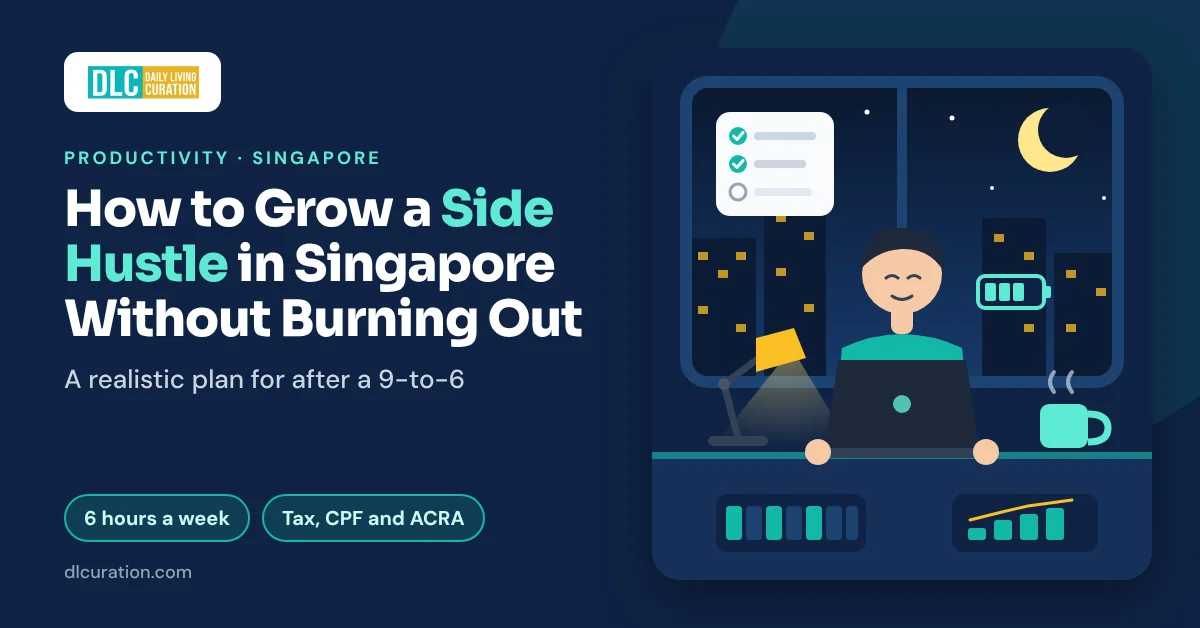
Decide your hours before the work decides them for you. I recommend starting with six hours a week:
- Two weeknight blocks of 90 minutes — for example, Tuesday and Thursday, 8.30pm to 10pm.
- One weekend block of three hours — Saturday morning works for most people.
- One full day completely off — no side hustle, no day job.
Add a hard stop. I use 10.30pm on weeknights: no hustle work after that, however close you are to finishing.
Six hours sounds small. Over a year of 48 working weeks, it is 288 hours — more than seven full 40-hour weeks of focused work.
What you end up with: A fixed weekly budget that protects your sleep and your rest day.
Time saved vs manual: Capped hours are focused hours. Three tired hours a night produce less than 90 rested minutes.
Step 4 — Put the Hours Where Your Energy Is (Weekly)
Not all hours are equal. Match the task to your energy:
- Hardest work (creating, writing, designing) goes in your best block — often the weekend morning, or early mornings if you are a morning person. My guide to building a morning routine shows how to make an early slot stick.
- Light admin (replies, invoices, listings) goes on your commute. My productive commute guide shows how to turn MRT time into a clear-the-decks session.
- Nothing goes in office hours. Park hustle ideas in your parking list and pick them up after 6pm. That is the spillover the Academy of Management Journal study warned about.
What you end up with: Each type of task in the time slot where it takes least effort.
Time saved vs manual: Creative work done fresh often takes half as long as the same work done exhausted.
Step 5 — Set Up the Money and Admin Once (2 Hours)
This is the step most people skip until a letter arrives. Do it in one sitting.
- Open the separate account and route all hustle income to it.
- Start the tracker and save every receipt.
- Set aside money for tax and MediSave. My rule of thumb: move 20% of every payment into a separate pot until you know your real numbers.
- Check whether you need to register with ACRA (see the rules section below).
- Put the tax deadline in your calendar — the filing window runs from 1 March to 18 April each year.
When you file, you declare side income in the same tax return as your salary, under “Trade, Business, Profession or Vocation”. If your revenue is S$200,000 or less, IRAS only asks for a 2-line statement: your revenue and your adjusted profit or loss.
You can deduct business expenses: the business share of your phone and internet bills, platform fees and commissions, advertising and supplies. Personal or household costs, fines and income tax are not deductible.
What you end up with: A side income that is legal, organized and ready for tax season.
Time saved vs manual: Two hours once replaces a panicked weekend every April.
Step 6 — Ship Something Small Every Week (Ongoing)
Progress in a side hustle comes from finished things, not hours logged. Set one weekly deliverable you can complete within your cap: one blog post, one client milestone, five new listings or one finished product page.
Review it on Sunday in 15 minutes. If you already do a weekly review, add the hustle as one more project in it.
What you end up with: A visible record of progress, even in slow months.
Time saved vs manual: Weekly deliverables stop the endless tinkering that eats evenings without producing anything.
Step 7 — Run a Monthly Burnout Check (15 Minutes)
On the first Sunday of each month, answer five questions:
- Am I sleeping as much as I was before the side hustle?
- Do I feel exhausted most days?
- Am I more cynical or detached about my day job — or the hustle?
- Is my day-job performance slipping?
- What did the hustle earn per hour this month?
The first four map to the WHO’s three signs of burn-out, plus sleep. If two or more answers have gotten worse, cut your weekly hours by a third next month. When the per-hour earnings keep falling, change what you sell before you add hours.
What you end up with: An early warning system, before your health or your day job sends the warning for you.
Time saved vs manual: Fifteen minutes a month is cheaper than three months of recovering from burnout.
The Full Time Breakdown
| Area | Old way | This plan |
|---|---|---|
| Weeknights | Most evenings, 9.30pm to midnight | Two 90-minute blocks, hard stop at 10.30pm |
| Weekends | On and off, both days | One three-hour block |
| Customer messages | Whenever they arrive, including office hours | Evenings and commute only |
| Admin and tax | A panic every April | Two hours once, then 10 minutes a month |
| Planning and review | None | 15 minutes weekly, 15 minutes monthly |
| Days off | None | At least one full day a week |
| Total | 12–15 scattered, tired hours a week | About six focused hours a week |
Your numbers will differ. The point is fewer, better hours — and a rest day you keep.
Side Hustle Rules in Singapore: Tax, CPF, ACRA and Work Passes
These are the rules that apply to most citizens and PRs with a side income. They change with each Budget, so check the linked pages before you rely on a figure.
| Rule | When it applies | What to do |
|---|---|---|
| Declare to IRAS | Your net trade income was over S$6,000, your total income was over S$22,000, or you received a tax form or filing notice | Declare under “Trade, Business, Profession or Vocation” by 18 April |
| 2-line statement | Revenue of S$200,000 or less | Report revenue and adjusted profit or loss |
| MediSave | Net trade income over S$6,000 | Pay when the CPF Board sends a notice after your tax assessment |
| ACRA registration | Regular activity for profit, unless exempt | Register as a sole proprietor: S$15 name application plus S$100 for one year |
| GST registration | Taxable turnover over S$1 million | Almost never relevant to a side hustle |
| Platform work | Delivery or ride-hail through an app | CPF under the Platform Workers Act, compulsory if born on or after 1 January 1995 |
| Records | Every year you earn business income | Keep records for five years |
Tax. IRAS’s reporting guide sets three triggers — and you need to report if any one applies. If your salary is over S$22,000 a year — and most full-time salaries are — you need to declare side income to IRAS even when it is small. S$6,000 is a reporting and MediSave threshold, not a tax-free allowance. Occasional money from a hobby is not taxable, but IRAS treats the activity as a business once you do it repeatedly or habitually to earn money.
MediSave. If your net trade income is over S$6,000, MediSave for self-employed persons is compulsory — even if you are also an employee. CPF says these contributions are “in addition to the CPF contributions you have made on your employment/platform work”. The rate runs from 4% to 10.5% of your net trade income, depending on your age and income. You do not declare anything to CPF separately — your tax return does that, and CPF bills you afterwards, with 30 days to pay.
ACRA. ACRA business registration applies if you carry out any activity for profit on a regular basis, unless you are exempt. One exemption matters to most side hustlers: trading under your full NRIC name only. “Tan Mei Ling” needs no registration. “Flowers by Tan Mei Ling” does. Even when you are exempt from ACRA, the IRAS and MediSave rules still apply.
What a Side Hustle Cannot Do (And Should Not Try To)
It cannot replace your salary quickly. Expect months, not weeks, before a side hustle earns meaningful money. Keep the day job until the side income has been steady for a long stretch.
It cannot fix a job you hate. A side hustle on top of a draining job adds load. If the day job is the problem, look at the job first.
It cannot run at full speed all year. Work has peak seasons — year-end, audit season, product launches. Plan a lighter month in advance instead of collapsing in the middle of one.
It does not make small income tax-free. The S$6,000 figure is a reporting and MediSave trigger. If you already file a tax return, side income counts from the first dollar of profit.
Tips to Get Better Results From Your Side Hustle
Set a reply window and tell customers. “I reply between 7pm and 9pm on weekdays” sounds professional, and it keeps your phone out of your office hours.
Raise prices before you add hours. If you are fully booked within your cap, the next move is a higher price, not a later bedtime.
Use your SkillsFuture Credit. Every Singaporean aged 25 and above gets a S$500 opening credit that does not expire, and those aged 40 and above get a S$4,000 Mid-Career credit. Use it on an eligible course that sharpens the skill you sell.
Let software do the admin. Invoicing, scheduling and first drafts are where AI tools save the most time. My roundup of the best AI tools for solopreneurs ranks the ones worth paying for.
Batch the busywork. Answer messages, update listings and send invoices in one session instead of trickling them through the week.
Pause on purpose. A planned two-week break during a busy month at work is a strategy. Being forced into one after you burn out is a setback.
The Budget Version of This Workflow
You can run this whole system for S$0:
- Trade under your full NRIC name if your hustle fits the ACRA exemption — no registration fee.
- Use a free spreadsheet for income, expenses and receipts.
- Use free selling platforms like Carousell to test demand before you spend on a website or stock.
The trade-off: trading under your own name looks less like a brand, and free platforms give you less control over your customers. Upgrade once the side hustle has earned enough to pay for it.
Frequently Asked Questions
Is it legal to have a side hustle in Singapore while working full time?
Yes, for citizens and PRs, unless your employment contract prohibits moonlighting or there is a conflict of interest with your employer. Check your contract and get written approval if it asks for it. Work pass holders generally cannot take on extra work or earn additional income in Singapore.
How do I choose a side hustle that suits my skills and schedule?
Start with skills you already use at work or in a hobby, then filter by schedule. Pick something that runs in 60–90 minute evening or weekend blocks and lets customers wait until after office hours. Avoid anything that competes with your employer or its clients.
What is the easiest side hustle to start in Singapore?
Selling things you no longer use on Carousell is the simplest way to learn pricing, listings and customer messages with almost no setup. For steady income, freelancing a skill from your day job usually pays more per hour. Either way, test with a small offer before you invest money.
How many hours a week should I spend on a side hustle?
I recommend starting with about six hours a week: two 90-minute weeknight blocks and one three-hour weekend block. Keep at least one full day completely off. Increase the hours only if your monthly burnout check stays clear.
Do I need to declare side income to IRAS?
Yes, if your net trade income was over S$6,000, your total income was over S$22,000, or IRAS sent you a tax form or filing notice. Declare it under “Trade, Business, Profession or Vocation” in the same return as your salary. If net trade income is over S$6,000, the CPF Board will also bill you for MediSave.
Do I need to register my side hustle with ACRA?
You need to register if you carry out an activity for profit on a regular basis, unless you are exempt. Trading under your full NRIC name only is exempt, so “Tan Mei Ling” needs no registration but “Flowers by Tan Mei Ling” does. Registration costs S$15 for the name application plus S$100 for one year.
Final Thoughts
A side hustle in Singapore grows on six focused hours a week, not on every free minute. Check your contract and pass, pick a hustle that fits a tired brain and cap your hours. Then put each task where your energy is, set up the admin once, ship something weekly and run a monthly burnout check.
The compounding is real. Six protected hours a week add up to 288 hours a year. Because you keep your rest day, you are still going in year two — when a side hustle has had time to start paying.
Start this weekend. Read your contract, pick one idea and book next week’s three blocks in your calendar.
→ Start a blog as your side hustle with my step-by-step guide
→ Find AI tools that cut your side hustle admin
→ Check whether you need to register with ACRA
What is your side hustle, and how many hours a week do you give it? Share your setup in the comments.
Continue reading: