

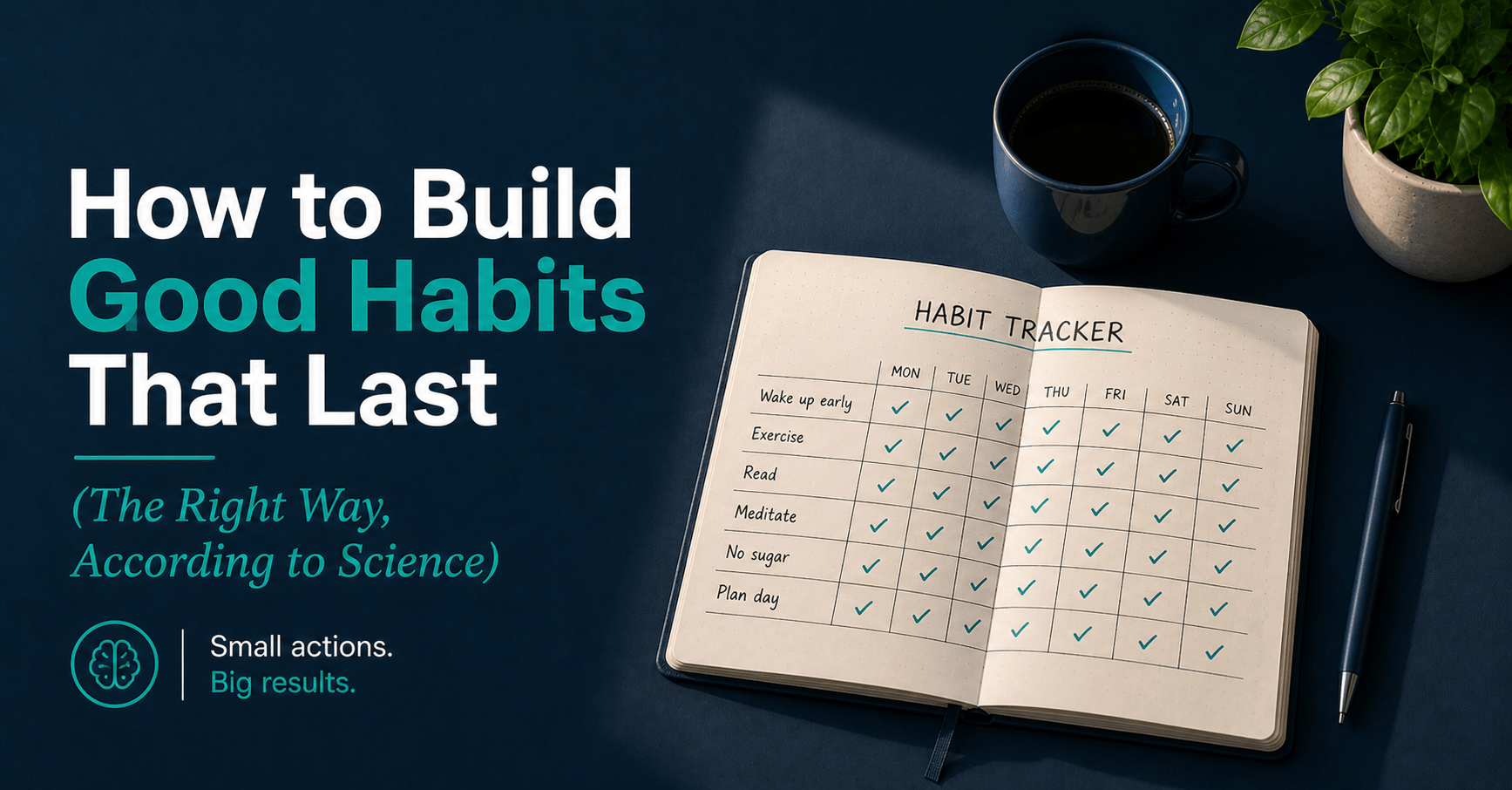
How to Build Good Habits That Last (The Right Way, According to Science)
Table of Contents
Most people trying to build a new habit follow the same arc. Day one: motivated. Day seven: still going. Day 14: slipping. Day 21: stopped — and quietly convinced that something is wrong with them.
Nothing is wrong with them. The timeline they were working from was wrong.
The “21 days to build a habit” idea traces back to a 1960 observation by plastic surgeon Maxwell Maltz, who noticed his patients took roughly three weeks to adjust to their new appearance. It was a casual observation, not a study. It had nothing to do with behavioural habit formation. But it became the most repeated piece of self-improvement advice in history — and it has caused more good habits to collapse prematurely than any other single idea.
A 2025 systematic review from the University of South Australia — the most comprehensive analysis of habit formation to date, covering more than 2,600 participants across 20 studies — found that new habits begin forming at a median of 59 to 66 days, with a range of four days to 335 days depending on the behaviour and the individual. Not three weeks. Two to ten months.
That number isn’t discouraging. It’s liberating. Because if you know habits take longer than you thought, you stop treating a bad week as a failure and start treating it as a normal part of a longer process.
Here is the system built around what the research actually says.
Why Most People Build Habits Wrong
The standard approach to building a new habit goes like this: decide what you want to do, summon motivation, do it every day, and rely on that motivation to carry you through until the habit sticks.
The problem is that motivation is a terrible habit-building tool. It’s high at the start, drops sharply by week two, and is completely absent on the days when building the habit matters most — difficult days, busy weeks, low-energy periods. A system built on motivation fails exactly when it needs to work.
The second mistake is starting too large. Wanting to run every morning sounds like ambition. Running five kilometres every morning before you’ve run at all in two years is a recipe for injury, soreness, and abandonment. The brain builds habits through repetition in consistent contexts — not through intensity. A small behaviour done reliably every day for 60 days is worth more than an ambitious behaviour done erratically for three weeks.
The core principle this system is built on: habits are built through context repetition, not motivation or willpower — and they take longer than you think they should.
Everything else follows from that.
The Tools You Need
This system runs on three things.
A habit tracker — paper or digital. The function is identical: make the habit visible and create a streak worth protecting. A simple paper grid (dates across the top, habit down the side, X when done) costs nothing and works as well as any app. Streaks ($4.99 one-time, iOS) is the best minimal digital option — tracks up to six habits, clean interface, no subscription. TickTick Premium ($27.99/year) includes habit tracking integrated with task management if you want both in one place.
A habit anchor — an existing behaviour you already do automatically, used as the trigger for the new habit. You don’t create a habit from nothing. You attach it to something that already happens every day. More on this in Step 2.
A “minimum viable habit” definition — a written-down version of what counts as a completed habit on a bad day. Not the ideal version. The minimum. This is the most important planning tool in the system and takes five minutes to write once.
Total cost: $0 to $4.99 one-time.
The Full System: Step by Step
Step 1 — Choose one habit and define it precisely (10 minutes)
The most common habit-building mistake is starting with too many habits at once. Research on habit formation consistently shows that stacking multiple new behaviours simultaneously reduces the automaticity of all of them — the cognitive load of maintaining several new routines competes with the repetition needed to encode any single one.
Start with one habit. One.
Then define it in three ways before you begin.
The full version: what the habit looks like on a good day. “Run for 30 minutes before work.”
The minimum viable version: what counts as done on a bad day. “Put on running shoes and walk to the end of the street.” This is not a consolation prize. It’s the version that keeps the habit chain intact on days when the full version isn’t possible — which is the most important function in the entire system.
The context: where and when the habit happens. Not “exercise more.” Specific: “7AM, before breakfast, starting at the front door.”
What you end up with: A single, precisely defined habit with a minimum version that survives bad days — the two most important components of a habit that lasts.
Time saved vs manual: Most habit attempts fail because the minimum version was never defined. When a bad day arrives and the full version feels impossible, there’s no fallback — so nothing happens, the streak breaks, and motivation collapses. Five minutes of upfront planning prevents this entirely.
Step 2 — Attach the habit to an anchor (5 minutes)
The brain builds habits by encoding behaviours that occur in consistent contexts. The most reliable context signal is an existing behaviour you already do automatically — your anchor.
The formula is: [Existing anchor] → [New habit].
The anchor doesn’t create the habit — repetition does. But it provides the consistent context signal that triggers the behaviour reliably, without requiring a decision each time. Over weeks and months, the anchor and the new behaviour become linked in the brain’s basal ganglia — the region responsible for automatic behaviour — and the habit starts running without conscious effort.
Choose an anchor that naturally precedes the time and place where your habit should occur.
| Habit goal | Anchor |
|---|---|
| Morning exercise | After making coffee |
| Reading | After sitting down on the commute |
| Journalling | After brushing teeth at night |
| Taking vitamins | After breakfast |
| Evening review | After closing the work laptop |
| Drinking water | After waking up, before picking up phone |
The anchor should already happen every day without fail. If it doesn’t — if it’s inconsistent itself — it’s a weak anchor and won’t provide a reliable context signal.
What you end up with: A clear trigger that happens automatically, making the decision to start the habit unnecessary. The anchor fires; the habit follows.
Time saved vs manual: Without an anchor, every habit instance requires a conscious decision to start. Over 60 days of building a habit, eliminating that decision each time compounds into a significant reduction in the willpower required to maintain the behaviour.
Step 3 — Set the streak and protect the minimum (ongoing)
Start the habit tracker the day you begin. Mark the first day.
The goal for the first two weeks is not to do the habit perfectly. It’s to do the minimum viable version every single day without breaking the streak. The minimum version — shoes on, walk to the end of the street — is what the streak is built on. The full version is what happens on good days, which will be most days. But the minimum version is what keeps the chain intact when life doesn’t cooperate.
Research shows that repeating a behaviour regularly in consistent contexts is the most critical factor in successful habit formation. Frequency and consistency matter more than intensity or duration, especially in the first 60 days when the habit is most fragile.
Two rules for protecting the streak:
Never miss twice. Missing one day is a slip. Missing two days in a row is the start of a new pattern. If the habit doesn’t happen on a given day — genuinely didn’t happen, not just the minimum — the only response is to do it the next day without negotiation. One miss is recoverable. Two misses require rebuilding momentum from lower ground.
The minimum version always counts. On days when doing the full version would require more energy or time than you have, doing the minimum version is not failure. It is the exact correct response. A 10-minute walk counts. A single page counts. One set counts. The behaviour happened, the context fired, the neural pathway was activated. That’s the point.
What you end up with: A growing streak that becomes its own motivation source — not through willpower, but through the increasingly concrete cost of breaking it.
Time saved vs manual: Most habits collapse during the first difficult stretch — a travel week, an illness, a high-stress period. The minimum viable habit and the “never miss twice” rule together act as a structural buffer that keeps the habit alive through these periods rather than requiring a restart afterward.
Step 4 — Add friction to bad habits, remove it from good ones (30 minutes, one-time setup)
The environment you live in is either building your habits or fighting them. This step is a one-time audit that restructures your environment to work with the system rather than against it.
For the habit you’re building: Remove every barrier between you and starting. Running clothes laid out the night before. Book on the pillow. Vitamins next to the kettle. Water glass on the bedside table. The friction between intention and action is where habits die — especially in the first 30 days before the behaviour is automatic.
For competing habits you’re trying to reduce: Add friction. Phone charger moved to another room. Social media apps removed from the home screen. TV remote stored in a drawer rather than on the couch. You’re not relying on willpower to resist these — you’re making the default path the path you want to take.
This principle — sometimes called “environmental design” — has strong research support. A 2025 study found that leaders who scheduled specific time blocks for new habits were 3.2 times more likely to maintain them than those who tried to fit them in throughout the day. The same logic applies to environment: make the desired behaviour the path of least resistance.
What you end up with: A physical environment where the default actions are the ones you actually want to take — without requiring a decision each time.
Time saved vs manual: Environmental friction is invisible until it kills a habit. A single 30-minute setup session — laying out clothes, repositioning items, removing apps — eliminates daily friction for the full duration of the habit-building period.
Step 5 — Review and adjust at the six-week mark (20 minutes)
According to the University of South Australia research, habit formation begins within around two months, but there is significant variability, with times ranging from four days to nearly a year. The six-week mark — roughly 42 days — is the most useful early checkpoint, because it’s where two things typically happen simultaneously: the initial motivation has largely faded, and the early signs of automaticity are either present or absent.
At six weeks, run a short review.
Is the habit happening automatically? If you’re starting the habit without consciously deciding to start it — if the anchor fires and the behaviour follows without effort — automaticity is developing. Continue as-is.
Is it still requiring full conscious effort every time? This usually signals one of three things: the anchor isn’t consistent enough, the habit is still too large and needs to be reduced to the minimum version for another few weeks, or the context is wrong and needs to change.
Is the minimum version too easy? If the minimum version feels genuinely effortless — not just easy, effortless — you can raise the floor. The new minimum becomes what was previously the full version. Do this gradually and only after at least six weeks of consistent minimum performance.
What you end up with: A calibrated habit that has been adjusted based on actual performance data rather than assumptions — and a realistic sense of how far into the automaticity timeline you are.
Time saved vs manual: Most people either abandon a habit at the six-week plateau or keep pushing the same approach without adjusting. A 20-minute review prevents both by giving you a clear picture of what’s working and what needs to change.
The Full Time Breakdown
| Step | Task | Old way | This system |
|---|---|---|---|
| 1 | Defining the habit | Vague intention — “exercise more” | 10 mins — full version, minimum version, context defined |
| 2 | Setting a trigger | Relying on memory and motivation | 5 mins — anchor identified and written down |
| 3 | Maintaining the streak | Full version or nothing — collapses on bad days | Ongoing — minimum version always counts, “never miss twice” rule |
| 4 | Environment setup | Never done — environment fights the habit | 30 mins one-time — friction removed from good habits, added to bad |
| 5 | Adjusting at six weeks | Abandon or restart | 20 mins — calibrate based on real data |
| Total setup time | 0 mins planning, months of restart cycles | ~65 mins upfront, continuous compounding |
What This System Cannot Do
It cannot build habits you don’t actually want. Habits driven purely by obligation — things you think you should do rather than things that connect to something you care about — have a lower automaticity ceiling. You can build them, but they require more conscious maintenance indefinitely. If a habit consistently feels like a punishment rather than a routine, examine whether it’s the right habit or the right approach before concluding the system is failing.
It cannot compress the timeline. The research is clear that individuals should anticipate at least two to five months to develop automaticity in new health habits. No technique, app, or system changes that fundamental biological reality. What the system does is prevent the premature abandonment that happens when people hit the normal plateau at weeks three to six and interpret it as failure.
It cannot run multiple ambitious habits simultaneously. The system is designed around one habit at a time for good reason. Once a habit reaches genuine automaticity — it’s running without conscious effort most days — adding a second is reasonable. Adding three new habits at once spreads the repetition required for each too thin and slows the formation of all of them.
It cannot fix the wrong minimum. If the minimum viable version of your habit is still too demanding for genuinely bad days, the streak will break anyway. If you set your minimum as “run for 10 minutes” and there are days when even that isn’t possible, the minimum is too high. The right minimum is something you can do in two minutes on the worst day of the month.
Tips to Get Better Results From This System
Write the minimum version down before you need it. The minimum version needs to be decided in advance — not negotiated in the moment when you’re tired and looking for a reason to skip. Write it down on day one. Refer to it when motivation is low.
Use a visible tracker, not a digital one buried in an app. A paper tracker on your desk or fridge is more effective than an app notification for one reason: visibility. You see the streak passively throughout the day, which creates a mild ongoing commitment effect. The best tracker is the one you actually see.
Pair the minimum version with something enjoyable. If the minimum version of your habit is “walk for five minutes,” pair it with a podcast episode you only listen to during that walk. The enjoyment becomes associated with the habit cue over time, which increases the automaticity of the trigger response.
Track consistency, not performance. Did the habit happen? That’s the only question the tracker needs to answer. Not “did I do it well” or “did I do the full version” — did it happen. Performance improvements come after automaticity is established, not before.
Expect a plateau at weeks three to six. The initial motivation drop at three weeks is normal and predictable. It is not a signal that the habit isn’t working. It’s the phase where repetition is doing the work that motivation was doing before. Getting through this phase is the single most important determinant of whether a habit becomes automatic.
Don’t add a second habit until the first is automatic. Automatic means: the anchor fires, you start the habit without a conscious decision most days, and skipping it feels slightly uncomfortable rather than the default. That’s the signal. Until that’s true, focus on one.
The Budget Version of This System
Everything in this system is free. The tracker, the anchor, the minimum viable definition — none of it requires a paid tool.
Free tracker option: A printed monthly calendar with one habit marked as X per day. Or a notebook page with a grid drawn in two minutes.
Free anchor setup: Five minutes writing down the existing behaviour you’re attaching the new habit to.
Free environment audit: Moving, removing, or repositioning items in your home or workspace — no purchase required.
The only paid upgrade worth considering is a dedicated habit tracker app if the paper version creates friction. → Try Streaks at $4.99 one-time on iOS is the cleanest minimal option. → Try TickTick at $27.99/year if you want habit tracking alongside task management in one place.
The system’s effectiveness comes from the protocol — one habit, anchor, minimum version, streak, environment, six-week review — not the tools used to run it.
Frequently Asked Questions
How long does it actually take to build a habit?
A 2025 systematic review from the University of South Australia — the most comprehensive analysis to date, covering more than 2,600 participants — found that habit formation begins at a median of 59 to 66 days, with a range of four days to 335 days depending on the behaviour and individual. The commonly cited 21-day figure traces back to a casual observation by a plastic surgeon in the 1960s and has no basis in behavioural science. Plan for two to five months as a realistic minimum before expecting a new habit to feel automatic.
Why do my habits always fail after a few weeks?
The three-week mark is where the initial motivation that launched the habit naturally fades — and for most people, motivation was the only thing sustaining it. Without a defined minimum version, an anchor trigger, and a streak to protect, the habit has no structural support once motivation drops. The system in this guide replaces motivation with structure: an anchor that fires the habit automatically, a minimum version that survives bad days, and a streak that creates its own commitment effect over time.
Should I build multiple habits at once?
No — at least not in the early stages. Research on habit formation shows that building multiple new behaviours simultaneously reduces the automaticity of all of them, because each one requires the same conscious repetition in the same context to encode. Start with one habit. Once it’s running automatically — you start it without consciously deciding to most days — add a second. The compounding effect of sequential habit-building outperforms parallel attempts over any meaningful time period.
What is habit stacking and does it work?
Habit stacking is the practice of attaching a new habit directly to an existing one — “after I [existing habit], I will [new habit].” It’s essentially the anchor method described in Step 2, formalized. The research supports it: linking a new behaviour to an established automatic behaviour provides a reliable context cue that reduces the decision-making required to start the new habit. It works best when the anchor habit is genuinely automatic and happens at the same time and place every day.
What’s the difference between a routine and a habit?
A routine is a sequence of behaviours you do deliberately and consistently. A habit is a behaviour that has become automatic — it fires in response to a context cue without requiring a conscious decision. The goal of this system is to move a new behaviour from routine (deliberate, effortful) to habit (automatic, low-effort). That transition takes two to ten months depending on the behaviour, and the six-week review in Step 5 is designed to help you assess where on that spectrum you currently are.
How do I get back on track after breaking a habit streak?
Resume the minimum viable version the next day without negotiation or self-criticism. Missing one day is a slip — it has no meaningful effect on the neural pathway being built. Missing two days is the start of a new pattern, which is why the “never miss twice” rule exists. When the streak breaks, the only productive response is to restart with the minimum version immediately. Don’t restart the tracker from day one — continue the streak with a note about the miss. The continuity of the behaviour matters more than the continuity of the number.
Final Thoughts
Building a habit that lasts is not a motivation problem. It’s a design problem.
The research is clear: habits take two to ten months to become automatic, not three weeks. The people who successfully build lasting habits aren’t more disciplined than everyone else — they have better systems. They defined a minimum version before they needed it. They attached the habit to something that already happens. They protected the streak through bad days rather than restarting after them. They designed their environment to make the default action the right action.
Over 60 days, those differences compound. A habit built with this system and maintained through the three-to-six week plateau will still be running six months from now. Most habits started without this structure will have been quietly abandoned long before then.
The steps:
- One habit only — defined with a full version, a minimum version, and a precise context
- One anchor — an existing automatic behaviour that triggers the new one
- Streak with the minimum version — the “never miss twice” rule keeps the chain intact
- Environment audit — friction removed from the good habit, added to competing ones
- Six-week review — calibrate based on real data, not assumptions
Start today. Pick one habit. Define the minimum version. Identify the anchor. Mark the first day on a tracker.
The rest is repetition.
→ Try Streaks for habit tracking | → Try TickTick for habits + tasks
Real-life DLC for your daily living.
Have you tried building a habit with a minimum viable version? Drop your experience in the comments — especially if you’ve found an anchor that works particularly well.
Continue reading:



One Comment