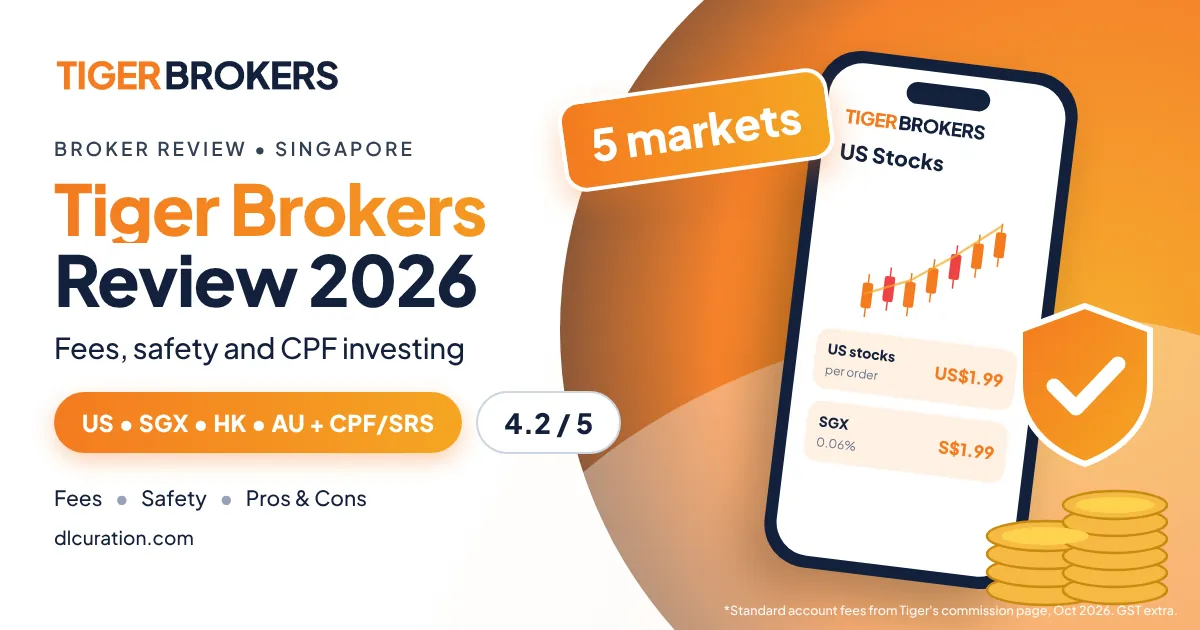
Tiger Brokers Review 2026: Is Singapore’s Multi-Market App Still Worth It?
Table of Contents
Tiger Brokers was one of the apps that made cheap US investing normal in Singapore. In 2026 it is no longer the cheapest — Webull charges US$0 on US stocks, while Tiger still has a US$1.99 minimum per order.
So is it still worth opening? For some investors, clearly yes. Tiger trades five markets from one app, takes CPF and SRS money, lets you sell CDP-held shares, and comes with a cash sweep and a debit card. For a monthly US$300 buyer who only wants US stocks, a zero-fee app costs less.
I went through Tiger’s own commission tables, its security and custody page, the Cash Boost terms for CPF and SRS, and parent company UP Fintech’s 2026 results and regulatory news. I also set Tiger against moomoo and Webull, the two apps most people compare it with. Here is the complete, honest verdict.
→ Open a Tiger Brokers account with referral code CG149G
Tiger Brokers at a Glance
| Factor | Rating |
|---|---|
| US stock fees | ⭐⭐⭐ 3.6/5 |
| SGX fees and CDP options | ⭐⭐⭐⭐ 4.2/5 |
| Market and product range | ⭐⭐⭐⭐⭐ 4.8/5 |
| CPF and SRS investing | ⭐⭐⭐⭐ 4.3/5 |
| App and tools | ⭐⭐⭐⭐⭐ 4.5/5 |
| Safety and custody | ⭐⭐⭐⭐ 4.2/5 |
| Best for | Investors who want US, SGX, HK and Australian shares plus CPF or SRS investing in one app |
| Not ideal for | Small, frequent US buyers who want the lowest cost per order |
| Free plan | Yes — no account fee, no minimum deposit and the SGX custody fee is waived |
| Starting price | US$1.99 per US order, S$1.99 per SGX order (before GST and exchange fees) |
| Overall rating | ⭐⭐⭐⭐ 4.2 / 5 |
→ Get the Tiger Brokers welcome rewards with code CG149G
What Is Tiger Brokers?
Tiger Brokers started in Beijing in 2014 as a mobile app for Chinese investors buying US and Hong Kong shares. The parent company, UP Fintech Holding, listed on Nasdaq under the ticker TIGR in 2019. It entered Singapore in 2020 and grew fast on low US commissions and big sign-up rewards.
The Singapore broker is Tiger Brokers (Singapore) Pte. Ltd. (UEN 201810449W). It holds a Capital Markets Services licence from the Monetary Authority of Singapore, according to Tiger’s licence page. The app is called Tiger Trade.
In 2026 Tiger covers US, Singapore, Hong Kong, Australian and China A-shares, plus options, futures, unit trusts, US Treasuries and a cash sweep called Tiger Vault. Since August 2025 its Cash Boost account also takes CPF-OA and SRS money for eligible SGX shares and ETFs. Group-wide, UP Fintech reported 1.3 million funded accounts and US$60.7 billion in client assets for the second quarter of 2026, and Singapore trading volume up 92% year on year, per Pulse 2.0.
The honest caveat: Tiger charges a minimum per order on every market. If you buy small amounts of US stocks often, that minimum is the biggest cost you will pay.
Tiger Brokers Fees in 2026: The Full Breakdown
There is no account fee, no minimum deposit and no inactivity fee. You pay a commission plus a platform fee on each trade. Every fee below is before 9% GST and exchange or regulatory charges, which apply at every broker. Source: Tiger’s commission page, checked 22 October 2026.
US Stocks and ETFs — US$0.01 per share, US$1.99 minimum
- Commission: US$0.005 per share, minimum US$0.99 per order.
- Platform fee: US$0.005 per share, minimum US$1 per order.
- Each is capped at 0.5% of trade value.
- Fractional orders (under one share): commission waived, platform fee 1% of trade value, capped at US$1.
- Auto-Invest on US stocks and ETFs from US$2, on a daily, weekly, fortnightly or monthly schedule.
In practice, most orders under about 200 shares pay the US$1.99 minimum. A US$500 buy costs US$1.99 in Tiger fees. Best for investors who place fewer, larger US orders.
SGX Stocks, ETFs and REITs — 0.06%, S$1.99 minimum
- Commission: 0.03% of trade value, minimum S$0.99.
- Platform fee: 0.03%, minimum S$1.
- SGX trading fee (0.0075%) and clearing fee (0.0325%) on top.
- Selling shares held in your own CDP account costs more: 0.22%, minimum S$9.99, per Beansprout’s October 2026 broker table.
A S$3,000 DBS buy costs S$1.99 in Tiger fees, against S$25 or more at a traditional bank broker. Best for regular SGX buyers who are happy to hold through Tiger’s custody.
CPF and SRS (Cash Boost Account) — free for 180 days, then 0.22%
- New Cash Boost links get zero commission for the first 180 days.
- After that, the Cash Boost fee table lists a 0.10% commission (minimum S$4.99) and a 0.12% processing fee (minimum S$5).
- Eligible SGX-listed SGD stocks and ETFs only, held under your CPF or SRS account.
So a CPF trade costs at least about S$9.99 after the free period. That is in line with bank brokers for CPF, not cheap. Best for CPF-OA or SRS investors who want to buy STI ETFs or blue chips in the same app as their cash account.
Hong Kong, Australia and China A-shares
- Hong Kong: 0.03% commission (minimum HK$7) plus 0.03% platform fee (minimum HK$8), so at least HK$15 per order, plus stamp duty and HKEX fees.
- Australia: 0.03% commission (minimum A$2) plus 0.07% platform fee (minimum A$6).
- China A-shares (through Stock Connect): 0.03% plus 0.03%, minimums CNH7 and CNH8, per Beansprout’s March 2026 review. A small portfolio fee from HKEX applies from 1 June 2026.
US Options — US$0.65 per contract
- Promotional fixed plan of US$0.65 per contract (US$0.35 commission plus US$0.30 platform fee), listed on our Tiger Brokers promo page as running to September 2027.
- Exchange and clearing fees (OCC, ORF, FINRA) on top.
- Options screener, multi-leg strategies, Greeks and P&L analysis in the app.
Hidden Costs to Know About
The minimum per order. This is the one that matters. On a US$200 order, US$1.99 is about 1% of the trade. Twelve monthly US$300 buys cost about US$24 a year at Tiger, US$12 at moomoo and close to nothing at Webull.
Currency conversion. Tiger does not list a separate FX fee. You pay through the exchange rate spread when you convert SGD to USD in the app. For large sums, compare the rate against the mid-market rate before converting.
CDP-linked selling. If you move CDP shares in to sell them, the 0.22% (minimum S$9.99) rate applies, not the cheap custodian rate.
GST on everything. Tiger’s tables are before 9% GST. The US$1.99 minimum is about US$2.17 once GST is added.
Leaving the welcome offer early. The welcome rewards claw back if you withdraw below the deposit tier during the 60-day retention window. Do not deposit money you might need in the next two months.
Core Features: What Tiger Brokers Actually Does
Five Markets in One App — The Strongest Feature
Tiger’s real advantage is breadth. From one account you can buy US, SGX, Hong Kong, Australian and China A-shares, trade US and Hong Kong options and futures, and hold unit trusts and US Treasuries. Most zero-fee apps in Singapore stop at US, SGX and Hong Kong.
That matters if your portfolio is spread out. An investor holding US tech, SGX banks and an ASX miner can do all of it with one login, one cash balance and one tax summary. The minimum fees are the price of that convenience.
Cash Boost — CPF and SRS Investing
Cash Boost launched in August 2025. It lets you link your CPF Investment Account or SRS account and buy eligible SGX-listed SGD stocks and ETFs, such as the STI ETFs, from the Tiger app. The same account handles selling SGX shares held in your own CDP account.
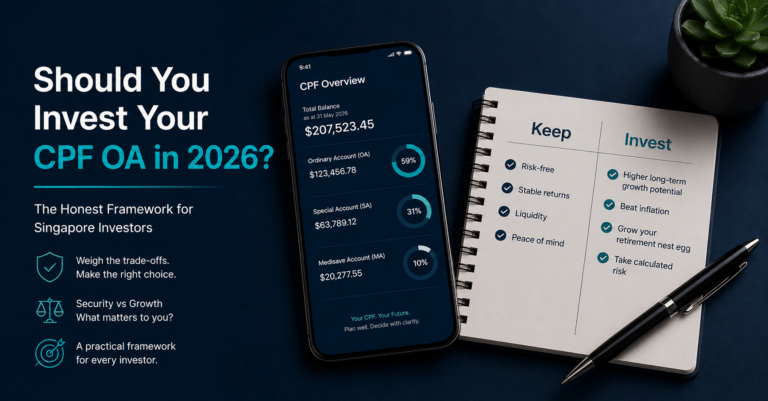
Most app brokers in Singapore, including moomoo and Webull, do not take CPF or SRS at all, per Beansprout’s October 2026 comparison. If you have been leaving CPF-OA money idle because your bank broker felt clunky, this is the feature that changes the decision. Read our CPF OA invest-or-keep guide before you move CPF money, since the 2.5% CPF-OA floor is hard to beat safely.
Tiger Vault — A Cash Sweep for Idle SGD and USD
Tiger Vault sweeps idle cash into a money market fund that you choose for each currency. It starts from US$1 or S$1, with no subscription or redemption fee and no lock-in. You can use 99% of the Vault balance to buy shares straight away, per Beansprout’s Tiger Vault review.
Returns follow the fund you pick, such as the Fullerton SGD Cash Fund, so they move with interest rates. Check the live yield in the app. Like every money market fund, Tiger Vault is not SDIC-insured.
Tiger Trade App — Pro and Lite Modes
The app has Pro and Lite views, so beginners see a simple buy screen and active traders see full charts, Level 2 data and options chains. Funded accounts get free Level 1 real-time US options quotes. There is also a community feed, earnings calendars and a stock screener.
Tiger BOSS Debit Card
The Tiger BOSS debit card pays 1% cashback on eligible spending, which you redeem for fractional shares once you have at least S$1 accumulated. Merchant exclusions apply. It is a small perk, not a reason to open the account, but it is a pleasant way to drip spare change into the market.
The Honest Assessment: What Holds Up and What Does Not
Custody holds up. Tiger’s security and custody page says client money and assets are kept separate from the company’s own funds under the Securities and Futures Act. SGX shares sit in a sub-account under Tiger’s nominee account at CDP. US trades are cleared by TradeUP Securities and held at the Depository Trust Company, and TradeUP is a SIPC member. Funds sit with Allfunds Singapore.
You do not own SGX shares in your own name by default. Like moomoo and Webull, Tiger holds SGX shares as a custodian. You still own them, but dividends and corporate actions come through Tiger, and you cannot vote at AGMs unless you request a proxy.
The parent company had a rough 2026. In May 2026 China’s securities regulator fined UP Fintech about RMB411 million for unlicensed cross-border business with mainland Chinese clients, per TradeInformer. From 12 June 2026 Tiger stopped mainland investors opening new positions, according to Caixin. This does not touch Singapore accounts, which sit with the MAS-licensed Singapore entity, and the group returned to profit in the second quarter. It is still worth knowing that the parent’s biggest market is shrinking.
Fees are fair, not the lowest. Tiger was cheap in 2020. In 2026, Webull charges US$0 on US stocks and moomoo charges US$0.99 per US order. Tiger’s US$1.99 minimum is now the highest of the three for small orders.
Promotions are confusing. Tiger runs many campaigns at once: welcome rewards, invite bonuses, transfer-in draws, trading contests. The headline numbers are real, but each has its own deposit tier and retention rule. Read the terms on the official promotions page before you fund.
Tiger Brokers vs moomoo vs Webull: Which Should You Choose?
| Factor | Tiger Brokers SG | moomoo SG | Webull SG |
|---|---|---|---|
| US stock fees | US$0.01/share, min US$1.99 | US$0.99 per order | US$0 |
| SGX fees (custodian) | 0.06%, min S$1.99 | 0.04–0.06%, min S$1.98 | Free year one, then ~0.05% (min S$1.60) |
| SGX in your own CDP | Sell only, 0.22% (min S$9.99) | Yes, 0.22% (min S$9.98) | No |
| Markets | US, SG, HK, AU, China A | US, SG, HK, JP, AU, China A | US, SG, HK, China A |
| CPF / SRS | Yes (Cash Boost) | No | No |
| US options | US$0.65 per contract | US$0.65 per contract (fixed plan) | ~US$0.55 per contract |
| Cash sweep | Tiger Vault | moomoo Cash Plus | Moneybull |
Tiger figures from its commission page (22 October 2026). moomoo and Webull figures from Beansprout’s 2 October 2026 broker comparison and our Webull Singapore review.
Choose Tiger if you want CPF or SRS investing in an app, you hold Australian shares, or you value having every market in one account. It is the only one of the three that takes CPF.
Choose moomoo if you also trade Japan and want slightly lower US costs. Its research tools and community are the strongest of the three.
Choose Webull if most of your money goes into US stocks and ETFs. US$0 per order beats both rivals, especially for small monthly buys.
None of the three offers London-listed ETFs such as CSPX or VWRA. For those, look at Interactive Brokers. Our best brokers in Singapore guide compares the full field.
Who Should Use Tiger Brokers
Tiger Brokers is a strong fit if:
- You want to invest CPF-OA or SRS money in SGX shares or ETFs from an app instead of a bank broker.
- You hold, or plan to hold, shares across the US, Singapore, Hong Kong and Australia.
- You place US orders of US$1,000 or more, where the US$1.99 minimum is a small share of the trade.
- You trade US options and want a fixed US$0.65 per contract.
- You want idle cash swept into a money market fund automatically.
Tiger Brokers is not a strong fit if:
- You buy US$100 to US$300 of US stocks every month. A zero-fee app costs less.
- You want every SGX share in your own CDP account and buy often. A CDP-linked bank broker suits that better.
- You want London-listed ETFs such as CSPX or VWRA.
- You are put off by the parent company’s 2026 regulatory trouble in China.
- You find stacked promotions with retention rules stressful.
Is Tiger Brokers Worth It in 2026?
For investors who use its range, yes. Take someone who invests S$1,000 a month into an STI ETF through CPF, buys US$1,000 of US stocks each quarter and holds a few ASX names. At Tiger, that is one app. Elsewhere it is often a bank broker for CPF, a zero-fee app for US stocks and a third account for Australia. Saving a dollar per US order is not worth juggling three logins for most people.
For a pure US investor, the maths runs the other way. Twelve US$300 orders a year cost about US$24 at Tiger and close to nothing at Webull.
The test to run in your first month: fund the account, place one SGX buy and one US buy, and check the contract notes against the fee tables above. If you plan to use CPF, link Cash Boost and buy one lot during the 180-day free period. If the app and the fees feel right, keep going.
Sign-up offer: new users who register with a referral code can get welcome rewards of S$200, S$400 or S$1,000 for net deposits of S$3,000, S$10,000 or S$100,000, held for 60 days, until 31 December 2026. The code must go in before you finish registering. The Tiger Brokers promo page tracks every live offer each month, and the Tiger Brokers referral code guide shows where to enter it.
→ Open Tiger Brokers with code CG149G
Frequently Asked Questions
Is Tiger Brokers safe and regulated in Singapore?
Yes. Tiger Brokers (Singapore) Pte. Ltd. holds a Capital Markets Services licence from MAS. Client money and assets are segregated from the company’s own funds. SGX shares sit in a sub-account at CDP, and US shares are held at the DTC through TradeUP Securities, a SIPC member. Tiger’s cash and SGX holdings are not SDIC-insured.
How much are Tiger Brokers fees in 2026?
US stocks cost US$0.01 per share with a US$1.99 minimum per order. SGX shares cost 0.06% with a S$1.99 minimum. Hong Kong costs 0.06% with a HK$15 minimum. All fees are before 9% GST and exchange charges. There is no account fee, and the SGX custody fee is currently waived.
Can I use CPF with Tiger Brokers?
Yes. The Cash Boost account takes CPF-OA and SRS money for eligible SGX-listed SGD stocks and ETFs. The first 180 days after linking are commission-free. After that, Tiger charges 0.10% (minimum S$4.99) plus a 0.12% processing fee (minimum S$5).
Is Tiger Brokers better than moomoo?
Tiger is better if you want CPF or SRS investing or Australian shares. moomoo is better for small US orders, at US$0.99 per order against Tiger’s US$1.99 minimum, and it adds Japan. Both hold SGX shares as a custodian by default and both offer US options at about US$0.65 per contract.
Does Tiger Brokers hold my SGX shares in my CDP account?
Not by default. SGX shares bought through Tiger sit in a sub-account under Tiger’s nominee account at CDP. You remain the owner, but you get dividends through Tiger. You can link your own CDP account to sell CDP-held shares, at 0.22% (minimum S$9.99).
Does the China penalty affect Singapore Tiger accounts?
No direct effect has been reported. The 2026 fine and the stop on new positions apply to mainland Chinese clients. Singapore accounts are held by the MAS-licensed Singapore company under Singapore segregation rules. UP Fintech said the penalty would not have a material adverse impact on its operations.
Final Verdict
Tiger Brokers earns 4.2 out of 5 stars.
It earns full marks on range. Five stock markets, options, futures, funds, a cash sweep and CPF and SRS investing in one app is hard to match in Singapore. The app suits both beginners and active traders, and custody follows the same MAS rules as every licensed broker.
The deductions come from cost and context. The US$1.99 minimum now looks expensive next to zero-fee rivals, SGX shares sit with a custodian unless you pay CDP-linked rates, and the parent company’s 2026 trouble in China is a fair reason to watch it.
Open Tiger if you want one app for everything, especially CPF. If you only buy US stocks in small amounts, start with a zero-fee broker instead.
→ Start with Tiger Brokers and claim the welcome rewards
Do you use Tiger for CPF investing, or just for US stocks? Tell me in the comments.
Continue reading: