
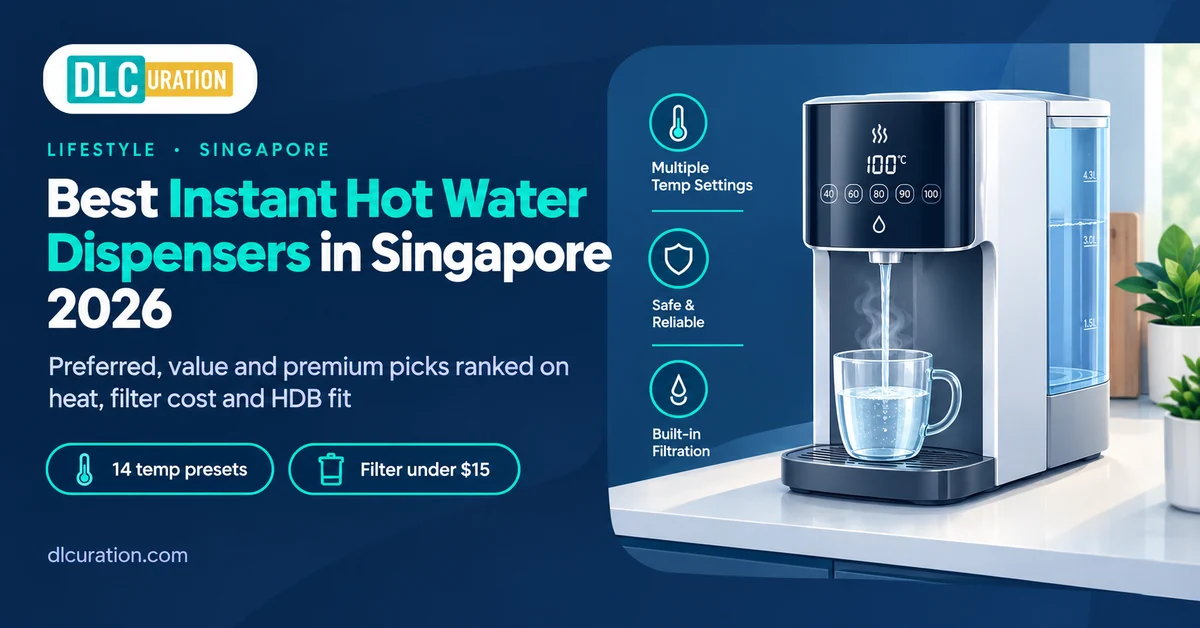
Best Instant Hot Water Dispensers in Singapore 2026: Preferred, Value & Premium Picks
Table of Contents
If you still wait three to five minutes for a kettle every time you want coffee, tea or instant noodles, you already know the friction. In a typical Singapore HDB kitchen the counter is tight, the 13 A socket is shared, and the water can leave scale on any heating element that sits unused.
Instant hot water dispensers remove that wait. Fill a tank once, select a temperature, and get water in three to ten seconds. The category has exploded with portable mini units, filtered countertop models and a few genuine RO machines. Not all of them survive daily use under Singapore conditions.
I ranked nine units that clear a transparent set of criteria rather than simply following today’s Shopee best-seller badges. The result is a short list that stays useful even when marketplace rankings shift.
Here are the nine best instant hot water dispensers available in Singapore right now.
What to Look For in an Instant Hot Water Dispenser
Heat performance and temperature accuracy. Look for real preset temperatures (especially 40–50 °C for formula and 85–95 °C for coffee or tea) and a claimed heat-up time that holds under load. Vague “3 seconds” claims without power ratings or measured behaviour are usually marketing.
Filtration quality and ongoing cost. Singapore tap water meets WHO guidelines, yet chlorine taste and occasional pipe sediment remain. A useful filter removes chlorine, microplastics and scale precursors. Replacement cost under $15 every six months is realistic for most households; RO cartridges at $200+ change the total cost of ownership.
Capacity versus footprint. A 2.5–4.3L tank covers a family of four without daily refills. Anything wider than 20 cm or deeper than 35 cm starts to crowd a standard HDB counter.
Descaling and maintenance. Hard water and residual minerals mean scale builds. Units with a dedicated descaling cycle or easy-access heating tube last longer. Plastic-only heating paths fail faster.
Safety and local support. Child lock, boil-dry protection, 316 or 304 stainless heating elements, and a Singapore safety mark are non-negotiable. Local brand service centres matter when the unit stops heating after 18 months.
Power and plug. All models below use 220–240 V and a standard 3-pin plug. Peak draw sits between 2 000 W and 2 600 W — fine on a dedicated kitchen circuit, not on a shared multi-plug.
The 9 Best Instant Hot Water Dispensers in 2026
| Product | Best For | Starting Price (SGD) | Free Plan / Filter Cost |
|---|---|---|---|
| Toyomi InstantBoil FB 5543F 4.3L | Overall balance & local support | $140–190 | Filter ~$10 / 6 months |
| Mayer MMIWD4008 4L | Strix filter & child lock | $190–200 | Aqua Optima Strix |
| Aerogaz AZ-288IB 2.7L | Value under $120 | $70–120 | Basic filter / self-clean |
| Russell Taylors 4L (Strix) | Premium filter feel | $90–95 | Strix filter |
| Philips ADD6910 RO 4L | True RO purification | $600–800 | RO cartridge ~$200 / year |
| Toyomi smaller InstantBoil (3–3.5L) | Compact filtered option | $120–160 | Filter ~$8–10 |
| IUIGA Portable Instant | Travel & single-user | $30–50 | None / bottle-fed |
| Generic 3-second mini portable | Absolute budget only | $25–35 | None or weak |
| IONA 6L Electric Airpot | Keep-warm large volume | $45–50 | None |
1. Toyomi InstantBoil 4.3L FB 5543F — Preferred Pick
→ Check current Toyomi InstantBoil 4.3L
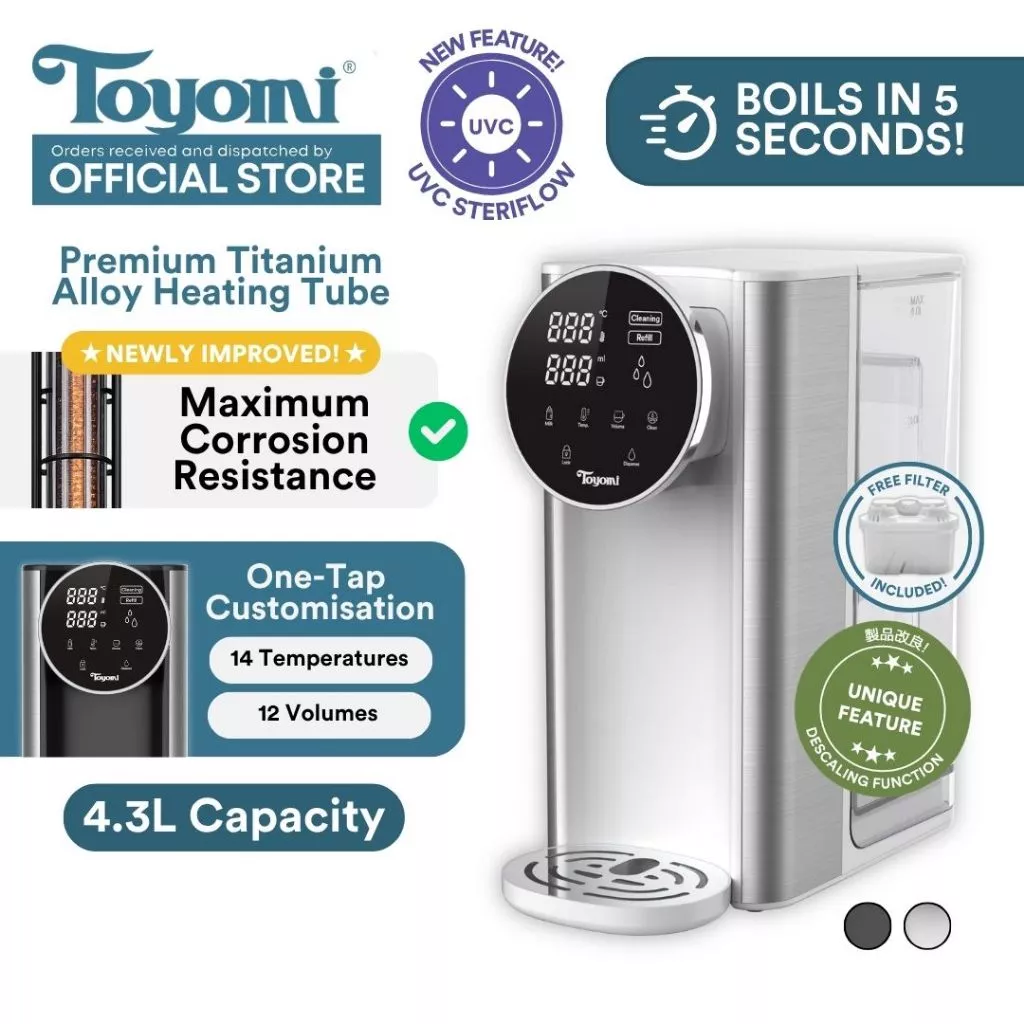
Toyomi is a long-standing Singapore brand. The FB 5543F is their current flagship InstantBoil model: 4.3L removable tank, 14 temperature presets from room temperature to 100 °C, and volume settings from 100 ml to continuous. Power is 2 000–2 600 W. The heating path uses a thick 316 medical-grade stainless tube and a 9-layer design that the brand claims improves speed and reduces energy waste.
Filtration is a 4-stage cartridge (non-woven, ion-exchange resin, activated carbon) that targets microplastics, chlorine, lead and scale precursors. Official replacement cost is about $10 and the recommended interval is six months or 1 800 L. The unit includes an intelligent descaling cycle that uses temperature swings to loosen deposits — useful given Singapore’s residual mineral content.
What Toyomi is great at:
- Precise low temperatures for baby formula and higher ones for coffee or tea.
- Local service centre and one-year warranty that is easy to claim.
- Affordable, readily available filters.
- Removable tank and drip tray that clean without tools.
Where it falls short:
- Not a reverse-osmosis system; TDS reduction is modest.
- Plastic exterior feels less premium than stainless-clad competitors.
- First few litres after a filter change can show carbon dust (normal, rinse it out).
Pricing:
- Unit: typically $140–190 depending on promotions.
- Filter: ~$10 every six months.
Bottom line: For most Singapore households this is the highest-scoring unit on the weighted criteria. It balances speed, filtration cost, descaling and local support without requiring plumbing or a $700 outlay.
→ Get the Toyomi InstantBoil here
2. Mayer MMIWD4008 4L — Strong Contender with Strix Filter
→ Check Mayer 4L Instant Heating Water Dispenser price
Mayer’s 4L model uses a UK Aqua Optima (Strix) filter — a recognised name for chlorine, heavy-metal and scale reduction. Heat-up is claimed at roughly 10 seconds. Seven temperature presets (room, 45, 55, 65, 75, 85, 100 °C) and five volume settings cover daily needs. Child lock, boil-dry protection and a low-water / descaling reminder are built in. Dimensions stay compact at 19 × 35 × 30 cm.
What Mayer is great at:
- Credible third-party filter brand with proven scale-reduction performance.
- Clear safety features and one-year local warranty.
- Straightforward sensor-touch interface.
Where it falls short:
- Fewer temperature steps than the Toyomi 14-preset model.
- Filter cost is higher than Toyomi’s generic cartridge.
- No dedicated “self-clean” cycle beyond the reminder.
Pricing:
- Unit: $190–200.
- Strix filters available from multiple Singapore retailers.
Bottom line: Excellent if you prioritise a known filter brand and child lock. Slightly behind Toyomi on temperature range and ongoing filter cost.
3. Aerogaz AZ-288IB 2.7L — Best Value

The 2.7L Aerogaz sits in the sweet spot under $120. Stainless housing, sensor-touch panel, seven temperatures (normal to 100 °C) and five volume settings. Power rating matches the class (2,200–2,600 W). It includes a self-cleaning function and a transparent removable tank. Safety mark is present.
What Aerogaz is great at:
- Lowest price among units with genuine temperature control and stainless elements.
- Compact footprint that fits tight counters.
- Simple, reliable interface.
Where it falls short:
- Filtration is basic compared with Toyomi or Mayer.
- Smaller tank means more frequent refills for larger households.
- Fewer temperature presets.
Pricing:
- Unit: $70–120 depending on seller and promotions.
Bottom line: The clear best-value pick if your budget stops around $100 and you still want real temperature selection and a self-clean cycle. Not the most refined filter, but the performance-to-price ratio is high.
4. Russell Taylors Instant Hot Water Dispenser (4L / 2.5L Strix models)

→ Check Russell Taylors 2.5L listing
→ Check Russell Taylors 4L listing
These models appear frequently in Singapore marketplaces with Strix filtration and similar power and volume controls to the Mayer. The 4L version targets family use; the 2.5L is more compact. Instant-boil claims and filter performance track the Strix standard.
What Russell Taylors is great at:
- Strix filter familiarity.
- Competitive pricing on promotions (often sub-$100 for the larger model).
- Clean digital interface.
Where it falls short:
- Brand support is thinner than Toyomi or Mayer in Singapore.
- Spec sheets vary by exact model; verify the heating element material before buying.
Pricing:
- 4L models often $90–95 on sale; 2.5L lower.
Bottom line: A solid alternative if you find a deep discount. Prefer Toyomi or Mayer when full local warranty and consistent filter supply matter.
5. Philips ADD6910 RO 4L — Most Premium

This is the step-up unit for buyers who want genuine reverse-osmosis performance. The AquaShield 5-in-1 RO system claims removal of 110 contaminants including heavy metals, bacteria, viruses and pesticides down to 0.0001 µm. UV-LED sterilises the tank. Instant heating delivers four temperature settings plus continuous flow. Capacity is 4L and the unit remains countertop-only — no plumbing required.
What Philips is great at:
- True RO filtration that goes well beyond carbon and ion-exchange.
- UV tank sterilisation and child lock.
- Consistent long-term user reports of durability (some units still running after 6–8 years).
Where it falls short:
- Purchase price $600–800 and annual RO cartridge cost around $200.
- Only four temperature presets.
- Larger footprint than pure instant-boil models.
Pricing:
- Unit: $600–800.
- Filter: ~$200 per year.
Bottom line: The most premium pick if filtration quality is the primary goal and budget allows. Overkill for households that mainly want fast hot water and basic chlorine reduction.
→ Get the Philips RO dispenser here
6. Toyomi Smaller InstantBoil Models (3.5L)

→ Get Toyomi NEW 3.5L InstantBoil
These share the same core technology and filter system as the 4.3L flagship at a lower entry price. Useful when counter space is extremely limited or household size is one or two people.
Bottom line: Same strengths and weaknesses scaled down. Choose the 4.3L unless footprint is the absolute constraint.
7. IUIGA Portable Instant Hot Water Dispenser

→ Check IUIGA Portable Instant Hot Water Dispenser
A bottle-fed unit designed for travel or single-user desks. Heats in seconds, five temperature settings, 3-pin plug included. No tank to clean and no filter.
What it is great at:
- True portability and minimal storage.
- Fast single-cup heating.
Where it falls short:
- No filtration.
- Limited capacity and no continuous family use.
Bottom line: Best for travel or office desks, not as a primary kitchen unit.
8. Generic 3-Second Mini Portable Units
→ Check Instant Heat water dispenser portable mini water dispenser
→ Check Instant Heat Water Dispenser Travel Mini Portable Desktop Water Dispenser
These dominate the lowest price band ($25–35) and appear high in marketplace “Best Selling” lists. Most lack meaningful filtration, use thin plastic heating paths, and show repeated user reports of scale failure and inconsistent temperature after a few months.
Bottom line: Marketing-heavy. Acceptable only as a temporary or travel spare if you accept short lifespan and no filtration.
9. IONA 6L Electric Airpot
→ Get the IONA 6L Electric Airpot Hot Water Dispenser here
A traditional keep-warm airpot rather than pure on-demand instant heating. Large capacity and stainless construction, but heat-up is slower and energy use is continuous while on standby.
Bottom line: Useful if you need large volumes of already-hot water rather than true instant dispensing.
How to Choose the Right Instant Hot Water Dispenser
- If you want the best overall balance for a typical Singapore household → Toyomi InstantBoil FB 5543F.
- If your budget is under $120 and you still want temperature control → Aerogaz AZ-288IB.
- If filtration quality is the priority and budget allows → Philips ADD6910 RO.
- If you need a known UK filter brand and child lock → Mayer MMIWD4008.
- If you mainly travel or need a desk unit → IUIGA portable.
- If you only need occasional single cups and accept no filter → generic mini portable (with eyes open).
The Best Instant Hot Water Dispenser Stack for Most Singapore Homes
Primary unit: Toyomi InstantBoil 4.3L FB 5543F.
Backup / travel: IUIGA portable.
Annual filter cost: roughly $20.
Total first-year outlay stays well under $250 for most buyers on promotion.
Frequently Asked Questions
Does Singapore tap water need a filter for an instant dispenser?
PUB water meets WHO guidelines and is safe to drink. Filters mainly improve taste by reducing chlorine and remove residual pipe sediment or microplastics. They also slow scale build-up on the heating element. A basic carbon + ion-exchange filter is sufficient for most homes; full RO is optional.
How often should I replace the filter?
Most countertop models recommend every six months or after 1 500–1 800 L. In practice, taste and flow rate are the best indicators. Toyomi and similar cartridges cost around $8–15; RO cartridges are significantly more expensive.
Is an instant hot water dispenser safe with children?
Units with a child-lock button and boil-dry protection are safer. Always place the dispenser where a child cannot reach the dispense button. Never leave the continuous-flow setting enabled when young children are present.
Do these units use a lot of electricity?
Peak draw is 2 000–2 600 W during heating, but only for a few seconds per cup. Standby consumption is low on modern models. Over a year the energy cost is typically lower than repeatedly boiling a full kettle.
Can I use these dispensers for baby formula?
Yes — provided the unit offers accurate 40–50 °C presets. Always follow the formula manufacturer’s temperature guidance and verify the dispensed temperature with a thermometer the first few times.
What is the difference between an instant dispenser and a traditional electric airpot?
An instant dispenser heats only the water you request on demand. An airpot keeps a larger volume hot continuously. Instant models save energy for intermittent use; airpots suit high continuous demand.
Final Verdict
Toyomi InstantBoil FB 5543F is the DLCuration Preferred Pick for 2026. It scores highest across heat accuracy, filtration cost, descaling convenience and local support — the factors that actually matter after six months of daily use in a Singapore kitchen.
Aerogaz AZ-288IB is the Best Value choice under $120.
Philips ADD6910 is the Most Premium option when true RO performance justifies the higher purchase and filter cost.
Start with the free-trial period or return window that most Singapore sellers offer. Run the unit for a week on your actual water and usage pattern. The evidence will make the decision clear.
→ Start with the Toyomi InstantBoil
Have you used any of these dispensers in an HDB kitchen? Share the real-world scale and filter experience in the comments.
Continue reading: