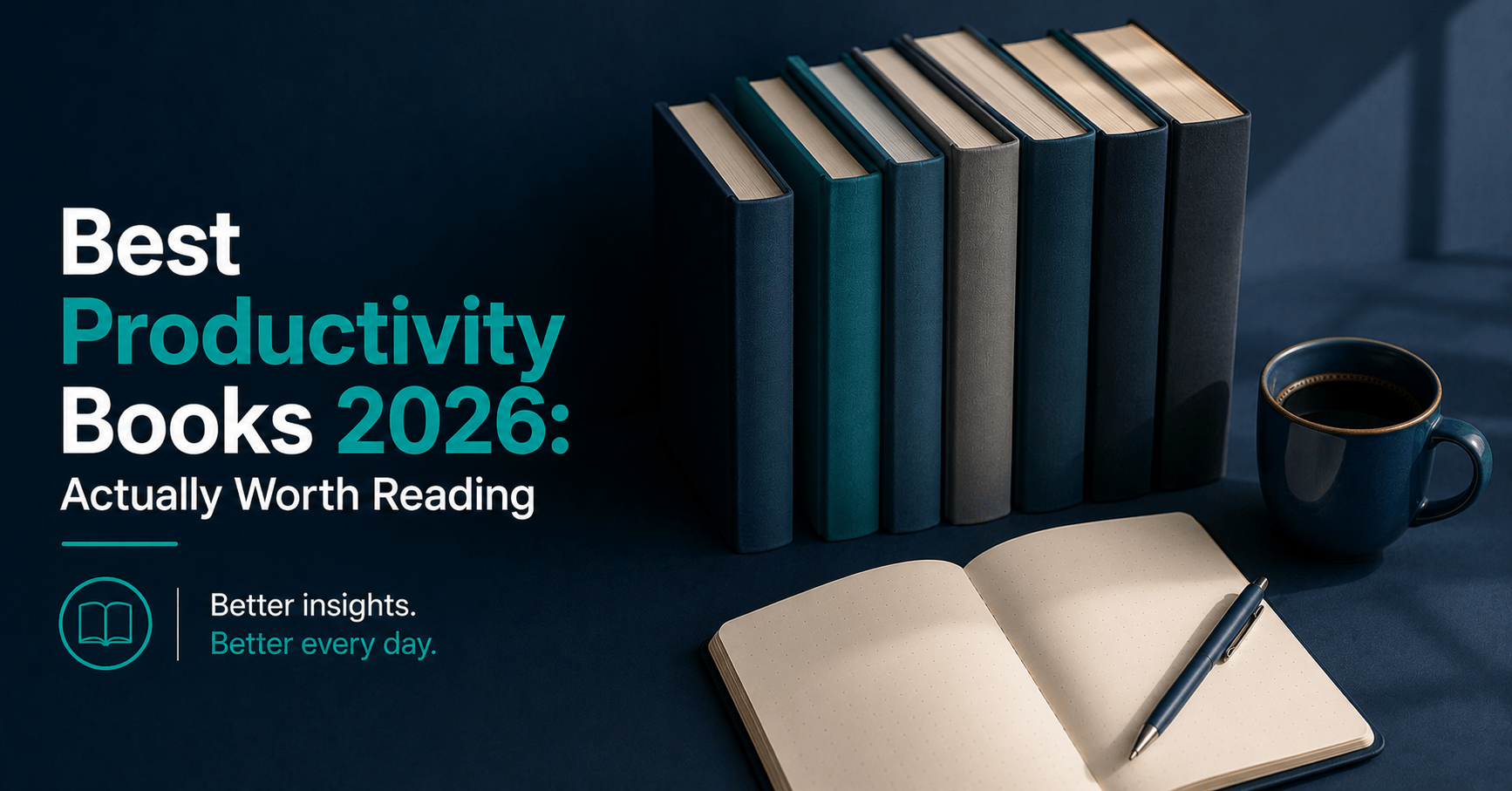
Best Productivity Books in 2026: The Honest Shortlist
Table of Contents
The productivity book category has a signal-to-noise problem. For every genuinely useful title there are ten books that repackage the same core ideas — time blocking, morning routines, prioritization — with a new framework name and a fresh set of anecdotes. Reading the wrong ones wastes time and produces the frustrating experience of recognizing every idea as something you’ve already encountered without learning anything new.
This list doesn’t try to be comprehensive. It’s a curated shortlist of eight books that each offer something genuinely distinct — a different angle, a different mechanism, or a different type of reader. For each one, I’ve included an honest take on who it’s actually for and who should skip it, because the best productivity book is not the most popular one. It’s the one that matches where you are right now.
What Makes a Productivity Book Worth Reading
Before the list, the filter I used — because the same criteria that makes a book worth recommending makes it worth your time to evaluate.
It changes behavior, not just thinking. The test of a productivity book is not whether you feel motivated after reading it. It’s whether you do something differently three months later. Books that offer frameworks with concrete implementation steps fare better on this test than books that offer philosophy with inspiring examples.
It has a genuine argument. The best books in this category take a position — often a contrarian one — and defend it with evidence. Books that try to include everything and offend no one tend to produce advice that fits every situation and changes nothing.
The ideas are distinct from what came before. A book that covers the same ground as three earlier titles, just with better writing, belongs on the “well-written summary” shelf, not the recommended reading list.
It doesn’t oversell the outcome. Books that promise to transform your life if you follow their system are almost always overselling. Books that honestly describe what their approach does well and where it falls short are more trustworthy — and their advice is more durable because you know what you’re actually signing up for.
The 8 Best Productivity Books in 2026
| Book | Author | Best for | Read time |
|---|---|---|---|
| Atomic Habits | James Clear | Building and breaking habits — the best framework available | 5–6 hours |
| Deep Work | Cal Newport | Anyone whose best work requires sustained concentration | 6–7 hours |
| Getting Things Done | David Allen | People who feel perpetually overwhelmed by open loops | 7–8 hours |
| Essentialism | Greg McKeown | People who are busy but not making progress on what matters | 5–6 hours |
| Four Thousand Weeks | Oliver Burkeman | Anyone who has read the standard productivity canon and still feels behind | 6–7 hours |
| The One Thing | Gary Keller & Jay Papasan | People who struggle to prioritize among many competing demands | 5 hours |
| Tiny Habits | BJ Fogg | People for whom Atomic Habits felt too abstract to implement | 5–6 hours |
| Slow Productivity | Cal Newport | Anyone burning out on the high-volume output model of modern work | 5–6 hours |
1. Atomic Habits — James Clear
Best for: Anyone who wants the most practical, research-grounded framework for building and breaking habits.
Atomic Habits is the best book on habit formation currently available. Clear’s four laws of behavior change — make it obvious, make it attractive, make it easy, make it satisfying — are the most actionable framework in the category, and the identity-based habits concept is a more durable foundation than goal-based approaches that most competing books use.
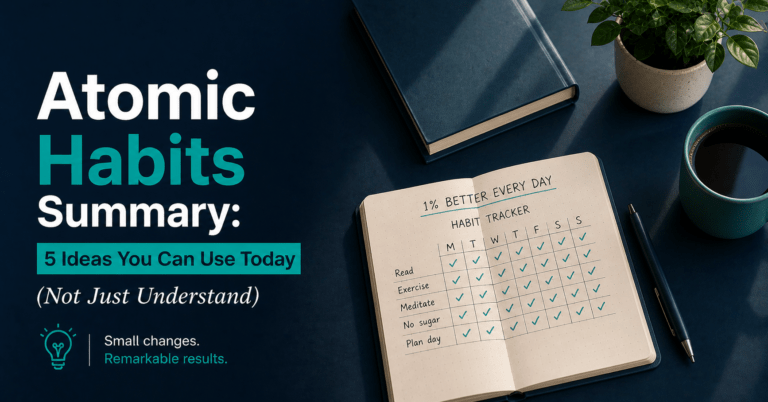
The book is well-structured, clearly written, and densely practical. It earns its reputation. The honest caveat is that it’s been so widely read and discussed that many readers will recognize the core ideas before reaching them — the 1% improvement concept, habit stacking, the two-minute rule — from blog posts, podcasts, and secondhand summaries. If you’ve encountered these ideas and haven’t acted on them, the book won’t change that. The framework needs to be implemented, not just understood.
Who should read it: Anyone who hasn’t yet built a reliable system for behavior change, regardless of how many times they’ve tried to build one. The framework is specific enough to produce real change if applied.
Who should skip it: People who have already read it and not implemented the ideas. A re-read won’t help. The implementation guide — not another read-through — is what’s needed.
The one idea worth the price: The identity reframe. Instead of “I want to exercise,” the shift to “I am someone who exercises.” Each behavior becomes a vote for or against an identity, and identity is more durable than motivation as a foundation for habit.
2. Deep Work — Cal Newport
Best for: Knowledge workers whose most valuable output requires sustained, uninterrupted concentration — and who aren’t currently getting enough of it.
Newport’s central argument: the ability to perform deep, focused work on cognitively demanding tasks is becoming simultaneously rarer and more valuable. People who can reliably produce this kind of work will increasingly outperform those who can’t, regardless of their baseline skill level.
The book is structured in two parts. The first makes the case for deep work’s value — the most persuasive section, with strong supporting evidence. The second offers four rules for cultivating it: work deeply, embrace boredom, quit social media, and drain the shallows. The rules are more prescriptive and less universally applicable than the argument that precedes them — Newport’s own approach involves extreme measures that don’t translate directly to most professional contexts. The principles, however, are sound and adaptable.
Who should read it: Anyone who ends most weeks feeling busy but unable to point to anything genuinely significant they produced. The book names the problem clearly and makes a compelling case for why it’s worth solving.
Who should skip it: People in roles that are genuinely reactive by nature — customer service, emergency response, hands-on management — where deep work windows are structurally limited. Newport’s framework assumes more schedule autonomy than many roles allow.
The one idea worth the price: The concept of “attention residue” — the cognitive cost of switching tasks that persists long after you’ve moved to something new. It reframes why fragmented work days produce so little, even when the total hours worked are high.
3. Getting Things Done — David Allen
Best for: People who feel chronically overwhelmed by the volume of things on their plate and can never fully concentrate because their mind is always carrying open loops.
Allen’s system — often called GTD — is the most comprehensive task and project management methodology available in book form. The core insight is that the human brain is poorly designed for storing commitments: every uncaptured task, open question, or unresolved obligation occupies working memory as a persistent, low-level stressor. The solution is to externalize everything into a trusted system, enabling what Allen calls “mind like water” — a state of clear, present-focused attention.
The book is dense and detailed in a way that either works well or doesn’t at all depending on the reader. GTD asks for a significant upfront investment — capturing and organizing everything, building the full system from scratch — before the benefits arrive. Many people start, don’t complete the setup, and conclude the system is too complicated. The people who build it properly tend to use it for decades.
Who should read it: Anyone whose mental overhead from tracking commitments is actively interfering with their ability to focus. Also essential reading for anyone building or optimizing a productivity system — GTD defines most of the vocabulary still used in this space.
Who should skip it: People looking for a quick-start approach. GTD is infrastructure, not a shortcut. If you’re not willing to invest several hours in an initial system setup, the book’s advice won’t produce results.
The one idea worth the price: The two-minute rule — if an action takes less than two minutes, do it immediately rather than adding it to a list. Simple, universally applicable, and produces immediate reduction in task list bloat.
→ Get Getting Things Done on Amazon
4. Essentialism — Greg McKeown
Best for: People who are busy, capable, and committed — but who, at the end of most weeks, feel like they made progress on everyone else’s priorities rather than their own.
McKeown’s central argument is that the undisciplined pursuit of more — more commitments, more projects, more options — is the primary obstacle to meaningful contribution. The essentialist asks a single question of every demand on their time: is this the most important use of this moment? Most things fail that test.
The book is more philosophical than tactical, which is both its strength and its limitation. It makes a compelling case for doing less and is unusually honest about the social and professional costs of saying no. The specific implementation guidance is thinner than books like GTD or Atomic Habits — it gives you the mindset shift more reliably than it gives you the mechanics for producing it.
Who should read it: People who already have good execution systems but keep applying them to the wrong things. Also useful for anyone who struggles to say no to requests and commitments, and wants a principled framework for doing so.
Who should skip it: People whose primary problem is execution rather than prioritization — who know what’s important but struggle to do it. Essentialism will clarify your priorities without helping much with the doing.
The one idea worth the price: The concept of the “trade-off” as a strategic tool rather than a failure. Every yes to one thing is a no to everything else competing for that time and attention. Making that trade-off explicit converts it from a source of anxiety into a deliberate decision.
5. Four Thousand Weeks — Oliver Burkeman
Best for: Anyone who has read the standard productivity canon, applied it, and still feels perpetually behind — and is starting to wonder if the problem is the approach rather than the execution.
This is the most unusual book on this list. Burkeman’s argument is that the entire productivity optimization project — the idea that the right system, used rigorously enough, will eventually allow you to get everything done — is structurally false. The average human life is approximately four thousand weeks. The tasks available to fill that time are effectively infinite. No system closes that gap. Accepting this isn’t defeat; it’s the prerequisite for making genuinely intentional choices about what to spend the time on.
The book is less about tactics and more about the psychological relationship with time and mortality that underlies most productivity anxiety. It’s the most philosophically honest thing in the category and the hardest to act on in the conventional sense, because its advice is largely about what to stop doing rather than what system to adopt.
Who should read it: People who feel like they’re failing at productivity despite significant effort and good intentions. People experiencing burnout from the relentless optimization cycle. Anyone who wants an honest conversation about why the pursuit of perfect productivity is self-defeating.
Who should skip it: People who are just getting started with productivity systems and need practical frameworks. Come back to this after you’ve implemented something and want to examine the assumptions underneath it.
The one idea worth the price: Pay yourself first — in time. Protecting time for the work that genuinely matters to you before filling the calendar with other people’s priorities. Not as a scheduling trick but as a deliberate philosophical choice about what a life is for.
→ Get Four Thousand Weeks on Amazon
6. The One Thing — Gary Keller & Jay Papasan
Best for: People who have too many competing priorities and struggle to decide what to focus on — especially in a professional context with multiple projects and stakeholders.
Keller and Papasan’s central question: what is the ONE thing that, if done, makes everything else easier or unnecessary? Applied recursively — to years, months, weeks, days, and the current moment — this question becomes a powerful prioritization filter that cuts through the noise of competing demands.
The book is straightforwardly written and more practically actionable than Essentialism on the question of what to do next. The core concept is not complicated, and the book makes a persuasive case for it with examples across multiple domains. The honest limitation is that the second half is significantly weaker than the first — the ONE thing concept is compelling and well-argued, and the supporting chapters on purpose, priority, and productivity feel like padding around a central idea that was already complete.
Who should read it: People in roles with multiple competing projects who struggle to decide what to work on. Also useful for anyone who spreads effort too thinly across too many initiatives and produces mediocre results across all of them.
Who should skip it: People whose primary problem is execution discipline rather than prioritization. Knowing your ONE thing doesn’t help much if you already know your priorities but struggle to protect time for them.
The one idea worth the price: The “domino” model of priority — some tasks, when completed, knock over a chain of other tasks or make them easier. Finding that domino task each day and doing it first is worth more than clearing fifteen minor items from a list.
7. Tiny Habits — BJ Fogg
Best for: People for whom Atomic Habits felt compelling but too abstract to implement — who understand the framework but haven’t been able to produce the behavior changes it describes.
Fogg’s approach shares significant DNA with Clear’s but arrives at it differently. Where Clear focuses on identity and environment design, Fogg focuses on motivation, ability, and prompt — and his implementation guidance is more granular and more immediately actionable for many people. The Tiny Habits method reduces new behaviors to their smallest possible form (smaller than even Clear’s two-minute rule in many cases), and the “celebration” element — an immediate positive emotional signal after completing a behavior — is a more explicit and effective reward mechanism than most habit books describe.
The book is less polished than Atomic Habits and occasionally repetitive, but the implementation details are genuinely richer. For people who have tried and failed with Clear’s framework, Fogg’s more granular approach often produces traction where the other didn’t.
Who should read it: People who have tried other habit systems and haven’t been able to make them stick. Also excellent for anyone building habits in domains where the “too hard to start” barrier is the primary obstacle — exercise, creative practices, health behaviors.
Who should skip it: People who are already successfully building habits. Tiny Habits and Atomic Habits cover enough overlapping ground that reading both provides diminishing returns unless you’re specifically struggling with implementation.
The one idea worth the price: The “anchor” concept — attaching a new tiny behavior to an existing automatic one, with an immediate celebration afterward. The celebration creates the positive emotional reinforcement that encodes the behavior faster than repetition alone.
8. Slow Productivity — Cal Newport
Best for: Knowledge workers who feel burned out on the relentless output model of modern work — the expectation of constant visible activity, rapid response, and maximum throughput — and want a principled alternative.
Newport’s most recent contribution to the productivity canon is deliberately contrarian. His argument: the dominant model of knowledge work — high volumes of activity, constant connectivity, rapid iteration — was designed for assembly-line manufacturing and is poorly matched to work that requires genuine cognitive depth. Sustainable, high-quality knowledge work requires fewer things done at a time, working at a natural pace, and obsessing over quality rather than quantity.
The book draws on historical examples — scientists, writers, and craftspeople who produced exceptional work across long careers through sustainable rather than intensive work patterns — to build the case for an alternative model. It’s less a tactical guide and more a philosophical reframing of what productive work looks like over a career rather than a quarter.
Who should read it: People experiencing burnout from productivity culture’s relentless optimization demands. Also useful for anyone doing creative or intellectual work who wants a long-term sustainable approach rather than a sprint-and-recover cycle.
Who should skip it: People looking for tactical systems or quick wins. Slow Productivity is a mindset shift for the medium-to-long term. Come to it after establishing a working system, not as a starting point.
The one idea worth the price: Do fewer things at once — not fewer things over time, but fewer simultaneous commitments at any given moment. The overhead of switching between many active projects consumes more cognitive capacity than the projects themselves, and reducing that overhead produces better outcomes across all remaining work.
→ Get Slow Productivity on Amazon
How to Choose the Right Book for Where You Are Now
The best productivity book is the one that addresses your actual current problem — not the most popular one or the one your network recommends.
If your primary problem is building new habits: Start with Atomic Habits. If that hasn’t worked for you before, try Tiny Habits instead.
If your primary problem is focus and attention: Deep Work is the right starting point. Pair it with the digital minimalism guide on this site.
If your primary problem is mental overwhelm and open loops: Getting Things Done addresses this more directly than anything else in the category. Commit to the full setup.
If your primary problem is doing too much of the wrong things: Essentialism or The One Thing depending on whether you need a philosophical reframe (Essentialism) or a practical daily filter (The One Thing).
If you’ve read most of the above and still feel behind: Four Thousand Weeks is the honest next step. It reframes what productivity is actually for.
If you’re experiencing burnout from the productivity culture itself: Slow Productivity is the right book for that specific problem.
Reading Order If You’re Starting From Scratch
For someone with no prior productivity reading who wants to build a solid foundation:
- Atomic Habits — establishes the behavior change framework everything else builds on
- Getting Things Done — provides the system infrastructure for managing everything you need to do
- Deep Work — addresses the focus question that GTD doesn’t cover
- Essentialism — refines what the system should be pointed at
- Four Thousand Weeks — the honest philosophical endpoint of the whole project
That’s roughly 30 hours of reading. One book per month for five months. Enough to produce a complete, coherent approach to how you work — if you implement as you read, not just after you finish.
Frequently Asked Questions
What is the single best productivity book to read first?
Atomic Habits for most people — it addresses the habit formation question that underlies almost every other productivity challenge, and its four-law framework is immediately implementable. If your primary problem is mental overwhelm rather than habit formation, start with Getting Things Done instead. The right first book is the one that addresses your most pressing current problem.
Are productivity books worth reading or is the content available for free online?
The core ideas of most productivity books are available in summaries, blog posts, and YouTube videos. What books provide that summaries don’t is the sustained argument — the evidence, the case studies, the worked examples that make the ideas genuinely convincing rather than just intellectually understood. Most people who read a summary and feel like they understand an idea haven’t been persuaded by it at the level required to change behavior. The full book does that; the summary usually doesn’t.
How many productivity books should I read?
Fewer than you think. The risk in this category is reading broadly and implementing nothing — accumulating frameworks without changing behavior. Five books read and implemented produce more change than 50 books read and noted. After the five-book foundation above, the marginal value of each additional productivity book decreases significantly. Reading fiction, history, science, and books in your domain of work tends to compound better than continuing to add to the productivity stack.
What is the difference between Atomic Habits and Tiny Habits?
Both address habit formation and share the anchor/trigger concept. The key differences: Atomic Habits focuses on identity-based habits and environment design, with the two-minute rule as the primary starting-small mechanism. Tiny Habits focuses on motivation, ability, and prompt, with an even smaller starting behavior and a more explicit celebration mechanism for embedding positive emotion into the habit loop. Both work. Tiny Habits tends to produce faster initial traction for people who struggle with starting; Atomic Habits provides a more complete long-term framework. Many people benefit from reading both.
Is Getting Things Done still relevant in 2026?
Yes — the core insight (externalizing commitments to free the mind for focused work) is more relevant now than when the book was written, given the increase in information volume and communication channels since 2001. The specific tool recommendations are dated, but the methodology is tool-agnostic and maps cleanly onto any modern task management app. The weekly review system Allen describes remains the most comprehensive available. Read it for the principles and adapt the tools to your current setup.
Final Verdict
Eight books. Each offering something genuinely distinct. None of them worth reading twice before implementing once.
- Atomic Habits — the best behavior change framework available
- Deep Work — the clearest argument for why focus is both rare and valuable
- Getting Things Done — the most complete task and project management system in book form
- Essentialism — the principled case for doing fewer things better
- Four Thousand Weeks — the honest philosophical reckoning with what productivity is actually for
- The One Thing — the best daily prioritization filter for people with too many competing demands
- Tiny Habits — the most granular implementation guide for people who’ve struggled with other habit systems
- Slow Productivity — the right book for anyone burning out on the high-volume output model
Start with the one that addresses your most pressing current problem. Implement it before picking up the next one. The productivity gains come from the doing, not the reading.
→ Get Atomic Habits | → Get Deep Work | → Get Four Thousand Weeks
Which productivity book made the biggest difference for you? Drop it in the comments — especially if it’s not on this list.
Continue reading: