
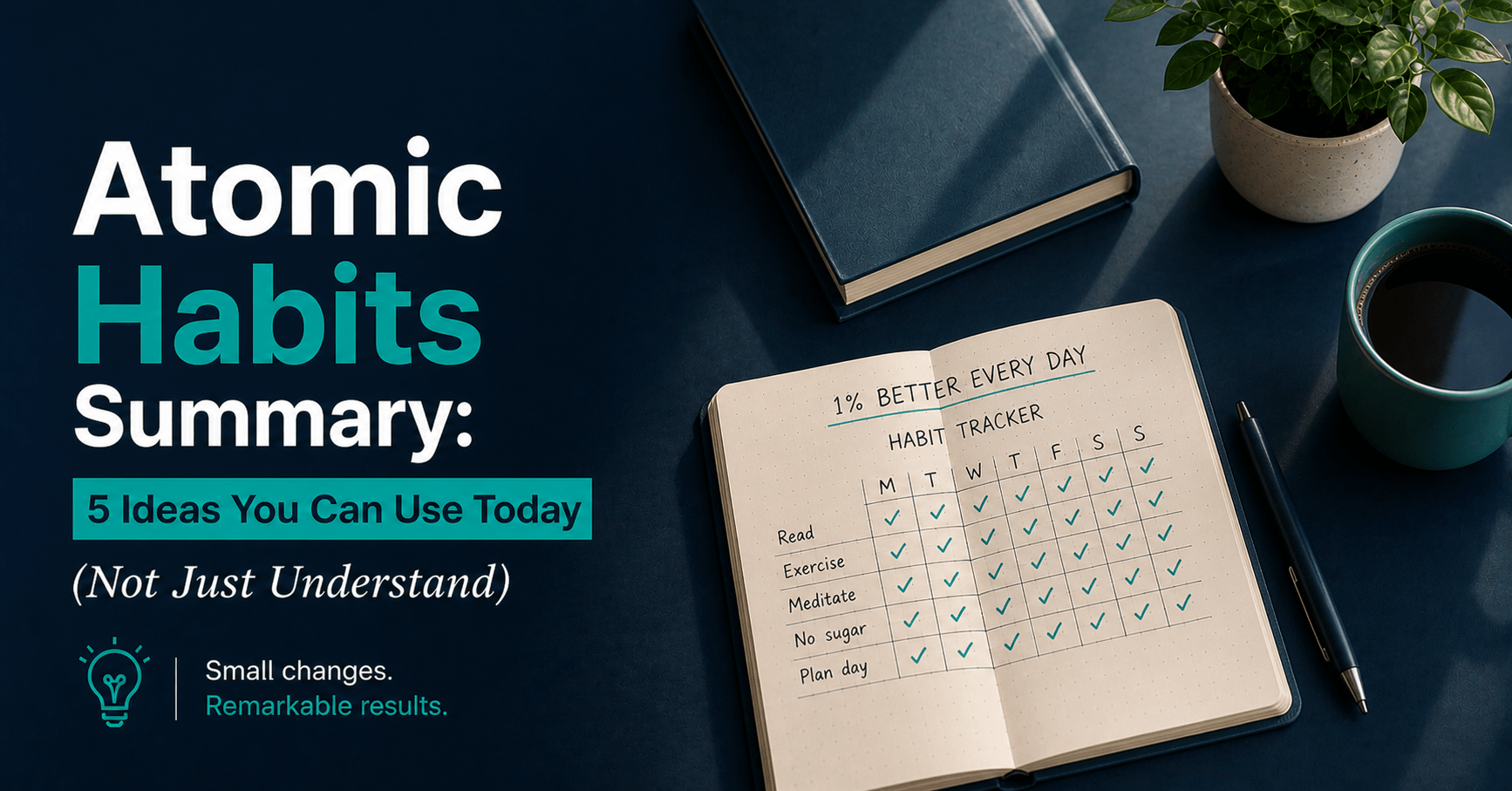
Atomic Habits Summary: 5 Ideas You Can Use Today (Not Just Understand)
Table of Contents
Atomic Habits by James Clear has sold more than 25 million copies. It spends years on bestseller lists. Practically everyone in productivity circles has read it, referenced it, or at least mentioned it in a meeting.
And most of them changed very little after finishing it.
That’s not a knock on the book — it’s one of the most practically useful things written about behaviour change in the last decade. The problem is the gap between understanding an idea and applying it. Reading about habit loops is easy. Redesigning your environment at 10PM on a Tuesday when you’re tired and just want to watch something is a different matter entirely.
This guide doesn’t recap the book chapter by chapter. It pulls out the five ideas that actually produce behaviour change when applied — not just understood — and gives you the specific implementation for each one. You can put all five to work today.
Why Most People Read Atomic Habits and Change Nothing
The book is structured as a framework: understand the system, apply the laws, build the habits. The problem is that most readers engage with it at the level of the framework and stop there. They understand that habits follow a cue-craving-response-reward loop. They agree that small changes compound. They nod along at the identity-based habits chapter.
Then they put the book down and continue with the same routines they had before.
This happens for one reason: understanding a principle and having a specific implementation for that principle in your actual life are two entirely different things. The book gives you the principles clearly. This guide gives you the implementations — concrete, specific, ready to use.
The core principle of everything that follows: behaviour change is a design problem, not a motivation problem. You don’t need more willpower. You need a better-designed environment, a clearer identity, and a smaller starting point than you think is necessary.
What You Need Before You Start
No tools required. A notebook and a pen for the identity and implementation intention exercises. Five minutes of honest thinking per idea.
That’s it. Every idea in this guide is free to implement today.
The 5 Ideas: Applied
Idea 1 — Identity First, Goals Second (15 minutes to implement)
Most habit-building starts with an outcome: lose weight, read more, exercise regularly. Clear’s central reframe is that outcome-based thinking is structurally weaker than identity-based thinking — because outcomes are external targets that disappear once reached, while identity is something you reinforce with every repetition.
The difference in practice:
- Outcome-based: “I want to run a 5K.”
- Identity-based: “I am someone who runs.”
Every time you put on your shoes and run — even for five minutes — you cast a vote for the identity “I am a runner.” Over dozens of repetitions, that identity becomes genuinely descriptive rather than aspirational. And identity-based action is self-reinforcing in a way that goal-based action isn’t: you don’t stop being a runner when you cross a finish line.
How to apply it today:
Write down the identity statement for the habit you’re trying to build. Not the goal. The identity.
Not “I want to read more.” → “I am someone who reads every day.” Not “I want to eat better.” → “I am someone who takes care of what I put in my body.” Not “I want to be more productive.” → “I am someone who does focused work before checking email.”
Then ask: what is the smallest action I can take today that is consistent with that identity? Do that. One vote for the identity. That’s the start.
What you end up with: A written identity statement and one completed action that reinforces it — the first repetition in a pattern that becomes self-sustaining over time.
Time vs doing nothing: Continuing to set outcome-based goals without an identity anchor produces the familiar pattern: motivation, progress, plateau, abandonment, restart. Identity-based framing breaks that cycle at the root.
Idea 2 — The 1% Rule: Make It Smaller Than Feels Necessary (10 minutes to implement)
Clear’s compounding argument is mathematically clean: getting 1% better every day for a year produces a result 37 times better than the starting point. The same logic in reverse — getting 1% worse every day — compounds to near zero.
Most people understand the maths. They then set habits that are far more ambitious than 1% improvement and wonder why they don’t stick.
The 1% principle is not about setting small goals. It’s about starting with an action so small that failure to do it would be genuinely embarrassing. The value of the small start is not the output of the first few sessions — it’s the unbroken repetition that encodes the behaviour as automatic.
Clear uses the example of “just show up.” Want to exercise? Commit to putting on your gym clothes and driving to the gym. That’s it. Commit to nothing more. Most of the time, once you’re there, you train. The showing-up behaviour becomes automatic long before the training does — and that’s the point.
How to apply it today:
Take the habit you want to build. Reduce it to a version so small that you can do it in two minutes.
- Reading habit → Read one page.
- Meditation habit → Sit quietly and breathe for two minutes.
- Writing habit → Open the document and write one sentence.
- Exercise habit → Do five minutes of movement.
Write that two-minute version down. That is your starting habit. Not a stepping stone to the real habit — the actual habit, for the first two to four weeks. Repetition first. Scale second.
What you end up with: A defined two-minute version of your target habit that removes the activation energy barrier entirely — the most common point where new habits fail.
Time vs doing nothing: An ambitious habit started and abandoned in three weeks produces zero long-term change. A two-minute habit maintained for 60 days produces a genuine automatic behaviour that can then be scaled. Smaller start, larger result.
Idea 3 — The Four Laws: Design Your Habit, Don’t Rely on Willpower (20 minutes to implement)
Clear’s four laws of behaviour change are the most practically dense part of the book. Each law maps to a stage in the habit loop — cue, craving, response, reward — and gives you a specific design lever.
To build a good habit: make it obvious, make it attractive, make it easy, make it satisfying. To break a bad habit: make it invisible, make it unattractive, make it hard, make it unsatisfying.
The key word in both directions is design. You’re not fighting your impulses. You’re restructuring the environment so the impulses point in the right direction.
Make it obvious: Put the cue for the habit somewhere you’ll see it. Running shoes by the door. Book on the pillow. Vitamins next to the kettle. Workout clothes laid out the night before. If you have to look for the starting point of your habit, it’s already harder than it needs to be.
Make it attractive: Pair the habit with something you genuinely enjoy. Only listen to a specific podcast during your walk. Only drink a particular coffee blend on mornings when you journal. The enjoyment becomes associated with the habit cue over time, which increases the pull toward starting.
Make it easy: Reduce the number of steps between you and the habit. Pre-prepare everything that can be pre-prepared. Set up your work environment the night before. Have the app open, the document ready, the mat already rolled out. Every additional step is a potential exit ramp.
Make it satisfying: Create an immediate reward for completing the habit. Mark an X on a paper tracker — the visual streak is a reward. Log a completed session. Treat yourself to something you enjoy immediately after. The brain reinforces behaviours that produce immediate positive signals, not just long-term outcomes.
How to apply it today:
Run a four-law audit on your target habit. Write down one specific change for each law:
- Obvious: What will I place or change to make the cue visible?
- Attractive: What will I pair this habit with to make starting feel good?
- Easy: What can I prepare in advance to reduce friction?
- Satisfying: What immediate reward will I give myself after completing it?
Four answers. Implement at least two of them before tonight.
What you end up with: A habit environment that works with your psychology rather than against it — one where the default path leads toward the behaviour you want.
Time vs doing nothing: Willpower-based habit attempts fail when motivation drops — which it does reliably, usually by week three. A four-law designed habit has structural support that doesn’t depend on motivation. Same habit, fundamentally different durability.
Idea 4 — Habit Stacking: Attach New Habits to Existing Ones (5 minutes to implement)
Habit stacking is Clear’s name for attaching a new behaviour to an existing automatic one. The formula is: After I [existing habit], I will [new habit].
The mechanism is the same as the anchor system described in the habit-building guide — the existing behaviour provides a reliable context cue that triggers the new one, without requiring a separate decision to start.
What makes this worth implementing specifically is the precision it demands. Vague habit stacking (“I’ll meditate in the morning”) is weaker than precise habit stacking (“After I pour my first coffee, I will sit down and set a five-minute timer”). The more specific the existing behaviour, the more reliable the trigger.
Examples:
- After I sit down at my desk, I will write tomorrow’s top priority before opening email.
- After I brush my teeth at night, I will read for 10 minutes before putting my phone down.
- After I close my laptop at the end of the workday, I will write three things that went well today.
- After I put on my shoes in the morning, I will take a 10-minute walk before coming back inside.
How to apply it today:
Identify the habit you want to build. Find the existing behaviour that most naturally precedes the time and place where you want the new habit to happen. Write the stack in the exact format: “After I [existing habit], I will [new habit].”
Put it somewhere you’ll see it — a sticky note on your desk, a note on your phone, the first page of your journal. Read it once a day for the first two weeks.
What you end up with: A precise habit trigger that fires automatically without requiring a separate decision — the single most effective way to reduce the activation energy of a new behaviour.
Time vs doing nothing: A habit with a clear stack fires reliably in its designated context. A habit without a stack requires a fresh decision each time, which means it competes with every other thing demanding attention in the same moment.
Idea 5 — The Plateau of Latent Potential: Expect Nothing to Happen for Weeks (2 minutes to understand, ongoing to apply)
This is the idea most people need most — and the one that gets the least attention.
Clear describes the gap between starting a new habit and seeing results as the “plateau of latent potential.” Change is happening beneath the surface long before it becomes visible. The habit is encoding, the neural pathway is forming, the environment is being restructured — none of which is visible in the first three to six weeks.
The problem is that humans expect linear progress. Day 10 should produce more visible results than day one. When it doesn’t — when week three looks identical to week one in terms of outcomes — the interpretation is usually that the habit isn’t working. So the habit gets abandoned.
The reality: nothing visible may happen for weeks. That’s normal. The work is still happening.
Clear uses the metaphor of ice at 25°F. You raise the temperature by one degree. Nothing happens. Another degree — still nothing. Then 32°F, and the ice melts. Every degree before 32 mattered. None of them were visible.
The six-week period — roughly the point where research shows habit automaticity begins to develop — is the equivalent of 31°F. You’re one degree from the threshold. This is not the moment to stop.
How to apply it today:
Acknowledge that the first six weeks of any habit are the plateau period. Write that down somewhere visible. When week three arrives and nothing feels different, that note is the reference point — not a reason to stop, but confirmation that you’re exactly where you should be.
Set a specific six-week review date. Don’t evaluate whether the habit is working before that date. The evaluation period starts at week six, not week two.
What you end up with: A realistic timeline expectation that prevents the most common cause of habit abandonment — quitting during the plateau because the plateau looks like failure.
Time vs doing nothing: Most habits fail between weeks two and four, precisely during the plateau period. A single mindset reframe — expecting the plateau rather than being surprised by it — extends persistence through the most critical phase of habit formation.
The Full Implementation Breakdown
| Idea | What it fixes | Time to implement | Do it |
|---|---|---|---|
| Identity first | Goal-based habits collapse when motivation drops | 15 minutes | Write your identity statement |
| 1% rule | Ambition kills habits before they form | 10 minutes | Define your two-minute version |
| Four laws | Willpower-based habits fail by week three | 20 minutes | Run the four-law audit |
| Habit stacking | New habits require a fresh decision every time | 5 minutes | Write your “After I… I will…” stack |
| Plateau of latent potential | Quitting during normal plateau mistaken for failure | 2 minutes | Set your six-week review date |
| Total | ~52 minutes | All five implemented today |
What These Ideas Cannot Do
They cannot replace the repetition. Every idea in this guide reduces the friction of starting and sustaining a habit. None of them replace the actual doing. The neural pathway is built through repetition in consistent contexts — not through identity statements or well-designed environments alone. The design work makes the repetition more likely. The repetition is still required.
They cannot compress the timeline. A 2025 University of South Australia systematic review found that habits take a median of 59 to 66 days to begin forming automatically, with a range of four days to 335 days. Applying all five ideas narrows the range by removing the most common failure points. It doesn’t move the ceiling.
They cannot fix ambivalence. If you genuinely don’t want the habit — if it’s something you think you should do rather than something connected to an identity or outcome you actually care about — no amount of design will sustain it indefinitely. The identity exercise in Idea 1 is partly diagnostic: if you can’t write a genuine identity statement for the habit, examine whether it’s the right habit before investing in building it.
They cannot work if only understood. This is the core problem stated at the start. Understanding that identity-based habits are stronger than outcome-based habits produces zero change. Writing the identity statement and doing the first identity-confirming action does. Implementation is the work.
Tips to Get More From These Ideas
Start with Idea 4 (habit stacking) if you don’t know where to begin. It’s the fastest to implement — five minutes — and produces immediate structural support for any habit. The other ideas can be layered on afterward.
Run the four-law audit on a habit that has already failed. Applying the four laws to a past habit failure is more instructive than applying it to a fresh one, because you can trace exactly which law was missing. Most failed habits break on “make it easy” — the environment wasn’t set up to reduce friction.
Write the identity statement in first person, present tense. “I am someone who exercises” is stronger than “I want to become someone who exercises” or “I will be someone who exercises.” The present tense signals to the brain that the identity is current, not aspirational.
Use the plateau expectation as a commitment device. Tell someone else — a friend, a partner, a colleague — that you’re expecting to see no visible results for six weeks and you’re committing to continuing anyway. The social commitment adds an external accountability layer on top of the internal one.
Review all five ideas at the six-week mark. Which ones are working? Which ones were implemented but haven’t held? The six-week review is the right time to adjust the implementation of any idea that isn’t producing the structural support it should.
Frequently Asked Questions
Is Atomic Habits worth reading if I’ve read this summary?
Yes — and for a specific reason. The summary here covers the five most actionable ideas and their implementation. The book provides the underlying research, extended case studies, and the full framework connecting all the ideas. Understanding the mechanism behind each idea makes the implementation more durable. The book is worth the time, and reading it after implementing these five ideas will make it more useful than reading it cold.
What is the most important idea in Atomic Habits?
The identity-based habits concept is the most structurally important — it’s the foundation the other ideas rest on. But the most immediately impactful for most people is the 1% rule applied as a starting size. The majority of habit failures trace back to starting too large. Reducing the starting habit to a two-minute version is the single change that most immediately prevents the most common failure mode.
How is Atomic Habits different from other habit books?
Most habit books focus on motivation and goal-setting — the “why” of behaviour change. Clear’s book focuses almost entirely on systems and environment design — the “how.” The four laws framework is the most practical implementation guide in the category, and the identity-based framing is a more durable foundation than goal-based approaches. The closest comparison is BJ Fogg’s Tiny Habits, which shares the small-start philosophy but takes a different route through motivation design.
Can I apply Atomic Habits ideas to breaking bad habits?
Yes — by inverting the four laws. To break a bad habit: make the cue invisible (remove the trigger from your environment), make the craving unattractive (associate it with a negative outcome rather than a positive one), make the response difficult (add friction between you and the behaviour), and make the reward unsatisfying (remove or replace the reward). The same design logic applies in reverse.
How do I know if my habit is becoming automatic?
Two signals: you start the habit without consciously deciding to start it most days, and skipping it produces a mild but genuine sense of discomfort rather than relief. Both typically begin appearing between weeks six and twelve for simple habits. If you’re still requiring full conscious effort to start the habit at week eight, the anchor (habit stack) or environment design (four laws) probably needs adjustment — not the habit itself.
Does Atomic Habits work for complex multi-step habits?
Better for simple, single-action habits than for multi-step sequences. Complex routines — a full morning routine, a detailed creative process — are better approached as a collection of individual stacked habits rather than a single complex habit. Build each component separately, anchor each one to the previous, and let the sequence form gradually. Trying to encode a six-step routine as a single habit is harder than encoding six single-step habits chained together.
Final Thoughts
Atomic Habits works when applied. That statement is true of every productivity book — but it’s especially true here, because the gap between understanding Clear’s framework and implementing it is a gap of about 52 minutes of concrete work.
The five ideas in this guide, applied today:
- Identity first — write the identity statement, do one identity-confirming action
- 1% rule — define the two-minute version of your target habit
- Four laws — run the audit, implement at least two changes before tonight
- Habit stacking — write the “After I… I will…” statement, put it somewhere visible
- Plateau of latent potential — set your six-week review date, expect nothing to change before it
Fifty-two minutes. One habit. Applied properly, the compounding starts from day one — even if you can’t see it yet.
The book that earns a permanent spot on your shelf is the one that changes your daily behaviour. These five ideas are the reason this one does.
Real-life DLC for your daily living.
Have you read Atomic Habits? Which idea made the biggest difference for you? Drop it in the comments.
Continue reading: