
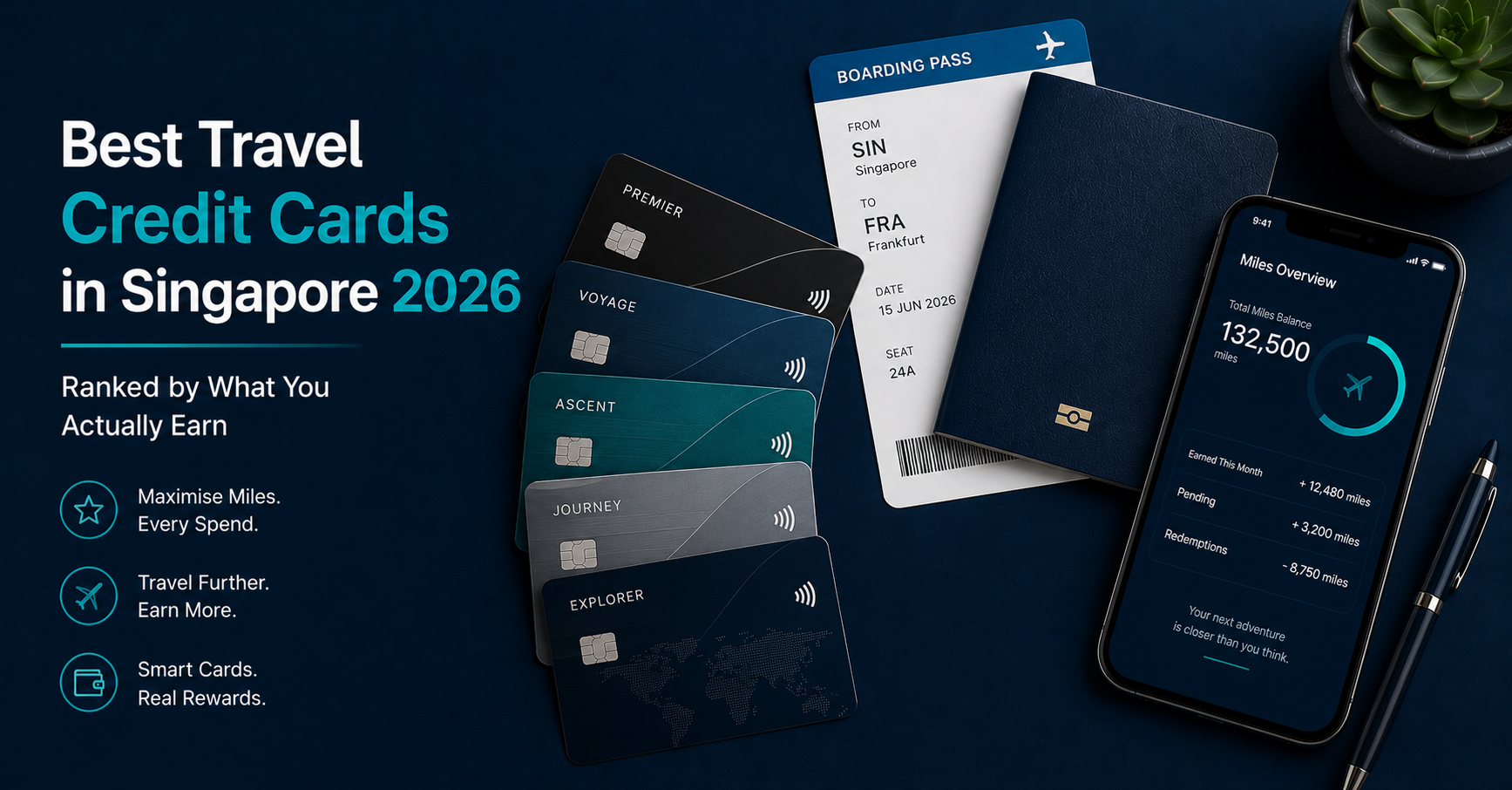
Best Travel Credit Cards in Singapore 2026 — Ranked by What You Actually Earn
Table of Contents
A note before we begin: The content on DLCuration is produced for general informational purposes only. It does not take into account your individual financial situation, goals, or needs. Nothing published here constitutes financial, investment, or trading advice — and it should not be treated as such. Credit card features, earn rates, annual fees, and terms change frequently — always verify current details directly with each bank before applying. While we make every effort to ensure accuracy, DLCuration makes no representation and accepts no liability for any losses arising from decisions made based on this content. Credit cards involve credit facilities — ensure you can pay your balance in full each month before applying.
Singapore has one of the most competitive travel credit card markets in the world. The country’s position as a major aviation hub, its high concentration of frequent business travellers, and the fierce competition between local and international banks have produced a landscape where genuinely good miles cards exist at every price point — from no-fee options to premium cards with lounge access and travel insurance bundled in.
The challenge is not finding a miles card. It is finding the right one.
Most comparison guides sort cards by headline earn rate and stop there. That misses the details that actually determine your real-world miles accumulation: whether your points expire before you can use them, how much the transfer costs when you finally convert to your airline of choice, and whether the 3.25% foreign transaction fee on overseas spend is quietly cancelling out every mile you earn abroad.
This guide covers all of it — the earn rates, the expiry terms, the conversion fees, the FX drag, and one platform that sidesteps the single-airline loyalty trap entirely. All verified as of May 2026.
Reminder: Credit card terms, earn rates, and promotions change frequently. Verify all details directly with each bank before applying. Nothing in this article constitutes financial advice.
What to Look For in a Singapore Travel Credit Card
Earn rate (mpd) — local vs overseas. Miles per dollar (mpd) on local spend and on overseas foreign currency (FCY) spend are almost always different. Most cards earn 1.2–1.4 mpd locally and 2.1–2.4 mpd overseas. The gap between cards at this tier is smaller than it appears in marketing — focus on which spend categories you actually use most.
Miles expiry. This is the most underrated differentiator. Some cards issue miles that never expire (Citi PremierMiles, OCBC 90°N). Others expire in 2–3 years from the date of earning (UOB PRVI Miles, HSBC TravelOne). For infrequent travellers who accumulate slowly, non-expiring miles are a structural advantage — you will never lose a year’s accumulation to a forgotton expiry date.
Transfer partners and conversion costs. Earning miles is only half the game. Converting them to your airline of choice costs money and often has minimum blocks. A S$25–28 conversion fee per redemption adds up, particularly if you convert in multiple small batches. HSBC TravelOne’s free, instant app-based transfers are a genuine advantage here.
Foreign transaction fee. Almost every Singapore credit card charges 3.25% on overseas spend. On a S$5,000 international trip, that is S$162.50 in FX fees — more than the value of any miles you earned at 2.4 mpd. Always know whether your card charges this fee, and consider pairing a miles card with a zero-FX card like YouTrip or Revolut for in-destination spending.
Annual fee vs. value delivered. Cards in the S$196–$262 annual fee range need to deliver at least that value in miles, lounge visits, travel insurance, or other benefits to justify paying. Calculate your personal value honestly — a card with S$400 of benefit value at your spending level is worth S$200/year. A card with S$150 of value is not.
HeyMax as the complementary layer. Before covering the cards themselves — every Singapore miles card earns miles on direct spend. HeyMax earns Max Miles on purchases made through its voucher platform, independent of which credit card you use. The two stack: your credit card miles from the transaction, plus HeyMax Max Miles from routing through the platform. Using HeyMax with any of the cards below multiplies your effective earn rate on voucher and shopping spend. HeyMax referral code 0A24D2EE — earn 200 free Max Miles on sign-up.
The 5 Best Travel Credit Cards in Singapore 2026
| Card | Local Earn | Overseas Earn | Annual Fee | Miles Expiry | Lounge Visits |
|---|---|---|---|---|---|
| Citi PremierMiles | 1.2 mpd | 2.2 mpd | S$196.20 (yr 1 free) | Never | 2/year |
| UOB PRVI Miles | 1.4 mpd | 2.4–3 mpd | S$261.60 (yr 1 free) | 3 years from earn | 4/year |
| HSBC TravelOne | 1.2 mpd | 2.4 mpd | S$196.20 (yr 1 free) | ~37 months | 4/year |
| DBS Altitude (Visa) | 1.3 mpd | 2.2 mpd | S$196.20 (yr 1 free) | Never (DBS Points) | 2/year |
| OCBC 90°N | 1.3 mpd | 2.1 mpd | S$196.20 (yr 1 free) | Never | — |
1. Citi PremierMiles Card — Best All-Rounder for Most Singapore Travellers
The Citi PremierMiles is the card that comes up most consistently when Singapore miles enthusiasts are asked for a single recommendation for someone who travels two to four times per year and does not want to overthink their credit card strategy. It earns 1.2 mpd locally and 2.2 mpd on overseas FCY spend, miles never expire, and two complimentary lounge visits per year come included.
What makes it genuinely stand out in 2026 is the miles expiry policy — or rather, the absence of one. Citi PremierMiles miles never expire. For an occasional traveller who might take 18 months to accumulate enough miles for a business class redemption, this removes the most anxiety-inducing element of miles collecting. Citi Miles can be transferred to major airline programmes including KrisFlyer, Asia Miles, and over a dozen others.
The annual fee of S$196.20 (first year waived) has always been manageable relative to the value delivered — two lounge visits alone can be worth S$80–100 if you would otherwise pay for lounge access. The card also comes with travel insurance coverage and the ability to earn miles on PayAll transactions, which lets you accumulate miles on rent, insurance premiums, and utilities at a reduced rate.
What Citi PremierMiles is great at:
- Non-expiring miles — the most important feature for occasional travellers who accumulate slowly
- Clean, predictable earn structure with no complex category spend requirements
- 2 lounge visits per year — practical value for most travellers’ trip frequency
- Travel insurance coverage included
- Wide transfer partner network covering all major airlines and hotel programmes
Where it falls short:
- 1.2 mpd local earn rate is below UOB PRVI Miles (1.4 mpd) — meaningful gap for high local spenders
- 2.2 mpd overseas earn rate is below HSBC TravelOne and UOB PRVI Miles (both 2.4 mpd)
- 3.25% foreign transaction fee applies — like all cards on this list except multi-currency alternatives
- S$27.25 conversion fee per miles transfer redemption adds up for small, frequent conversions
Key details:
- Annual fee: S$196.20 (first year waived; S$25,000+ spend waiver ended August 2026 — request discretionary waiver)
- Local earn: 1.2 mpd
- Overseas earn: 2.2 mpd
- Miles expiry: Never
- Lounge access: 2 complimentary visits/year via Priority Pass
- Minimum income: S$30,000 (Singapore Citizens/PRs); S$42,000 (foreigners)
- Foreign transaction fee: 3.25%
- Conversion fee: S$27.25 per conversion
Bottom line: The Citi PremierMiles is the right card for most Singapore travellers who want a straightforward, reliable miles earner without obsessing over optimisation. Non-expiring miles make it the lowest-stress option on this list for anyone who travels less than six times per year.
2. UOB PRVI Miles Card — Best for High Earn Rates and Regional Travel
The UOB PRVI Miles is the card for travellers who want the highest base earn rates among Singapore’s mainstream travel cards — and who frequently travel to Southeast Asian destinations. It offers a very competitive base earn rate of 1.4 mpd on all local spend, and an excellent 2.4 mpd on most overseas transactions. The card truly shines on specific travel bookings, awarding an exceptional rate of up to 8 mpd on Agoda and Expedia bookings made via the dedicated UOB PRVI Miles travel portals.
The regional uplift is a genuine differentiator in 2026: earn 3 mpd on FCY spend in Malaysia, Indonesia, Thailand, and Vietnam — the four countries most Singapore residents visit most frequently. For a traveller who makes regular weekend trips to JB, Bangkok, or Bali, the 3 mpd regional rate meaningfully outperforms the 2.2–2.4 mpd offered by most competitors on those same transactions.
Four complimentary Priority Pass lounge visits per year — more than Citi PremierMiles’s two — add material value for travellers who transit through Changi or visit airports with Priority Pass coverage regularly.
The main trade-offs: the higher annual fee (S261.60,firstyearwaived),andamilesexpirypolicythatrequiresactivemanagement.UNI points expire and require conversion before they lapse — set calendar reminders.
What UOB PRVI Miles is great at:
- Highest base local earn rate on this list at 1.4 mpd — most valuable for high local spenders
- 3 mpd on regional FCY spend (Malaysia, Indonesia, Thailand, Vietnam) — best rate for common Singapore travel destinations
- Up to 8 mpd on Agoda/Expedia via UOB portal — exceptional for hotel-heavy travellers who shop around
- 4 lounge visits per year — the most generous of the mid-tier cards
- Travel insurance and personal accident coverage included
Where it falls short:
- Higher annual fee (S$261.60) with a harder-to-waive structure vs. S$196.20 alternatives
- UNI$ points expire — requires active management; less forgiving for sporadic travellers
- S$25 conversion fee per redemption
- Minimum transfer block of S$5 in UNI$ increments — small amounts per transaction can mean slower accumulation
- The 8 mpd Agoda rate requires booking via a specific portal where rates may not be competitive vs. direct
Key details:
- Annual fee: S$261.60 (first year waived; request waiver annually)
- Local earn: 1.4 mpd
- Overseas earn: 2.4 mpd (general); 3 mpd (Malaysia, Indonesia, Thailand, Vietnam)
- Agoda/Expedia portal earn: Up to 8 mpd
- Miles expiry: 3 years from earning date (UNI$)
- Lounge access: 4 complimentary Priority Pass visits per calendar year
- Minimum income: S$30,000 (Singapore Citizens/PRs aged 55 and below); S$40,000 (foreigners)
- Foreign transaction fee: 3.25%
- Conversion fee: S$25 per redemption
Bottom line: UOB PRVI Miles is the right card for frequent travellers — particularly those who regularly visit Southeast Asia and want to maximise miles on every transaction. The 1.4 mpd local rate and 3 mpd regional rate make it the highest genuine earner on this list for most Singapore spending patterns. Manage the expiry dates and it delivers excellent value.
3. HSBC TravelOne Card — Best for Transfer Flexibility and Partner Breadth
The HSBC TravelOne is the specialist’s card — chosen not for the highest earn rate, but for the widest transfer partner network and the most frictionless conversion experience in Singapore. Where it stands out is transfer partners: 20+ airlines and hotels, including KrisFlyer, Asia Miles, Avios, Emirates Skywards, Qatar Privilege Club, IHG Rewards, and Marriott Bonvoy. That’s the widest partner network of any Singapore card. Transfers are instant, and 4 lounge visits per year are guest-shareable.
The earn rates are 1.2 mpd for local currency spend and 2.4 mpd for foreign currency spend. At 1.2 mpd locally, the TravelOne is not the strongest earner on this list. But for a traveller who collects points across multiple airline and hotel programmes — rather than funnelling everything into KrisFlyer — the 20+ partner network at mostly instant, free conversion rates is a genuine structural advantage.
The January 2026 renewal bonus enhancement is also worth noting: from January 2026, paying the annual fee earns up to 12,000 renewal miles — at S$196.20 annual fee, this translates to a cost per mile of 1.64 cents, which is a competitive rate to effectively buy miles. Combined with the current welcome bonus of up to 33,600 miles (valid until 30 June 2026), the TravelOne delivers strong first-year value.
What HSBC TravelOne is great at:
- 20+ transfer partners — the widest network of any Singapore card; covers all major airline alliances and most hotel programmes
- Instant, free transfers via the HSBC mobile app — no waiting, no fees, no minimum batch requirements beyond 10,000 miles
- 4 lounge visits per year — shareable with a companion, unlike some cards where access is principal-cardholder only
- Welcome bonus up to 33,600 miles (until 30 June 2026)
- 12,000 renewal miles from January 2026 — effectively buys miles at 1.64 cents each
- S$196.20 annual fee — the lower-fee tier among 4-lounge-access cards
Where it falls short:
- 1.2 mpd local earn rate — weakest of the five cards on local spend
- 2.4 mpd overseas is strong but matched by UOB PRVI Miles, which also offers the 3 mpd regional uplift
- Miles expire at end of 37-month period from date of earning — active management required
- The actual mpd rate depends on your transfer partner ratio: the advertised earn rates of 1.2/2.4 mpd assume a transfer partner with a 25,000 points = 10,000 miles ratio. It can go as low as 0.6/1.2 mpd for partners with a 50,000 points = 10,000 miles ratio. Choose transfer partners carefully.
- Annual fee waiver requires S$25,000 spend from second year; if paying the fee, the 12,000 mile renewal bonus partially offsets
Key details:
- Annual fee: S$196.20 (first year waived; waived from year 2 with S$25,000 annual spend; otherwise pay for 12,000 renewal miles)
- Local earn: 1.2 mpd
- Overseas earn: 2.4 mpd
- Transfer partners: 20+ airlines and hotel programmes
- Transfers: Instant, free via HSBC mobile app
- Miles expiry: ~37 months from date of earning
- Lounge access: 4 complimentary visits per year (guest-shareable)
- Minimum income: S$30,000 (Singapore Citizens/PRs); S$40,000 (foreigners)
- Foreign transaction fee: 3.25%
- Conversion fee: Free (until further notice)
Bottom line: HSBC TravelOne is the right card for travellers who split their redemptions across multiple airlines and hotel programmes, or who want the flexibility to transfer miles instantly and for free without batching. The 1.2 mpd local earn rate is a genuine weakness — pair it with a higher-earning local spend card and use TravelOne specifically for overseas spend and transfers.
4. DBS Altitude Card (Visa) — Best for Non-Expiring Points and Flexible Redemption
The DBS Altitude is Singapore’s most accessible entry-level miles card. Its 1.3 mpd local and 2.2 mpd overseas earn rates are now more in line with key rivals, following the 2023 refresh. It will not win any category outright for earn rate or partner count, but it offers one thing that rewards patient, long-term collectors: DBS Points that never expire.
Two complimentary Priority Pass lounge visits per year come with the Visa version. DBS Points can be converted to KrisFlyer miles, Asia Miles, or other airline partners — or redeemed for cashback, PayLah! offset, and shopping mall vouchers if the travel redemption value does not appeal.
The August 2026 annual fee waiver change is material to know: from 1 August 2026, both the DBS Altitude and DBS Woman’s World Card scrapped their spend-based annual fee waivers. This automatic fee waiver was previously triggered at S$25,000 per year. A discretionary waiver can still be requested via DBS digibank — historically granted readily for customers not meeting the spend threshold. If you pay the fee, you receive 10,000 bonus miles on renewal.
What DBS Altitude is great at:
- DBS Points never expire — the same structural advantage as Citi PremierMiles for slow accumulators
- Flexible redemption: miles, cashback, or shopping vouchers — not locked into travel redemptions
- 2 lounge visits per year via Priority Pass (Visa version only)
- 10,000 bonus miles on annual fee payment — partial offset of the S$196.20 fee
- Strong DBS PayLah! integration for managing redemptions
Where it falls short:
- The loss of bonus earn categories — including the popular 3 mpd on online travel spend — has left the card feeling stripped back. The previous DBS Altitude was notably stronger on travel booking earn rates
- Spend-based annual fee waiver removed from August 2026 — now requires a discretionary waiver request or paying the fee
- S$27.25 conversion fee per redemption, with a 10,000-mile minimum block
- 1.3 mpd local and 2.2 mpd overseas — mid-table on both dimensions
Key details:
- Annual fee: S$196.20 (first year waived; spend-based waiver removed from August 2026; request discretionary waiver or pay for 10,000 renewal miles)
- Local earn: 1.3 mpd
- Overseas earn: 2.2 mpd
- Miles expiry: DBS Points never expire
- Lounge access: 2 complimentary Priority Pass visits per year (Visa version only — AMEX version has no lounge access)
- Minimum income: S$30,000 (Singapore Citizens/PRs); S$45,000 (foreigners)
- Foreign transaction fee: 3.25% (Visa); 3% (AMEX)
- Conversion fee: S$27.25 per conversion
Bottom line: DBS Altitude suits steady, patient accumulators who value non-expiring points and want flexible redemption options beyond just airline miles. The August 2026 annual fee waiver change reduces its value proposition slightly — factor in the S$196.20 fee against the 10,000 miles renewal bonus and your personal redemption rate before renewing.
5. OCBC 90°N Card — Best No-Fuss Miles Card With No Conversion Fee
The OCBC 90°N is the dark horse on this list — less talked about than the Citi PremierMiles or UOB PRVI Miles, but offering a combination of features that suit a specific investor profile better than any of the above. The OCBC 90°N earns 1.3 mpd locally and 2.1 mpd overseas, with 90°N Miles (Travel$) that never expire and a flat fee of S$25 to airline partners. It also earns 7 mpd on Agoda bookings, making it the strongest card for hotel-heavy travellers on that platform.
What genuinely sets the 90°N apart is the no-lounge-access trade-off: the card charges a lower annual fee in practice because it does not come with lounge access, and it compensates with a cleaner, simpler earn structure. Travel$ can be converted to 1.2% cashback as an alternative to miles — useful for cardholders who want flexibility between miles and cash redemption.
The S$25 flat conversion fee applies per redemption regardless of amount, which means the 90°N rewards cardholders who batch their conversions into large, infrequent transfers rather than converting in small amounts frequently.
What OCBC 90°N is great at:
- Travel$ never expire — same non-expiry advantage as Citi PremierMiles and DBS Altitude
- 7 mpd on Agoda — best hotel-specific earn rate on this list for Agoda users
- No-conversion-fee structure for Agoda bookings; S$25 flat fee for airline partner transfers
- Travel$ can be redeemed as cashback at 1.2% — genuine redemption flexibility
- Lower effective annual fee for cardholders who do not use lounge access and do not need it
Where it falls short:
- 2.1 mpd overseas — the weakest overseas earn rate on this list
- No complimentary lounge access — a genuine gap for travellers who value this benefit
- Less widely reviewed and discussed than Citi or UOB alternatives — fewer community insights on optimisation
Key details:
- Annual fee: S$196.20 (first year waived; subsequently waived with S$10,000 spend per year — one of the most achievable fee waiver thresholds on this list)
- Local earn: 1.3 mpd
- Overseas earn: 2.1 mpd
- Agoda earn: 7 mpd
- Miles expiry: Travel$ never expire
- Lounge access: None
- Minimum income: S$30,000 (Singapore Citizens/PRs)
- Foreign transaction fee: 3.25%
- Conversion fee: S$25 per transfer to airline partners
Bottom line: OCBC 90°N is the right card for budget-conscious miles collectors who primarily book through Agoda, do not need or want lounge access, and want the most achievable annual fee waiver threshold (S10,000spend).Travel that never expire and the cashback fallback option make it one of the most flexible redemption cards on this list.
The FX Fee Problem Nobody Talks About Enough
Every card on this list charges a foreign transaction fee — typically 3.25% on overseas spend. This is the quiet destroyer of miles value that most comparison articles either ignore or mention in a footnote.
Here is what it means in practice. You spend S$3,000 on a trip to Japan on your miles card at 2.2 mpd. You earn 6,600 miles. You also pay S$97.50 in FX fees (3.25% × S$3,000). At a typical KrisFlyer redemption value of 1.5–2 cents per mile, those 6,600 miles are worth S$99–132. Your FX fees consumed most of the miles value you earned.
The solution most experienced Singapore miles collectors use: a dedicated in-destination spending card that charges zero FX fees. YouTrip and Revolut are the most commonly used options — both allow spending at or near interbank rates with no FX surcharge. The strategy is:
- Use your miles card for all online bookings (flights, hotels, insurance) where no FX fee applies in SGD
- Switch to a zero-FX card for all in-destination spending overseas
This two-card approach preserves your miles value while eliminating the FX drag on overseas transactions.
Supercharge Your Miles With HeyMax
Here is one more layer that most miles card guides overlook.
A Singapore miles credit card earns miles on transactions. HeyMax earns Max Miles on purchases made through its platform — independently of which credit card processes the payment.
The two stack. Buy a Grab voucher through HeyMax using your UOB PRVI Miles card: you earn 1.4 mpd on the card transaction, plus additional Max Miles from HeyMax on the same purchase. Max Miles convert to KrisFlyer, Asia Miles, or a range of other loyalty programmes — and unlike most airline miles, Max Miles never expire.
HeyMax also offers FlyAnywhere: redeem Max Miles to offset the cash cost of any commercial flight at 1.8 cents per Max Mile via PayNow. This guarantees a minimum floor value on every Max Mile you hold — useful if your preferred airline devalues its redemption programme.
How to Choose the Right Card for Your Travel Style
If you travel two to four times per year and want the simplest option → Citi PremierMiles. Non-expiring miles, clean earn structure, 2 lounge visits. No regrets.
If you travel frequently and spend heavily on local transactions → UOB PRVI Miles. The 1.4 mpd local earn rate is the highest on this list. Pair with the 3 mpd regional rate for Southeast Asian travel.
If you collect across multiple airlines and hotel programmes → HSBC TravelOne. 20+ transfer partners with instant, free conversions. The best card for points flexibility.
If you are a patient accumulator who wants points that never expire and redemption flexibility → DBS Altitude or Citi PremierMiles. Both offer non-expiry. DBS adds cashback and voucher redemption as alternatives.
If you primarily book hotels through Agoda and want the lowest-maintenance annual fee waiver → OCBC 90°N. The S$10,000 spend waiver threshold is achievable for most cardholders, and 7 mpd on Agoda is best-in-class for that platform.
Frequently Asked Questions
Which travel credit card has the best miles earn rate in Singapore in 2026?
UOB PRVI Miles offers the highest base earn rates: 1.4 mpd locally, 2.4 mpd overseas (general), and 3 mpd on FCY spend in Malaysia, Indonesia, Thailand, and Vietnam. For most Singapore travellers who frequently visit Southeast Asia, this is the strongest everyday earner. The catch is a higher annual fee (S$261.60) and miles that expire in 3 years from earning.
Do Singapore credit card miles expire?
It depends on the card. Citi PremierMiles and DBS Altitude (DBS Points) never expire. OCBC 90°N Travel$ never expire. UOB PRVI Miles (UNI$) expire — typically after 2 years. HSBC TravelOne points expire at the end of a 37-month period from the month subsequent to when they were earned. Always confirm the exact expiry policy directly with the issuing bank.
What is the foreign transaction fee on Singapore travel credit cards?
Almost all Singapore credit cards charge 3.25% on overseas foreign currency transactions. This applies to physical purchases abroad and to online purchases billed in a foreign currency. The only practical way to avoid this fee is to use a zero-FX card (YouTrip, Revolut) for in-destination spending, while using your miles card for SGD-billed bookings such as flights and hotels purchased online.
Can I use HeyMax with any of these cards?
Yes. HeyMax earns Max Miles on purchases made through its platform and is independent of your credit card. You can use your Citi PremierMiles, UOB PRVI Miles, HSBC TravelOne, DBS Altitude, or OCBC 90°N card for the transaction and earn both card miles and HeyMax Max Miles simultaneously. The two programmes are entirely separate and stack without restriction.
Is the annual fee worth paying for a miles card?
For most cardholders who pay their balance in full monthly and travel at least twice per year, yes. A card like UOB PRVI Miles with four annual lounge visits (worth approximately S$80–120 in access value) and travel insurance coverage (worth S$50–100 equivalent) can easily deliver S$150–200 in tangible value against a S$261.60 annual fee — before counting the miles earned. The calculation changes if you rarely travel or rarely use the card perks. Always evaluate your personal usage honestly before paying the fee.
Which card is best for KrisFlyer miles specifically?
All five cards on this list transfer to KrisFlyer. The card with the highest KrisFlyer-effective earn rate for Singapore-heavy spenders is UOB PRVI Miles at 1.4 mpd locally. For overseas spend, UOB PRVI Miles (2.4–3 mpd), HSBC TravelOne (2.4 mpd), and Citi PremierMiles (2.2 mpd) are the main options. Note that HSBC TravelOne’s advertised rates assume specific transfer partner ratios — verify the KrisFlyer-specific conversion ratio before relying on the headline number.
Final Verdict
The best travel credit card in Singapore in 2026 is the one that matches how you actually spend — not the one with the highest theoretical earn rate on a category you never use.
- Citi PremierMiles — the reliable all-rounder for most travellers. Non-expiring miles, clean structure, no stress.
- UOB PRVI Miles — the highest earner for local and Southeast Asian spend. Best card for frequent regional travellers.
- HSBC TravelOne — the flexibility card. 20+ partners, instant free transfers, best for multi-programme collectors.
- DBS Altitude — the patient accumulator’s card. Non-expiring points, flexible redemption, 10,000 renewal miles.
- OCBC 90°N — the low-maintenance option. Never-expiring Travel$, 7 mpd Agoda, easiest fee waiver threshold.
Add HeyMax on top of whichever card you choose for additional Max Miles on voucher and platform spend — the two programmes stack, and Max Miles offer a guaranteed FlyAnywhere floor value that airline miles do not.
Reminder: Credit card earn rates, fees, and terms are subject to change. Verify all details directly with each issuing bank before applying. Credit cards involve credit facilities — only apply if you can pay your balance in full each month.
→ Sign up for HeyMax with referral code 0A24D2EE — earn 200 free Max Miles
Which travel card are you using in 2026 — and has the DBS annual fee waiver removal changed your calculus? Share your current setup in the comments.
Continue reading: