
How to Value Air Miles in Singapore: The Cents-Per-Mile Framework Every Miles Collector Needs
Table of Contents
Ask ten Singapore miles collectors how much their miles are worth, and you will get ten different answers.
One will say “one cent each.” Another will say “two cents.” A third will wave the question away and say “depends on what you redeem for.” They are all technically right — and that is exactly the problem. Without a consistent way to measure the value of your miles, you cannot make rational decisions. You cannot know whether earning 1.2 miles per dollar beats a 1.5% cashback card. You cannot decide when to transfer Max Miles to an airline partner versus using FlyAnywhere. You cannot tell whether a redemption you are considering is actually good — or whether you are burning hard-earned miles for less than you think.
This guide teaches you the one calculation that answers all of those questions: the cents-per-mile (CPM) formula. I will walk through how it works, what the realistic value ranges are for KrisFlyer miles and HeyMax’s Max Miles in Singapore’s specific context, and how to use it to make better decisions across every stage of your miles journey — from which credit card to use, to when to pull the trigger on a redemption.
If you use HeyMax, this matters even more — because Max Miles give you more flexibility than a traditional airline programme, and that flexibility is only valuable if you know how to measure it.
Why Most Miles Collectors Get the Valuation Wrong
The most common mistake is treating miles as a binary thing: either good or bad, either worth collecting or not.
The truth is that a mile has no fixed value. The same KrisFlyer mile can be worth 1 cent when you use it to offset a Scoot ticket, 1.5 cents when you redeem economy class to London, or five cents when you land a Saver award for a Business Class seat on Singapore Airlines to New York. The mile did not change. The redemption did.
The second mistake is using the “sticker price” method — comparing the number of miles needed against the cash price of the exact same flight without accounting for taxes, fees, and whether that cash price is realistic.
The core principle behind mile valuation: a mile is only worth what you actually get out of it, compared to what you would have paid otherwise.
That last phrase — “what you would have paid otherwise” — is where most people go wrong. It is very easy to value a Business Class ticket to Paris at $8,000 if that is the published fare. It is less honest to do so if you would never in a million years have paid $8,000 for a flight.
The Cents-Per-Mile Formula
The calculation is simple.
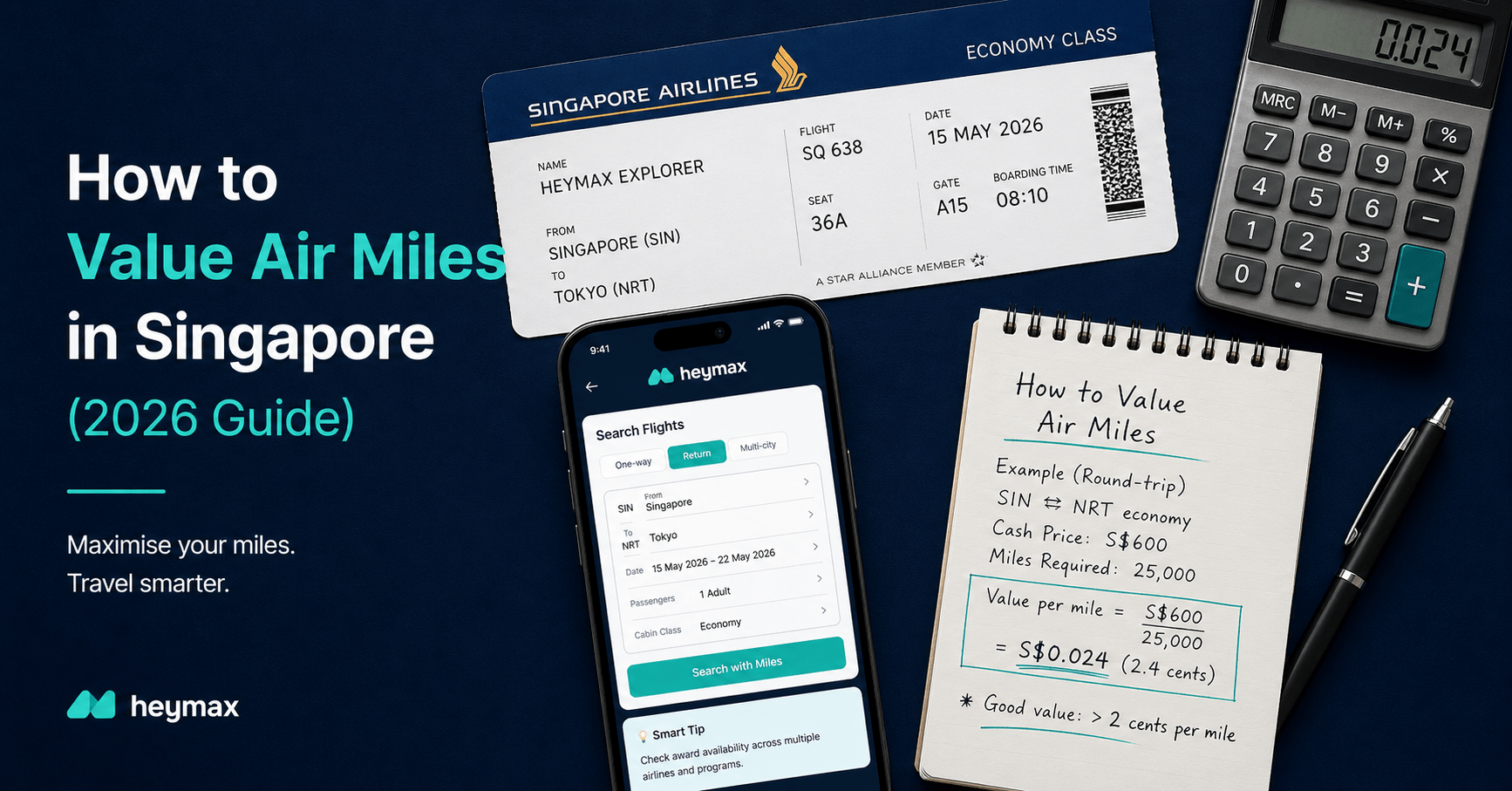
(Cash fare − Taxes and fees on award ticket) ÷ Miles required = Cents per mile (CPM)
Here is an example with real numbers. Suppose you want to fly Singapore to Tokyo on Singapore Airlines in Economy Class. A Saver award costs 35,000 KrisFlyer miles one way, plus roughly S$70 in taxes. The same seat in cash costs S$600.
(S$600 − S$70) ÷ 35,000 = 1.51 cents per mile
That means each KrisFlyer mile, in this redemption, is worth 1.51 Singapore cents.
Now you have a number you can use. If you paid 1.3 cents per mile to acquire those KrisFlyer miles — via a credit card that earns 1.2 miles per dollar on a 1.5% fee payment — a 1.51 CPM redemption is a net positive. You bought at 1.3, redeemed at 1.51. You are ahead.
If the cash fare was only S$350 because you are checking during peak season pricing on a flexible date, the same calculation gives you:
(S$350 − S$70) ÷ 35,000 = 0.80 cents per mile
That is a bad redemption. Your miles are worth less than what it cost you to earn them. Pay cash and save the miles.
What Singapore Miles Are Actually Worth: The Realistic Ranges
Every publication quotes a different CPM figure for KrisFlyer miles — NerdWallet says 1.1 cents, SingSaver says 1.5 cents, MileLion has historically quoted 1.7 cents. The reason for the divergence is not that anyone is lying. It is that each figure reflects different assumptions about cabin class, route, and redemption style.
Here is how to think about the ranges honestly.
The floor: 1 cent per mile
From 1 July 2025, Singapore Airlines standardised the value of KrisFlyer miles when used to offset flights, Kris+, KrisShop, and Pelago purchases. The rate is 100 miles = S$1, or exactly 1 cent per mile. This is the guaranteed minimum — you know you will never get less than 1 cent per mile as long as you are using them within the SIA ecosystem for something you were going to buy anyway.
This also means that any method of earning miles that costs you more than 1 cent per mile is a guaranteed loss unless you plan to redeem for flights.
The baseline: 1.3–1.5 cents per mile
This is the realistic economy-class redemption range on mid- to long-haul routes — Singapore to Japan, Singapore to Australia, Singapore to Europe. These redemptions are achievable without hunting for rare Saver award seats during peak periods. If you are an occasional miles collector who flies once or twice a year, design your strategy around this range.
The sweet spot: 2–4 cents per mile
Business Class Saver awards on Singapore Airlines, or Economy redemptions on partner airlines where KrisFlyer pricing is significantly cheaper than the airline’s own programme. The classic example is redeeming through United MileagePlus for some SIA routes — you can sometimes pay 22,000 miles for a seat that KrisFlyer prices at 45,000. HeyMax’s 1:1 transfer to programmes like United, ANA, and Air Canada opens up these sweet spots without a dedicated credit card for each programme.
The aspirational ceiling: 4–6+ cents per mile
First Class and Singapore Suites redemptions. Mathematically compelling — but only honest if you would genuinely have paid for Business or First Class in cash. If your alternative was a budget airline, the comparison is misleading.
The number I use for my own decisions: 1.5 cents per mile. It is conservative enough that any redemption above it feels like a win, and aggressive enough that it screens out genuinely poor uses of miles.
Where Max Miles Fit In
If you are using HeyMax, your primary currency is Max Miles — not KrisFlyer miles directly. Max Miles transfer at a 1:1 ratio to 30+ airline and hotel loyalty programmes, with no conversion fees, making them a flexible intermediary currency.
That flexibility means Max Miles have a different valuation framework from a closed-loop programme like KrisFlyer.
→ Sign up for HeyMax and get 200 Max Miles as a new user
The floor for Max Miles: 1.8 cents per mile
HeyMax’s FlyAnywhere feature lets you offset any commercial flight — any airline, any cabin, any OTA or direct booking — by submitting your receipt and redeeming at S$0.018 per Max Mile. The cash lands in your PayNow account within hours.
This is the most important number to know as a HeyMax user. It means:
- You should never transfer Max Miles to a loyalty programme unless you value that programme’s miles at more than 1.8 cents each.
- Voucher redemptions and gift cards, which typically offer 1 cent per Max Mile, are almost always worse than FlyAnywhere.
- If you are unsure what to do with your Max Miles, FlyAnywhere is the safe default.
Transferring Max Miles to airline programmes
Max Miles can be transferred 1:1 to programmes including British Airways Avios, Air Canada Aeroplan, United MileagePlus, ANA Mileage Club, EVA Air Infinity MileageLands, Accor Live Limitless, World of Hyatt, and many others. This is where experienced collectors can extract more than 1.8 cents per Max Mile — by using those programmes to access sweet spots.
The MileLion’s own working valuation for Max Miles is effectively “1.8 cents as a floor, with upside if you use them well.” I agree with that framing. Most of my Max Miles end up in World of Hyatt or Accor, where the redemption value comfortably clears 2–3 cents equivalent.
What about converting to KrisFlyer? Under normal conditions, the route is Max Miles → yuu Points → KrisFlyer, which nets you 0.83 KrisFlyer miles per Max Mile — a 17% haircut before you even start. Unless HeyMax is running a Max Miles Day promotion with 20% milesback on yuu conversions (which brings the ratio to roughly 1:1), there is almost no reason to do this. You would be better off using FlyAnywhere or transferring to another programme.
The Full Valuation Workflow: Step by Step
Step 1 — Know Your Acquisition Cost (5 minutes, one-time setup)
Before you can evaluate whether a redemption is good, you need to know what your miles cost you to earn.
This is the acquisition cost per mile — the implicit price you paid.
For credit card miles, the formula is:
Acquisition cost = (Fee paid × Fee rate) ÷ Miles earned
Example: You use a card with a 2% fee on bill payments and earns 1.5 miles per dollar. On a S$1,000 bill:
- Fee: S$20 (2%)
- Miles earned: 1,500
- Acquisition cost: S$20 ÷ 1,500 = 1.33 cents per mile
For HeyMax Max Miles earned by shopping through the portal, your acquisition cost is effectively zero — you are earning miles on purchases you would have made anyway. This is the appeal of the platform.
What you end up with: A clear cost-per-mile figure for each earning method you use. Write this down. It becomes your personal break-even threshold — any redemption below this CPM is a loss.
Time saved vs guessing: You stop accepting any redemption just because it “uses miles” and start screening each one against a real number.
Step 2 — Calculate the CPM for Any Redemption (10 minutes per redemption)
When you are considering a redemption, run the formula before you commit.
- Find the cash fare for the same seat, same airline, same approximate dates — use the airline’s website or a tool like Google Flights. Use the cheapest comparable cash fare you could realistically book, not the premium full-flex fare.
- Note the taxes and surcharges on the award ticket. For KrisFlyer awards, this typically ranges from S$40 to S$200 depending on the carrier and route.
- Note the miles required.
- Plug into the formula: (Cash fare − Award taxes) ÷ Miles required
If the CPM is above your personal valuation threshold — above 1.5 cents for most people — proceed. If it is below, pay cash and keep the miles.
What you end up with: A go/no-go decision on each redemption based on actual numbers, not gut feel.
Common mistake to avoid: Using an inflated cash fare as the comparison. If you would never realistically pay S$1,200 for the economy seat because it is only S$450 on the same route via another airline, use S$450. Be honest about what your alternative is.
Step 3 — Identify Your Best Redemption Category (30 minutes, done once a year)
Not all miles programmes are equal, and not all routes are equal within the same programme.
The general hierarchy for KrisFlyer miles — from best to worst CPM — is:
- First Class and Suites Saver awards on Singapore Airlines: 4–6+ CPM if valued against published fares
- Business Class Saver awards on Singapore Airlines: 2.5–4 CPM on long-haul routes
- Economy Saver awards on Singapore Airlines (long-haul): 1.3–1.8 CPM
- Scoot Economy awards: 1–1.5 CPM depending on route and cash fare comparison
- Miles & Cash on Singapore Airlines (offsetting the ticket price): 1 CPM
- KrisShop, Pelago, or Kris+ spending: 1 CPM (the floor)
- Converting to hotel points or non-travel rewards: typically below 1 CPM
For HeyMax Max Miles, the hierarchy is:
- High-value airline or hotel transfer partner sweet spots (Hyatt, Accor, Aeroplan): 2–3+ CPM equivalent
- FlyAnywhere (any commercial flight): 1.8 CPM, guaranteed
- Voucher redemptions: 1 CPM — almost always worse than FlyAnywhere
What you end up with: A personal redemption policy. You know your best use cases and your categories to avoid.
Step 4 — Apply the Framework to Miles vs Cashback Decisions (5 minutes per card comparison)
Once you have a personal CPM valuation, comparing miles cards against cashback cards becomes arithmetic.
Example: A miles card earns 1.2 mpd and a cashback card earns 1.5% cashback. Which is better?
At a 1.5 CPM valuation: 1.2 mpd × 1.5 cents = 1.8 cents effective return per dollar on the miles card
That beats the 1.5 cents return from the cashback card — by 20%.
But if your typical redemption only extracts 1.0 CPM (because you mostly use miles for gift cards or vouchers):
1.2 mpd × 1.0 cents = 1.2 cents effective return per dollar
Now the cashback card wins.
This is why people who redeem miles for economy short-haul flights or non-flight rewards often do better with cashback. The miles mechanics favour people who redeem for Business Class or who use programmes like HeyMax that guarantee a floor of 1.8 CPM.
What you end up with: A card-by-card comparison using your actual redemption behaviour — not theoretical maximums.
The Full Valuation Breakdown
| Miles Type | Floor CPM | Realistic Economy CPM | Business Class CPM | Best Possible CPM |
|---|---|---|---|---|
| KrisFlyer (SIA flights) | 1.0¢ (Kris+ / offset) | 1.3–1.5¢ | 2.5–4¢ | 5¢+ (Suites) |
| KrisFlyer (Scoot) | ~0.8¢ poor routes | 1.0–1.5¢ | N/A | 4¢+ good routes |
| Max Miles (FlyAnywhere) | 1.8¢ guaranteed | 1.8¢ | 1.8¢ | 1.8¢ |
| Max Miles (transfer to partner) | Varies | 1.5–2.0¢ | 2.5–4¢ | 3¢+ (Hyatt / Accor) |
| Gift cards / vouchers | 0.8–1.0¢ | 0.8–1.0¢ | N/A | 1.0¢ |
What Miles Valuation Cannot Tell You
Whether award seats will be available. A Saver Business Class award on Singapore Airlines to London might be worth 3.5 CPM — but if there are no Saver seats available, that number is theoretical. Advantage awards cost significantly more miles and drop the CPM substantially.
Your personal opportunity cost. If collecting miles means turning down 1.5% cashback you would have put toward loan repayment or savings at 3.5% interest, the miles have a real cost you need to factor in separately.
Programme risk. Both KrisFlyer and HeyMax reserve the right to change award pricing, transfer ratios, and programme terms. A CPM that looks good today might look worse after a devaluation. KrisFlyer itself raised Saver award prices in 2025. The best hedge is to earn miles efficiently and redeem promptly rather than holding large balances long-term.
Whether you will actually use them. Miles you never redeem are worth zero CPM. The best valuation model in the world does not help if your miles expire unused or accumulate past any realistic redemption goal.
Tips for Applying This Framework
Set your personal CPM threshold and write it down. Mine is 1.5 cents. Whenever a redemption comes up, I run the formula before committing. If it is below 1.5 CPM, I pay cash. This removes emotion from the decision.
Use FlyAnywhere as your Max Miles baseline. Every time you consider converting Max Miles to a loyalty programme, ask: “Am I confident this transfer will give me more than 1.8 CPM?” If the answer is no, use FlyAnywhere instead.
Compare against the realistic cash fare, not the published fare. The published Business Class fare to London might be S$8,000 — but if you would have booked Premium Economy at S$3,500, that is your baseline.
Watch for devaluations and factor in programme risk. Any miles sitting idle are subject to devaluation risk. Earn and redeem on a reasonable cadence rather than accumulating years of miles at risk of rule changes.
Stack with HeyMax where possible. HeyMax earns Max Miles on top of your existing credit card miles at many merchants. The two currencies do not compete — they compound. A transaction that earns 1.2 miles per dollar on your credit card and 2 Max Miles per dollar through HeyMax gives you an effective 3.2 CPD (combined) — then you value each currency independently at redemption.
→ Sign up for HeyMax and start earning Max Miles on purchases you already make
Frequently Asked Questions
How much is a KrisFlyer mile worth in Singapore dollars?
It depends on how you redeem it. The guaranteed minimum — set by Singapore Airlines from July 2025 — is 1 cent per mile, redeemable against SIA and Scoot flights, Kris+, KrisShop, and Pelago. Economy Class award redemptions on longer routes typically yield 1.3–1.5 cents per mile. Business Class Saver awards on Singapore Airlines can realistically reach 2.5–4 cents per mile. If you want one working number for planning purposes, 1.5 cents per mile is a reasonable, honest baseline.
Is it better to earn miles or cashback with a credit card in Singapore?
It depends on how you redeem. If you consistently redeem miles for Business or First Class award flights and extract 2+ cents per mile, miles cards almost always win against 1.5–2% cashback cards. If you mostly redeem for economy short-haul flights, gift cards, or vouchers — where CPM frequently falls to 1 cent or below — cashback cards often come out ahead. Run the CPM formula on your last two or three redemptions to see which camp you actually fall into.
What are HeyMax Max Miles worth?
The guaranteed floor is 1.8 Singapore cents per Max Mile, via the FlyAnywhere feature — which reimburses you in cash for any commercial flight booking within one month of purchase. If you transfer Max Miles to an airline or hotel loyalty programme and redeem strategically, you can extract more — typically 2–3+ cents equivalent through programmes like World of Hyatt or Accor. Gift card and voucher redemptions offer the worst value at around 1 cent per mile and should generally be avoided unless there is a specific promotion.
Can you convert HeyMax Max Miles to KrisFlyer miles?
Not directly. The indirect route is Max Miles → yuu Rewards Club → KrisFlyer, but under normal conditions this conversion results in about 0.83 KrisFlyer miles per Max Mile — a 17% loss. HeyMax runs Max Miles Day on the 25th of each month, sometimes offering 20% milesback on yuu conversions that effectively restores a 1:1 ratio. Outside of those promotions, most experienced collectors prefer to keep Max Miles for the FlyAnywhere floor value or for transfer to other programmes with better sweet spots.
How do I know if a redemption is worth it?
Use the CPM formula: (Cash fare − Award ticket taxes) ÷ Miles required. Compare the result against your personal acquisition cost per mile. If the redemption CPM is higher than what you paid to earn those miles, the redemption adds value. If it is lower, you are better off paying cash. A second benchmark: if the CPM is above 1.5 cents for KrisFlyer or above 1.8 cents for Max Miles, the redemption is generally worthwhile.
Do air miles expire in Singapore?
KrisFlyer miles expire three years after they are earned, but the clock resets with any earning or redemption activity — so active accounts rarely see expiry in practice. HeyMax Max Miles never expire as long as your account is active. Hotel programme expiry policies vary significantly; Accor and Hyatt, for example, have different activity-based reset policies. Always check the specific programme’s terms before letting a balance sit idle for more than a year.
Final Thoughts
Miles valuation is not glamorous. It is arithmetic — a formula you run before every redemption decision, and a threshold you set once and apply consistently.
But that arithmetic is what separates the people who use miles as a genuine financial tool from the people who collect them for years and eventually let them expire on an unused KrisFlyer account.
The framework in this guide does three things for you. It tells you what your miles actually cost to earn. It tells you what each redemption is actually worth. And it gives you a clean comparison against cashback — so you are always making the decision that is best for your specific situation, not someone else’s.
If you are starting or refreshing your miles strategy in Singapore, HeyMax is the most efficient tool I have found for earning additional miles on top of credit card rewards without changing your spending behaviour. The 1.8 cents-per-mile FlyAnywhere floor means every Max Mile has a guaranteed use case — and the 30+ transfer partners mean you have access to sweet spots that most Singapore credit cards do not reach on their own.
→ Sign up for HeyMax and get 200 bonus Max Miles
Once you have your first stash of Max Miles, come back to Step 2 of this guide. Run the CPM formula. You will know exactly what to do with them.
How do you personally value your miles — and what CPM threshold do you use to decide when to redeem? Drop it in the comments below.