
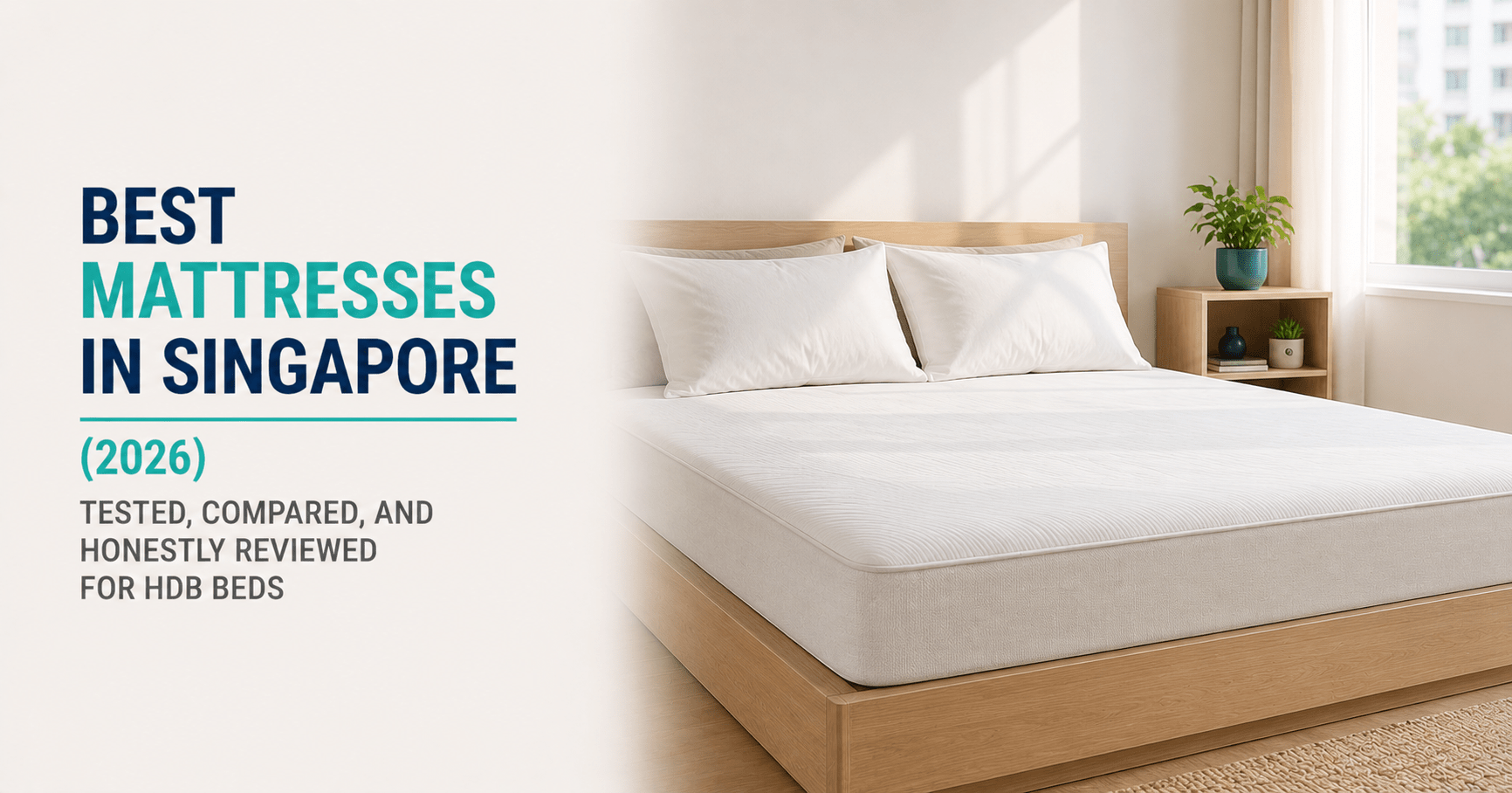
Best Mattresses in Singapore (2026): Tested, Compared, and Honestly Reviewed for HDB Beds
Table of Contents
A mattress is one of the highest-cost-per-use purchases most households make.
At eight hours a night, you spend roughly one-third of your life on it. A mattress that costs $1,200 and lasts 10 years costs $0.33 per night. A $400 mattress that degrades in three years and disrupts your sleep costs more — in money, and in the accumulated deficit of poor rest that affects everything else.
The Singapore mattress market does not make this decision easy. Showroom sales environments are designed to obscure comparison — different brands use proprietary foam names that mean nothing outside their own marketing, trial period conditions are buried in fine print, and the range from $200 to $5,000 makes it genuinely unclear what you are paying for at each price point.
I went through the key specifications that actually determine whether a mattress works — material type, firmness consistency, motion transfer, edge support, and heat retention in Singapore’s climate — and identified the models that hold up honestly across each price tier.
Here are the six best mattresses available in Singapore in 2026.
What to Look For in a Mattress for Singapore Homes
Material type determines most of the experience
Memory foam contours closely to the body, reduces motion transfer between sleeping partners, and provides pressure relief for side sleepers. The drawback in Singapore’s climate is heat retention — memory foam traps body heat, and in a room without overnight aircon, it sleeps warm. Gel-infused memory foam reduces this but does not eliminate it.
Latex — both natural and synthetic — is the most popular premium mattress material in Singapore for good reason. It is naturally breathable (open-cell structure allows airflow), responsive rather than contouring (it pushes back rather than cradling), durable (natural latex typically outlasts foam by several years), and cooler-sleeping than memory foam. Natural latex is also hypoallergenic and resistant to dust mites — relevant for Singapore’s humidity. The trade-off is weight and price.
Pocketed spring (individually wrapped coils) provides strong edge support, excellent airflow through the coil layer, and a traditional bouncy feel. Modern hybrid mattresses combine pocketed springs with a comfort layer of foam or latex on top — this is the most popular format in the mid-to-premium Singapore market and typically offers the best combination of support, breathability, and comfort.
Bonnell spring (continuous coil) is the technology in most budget mattresses. Springs are connected, which means motion transfers easily between partners and the mattress degrades faster under repeated compression. For single sleepers on a tight budget, it is serviceable. For couples, it is worth paying more to avoid.
Firmness: Singapore context
Most Singapore sleepers — based on typical HDB bed height and sleep position data — fall into the medium to medium-firm range as the most versatile choice. Side sleepers generally need softer (for shoulder and hip pressure relief); back and stomach sleepers generally need firmer (for spinal alignment). Couples with different preferences usually compromise at medium.
The key is that firmness descriptors vary significantly between brands. One brand’s “medium” is another’s “firm.” Always test in-store if possible, or choose a brand with a genuine no-conditions trial period.
Heat retention in Singapore’s climate
This matters more in Singapore than in almost any other market. HDB bedrooms without overnight aircon — or with aircon set above 26°C — expose the mattress to 26–30°C ambient temperatures for eight hours. Memory foam at these temperatures retains body heat noticeably. Latex and spring systems breathe significantly better.
If you run aircon overnight at 24–25°C, heat retention is a minor consideration. If you sleep with the windows open or aircon set high, prioritise latex or hybrid spring constructions over pure memory foam.
Trial period — what to actually check
Most Singapore mattress brands now offer trial periods of 100–365 nights. Before buying, check: whether the return is truly free (some charge collection fees of $50–$150), whether the mattress needs to be in original condition (almost impossible after 30 nights of use), and whether a full refund or store credit is offered. Store credit is not a free trial — it locks your money into the brand.
The 6 Best Mattresses in Singapore (2026)
| Model | Type | Best For | Trial Period | Starting Price |
|---|---|---|---|---|
| Sonno Original | Foam hybrid | Best overall value — most sleepers | 100 nights | ~$699 (queen) |
| King Koil WorldSupport | Pocketed spring hybrid | Couples, back pain, edge support | 365 nights | ~$1,299 (queen) |
| Noa Mattress | Latex + foam hybrid | Hot sleepers, latex feel at mid price | 120 nights | ~$999 (queen) |
| Seahorse Latex | Natural latex | Durable premium, Singapore brand | 10-year warranty | ~$1,499 (queen) |
| IKEA Hauga / Valevåg | Foam / spring | Budget pick, single sleepers | 365-day exchange | ~$299–$499 (queen) |
| SleepNation Cloud | Memory foam | Pressure relief, side sleepers | 120 nights | ~$799 (queen) |
1. Sonno Original — Best Overall Value for Most Singapore Sleepers
→ Check price on Sonno Singapore
The Sonno Original is the mattress I recommend most often to Singapore households asking for a single recommendation without a specific sleep issue or budget constraint.
It is a three-layer foam hybrid — a ventilated transition foam base, a contouring memory foam middle layer, and a breathable top layer — that sits at medium firmness and handles the majority of sleep positions competently. The foam construction keeps the price accessible, and Sonno’s Singapore-based operation means the trial period logistics — 100-night free return with free collection — actually work as described, which is not universally true in this market.
The ventilated construction moderates heat retention better than a standard memory foam mattress. In an air-conditioned HDB bedroom, heat is a minor issue. In a non-aircon bedroom in Singapore’s climate, latex or spring would be the better call over any foam construction.
What the Sonno Original is great at:
- Genuine 100-night free trial with free collection — no conditions buried in small print
- Medium firmness suits back sleepers and couples compromising on preference
- Good motion isolation for a foam mattress at this price — a restless partner disturbs less than on spring
- Singapore-brand with local customer support that responds within a working day
Where it falls short:
- Pure foam construction retains more heat than latex or hybrid spring — not ideal for non-aircon bedrooms
- Edge support is average — sitting on the edge of the bed compresses noticeably, which matters if you dress while seated on the bed
- Foam constructions generally have shorter lifespans than latex — expect eight to 10 years before meaningful degradation
Pricing:
- Single: ~$399 | Queen: ~$699 | King: ~$849
- Free delivery and setup in Singapore
- 100-night free trial with free collection
Bottom line: The Sonno Original is the most honest value proposition in the Singapore mattress market for most sleepers. The trial period works, the firmness suits the majority, and the price is fair for the construction quality.
→ Try the Sonno Original with a 100-night trial
2. King Koil WorldSupport — Best for Couples and Back Pain
→ Check price on King Koil Singapore
King Koil’s WorldSupport series is the mattress I point couples toward — particularly where one or both partners have lower back concerns or significantly different firmness preferences.
The individually pocketed coil system is the core of its value: each spring reacts independently, which means weight distribution is localised and a partner rolling over at 3am does not transmit as a full-mattress disturbance. The edge support from the reinforced perimeter coil is among the best in the Singapore market at this price tier — the sleeping surface is usable all the way to the edge, which matters for couples sharing a queen bed.
The pillow-top comfort layer in the WorldSupport models adds surface softness over the spring support — achieving a medium-firm feel that back sleepers find supportive without being rigid.
What King Koil WorldSupport is great at:
- Individually pocketed springs minimise motion transfer between sleeping partners
- Strong edge support — reinforced perimeter means usable sleeping surface edge-to-edge
- Better airflow than foam constructions — the coil layer breathes, which helps in Singapore’s climate
- 365-night trial period — the longest standard trial in this comparison
Where it falls short:
- Higher price point than foam alternatives at comparable queen sizing
- Pillow-top surfaces can develop body impressions faster than firmer foam or latex tops under heavier sleepers
- Delivery and setup lead times can run two to four weeks during peak periods
Pricing:
- Queen: ~$1,299–$1,899 depending on model tier
- Free delivery and setup
- 365-night trial (check current trial terms at point of purchase)
Bottom line: For couples who need genuine motion isolation and strong edge support, and for back sleepers who want spring-based support with a softer top layer, the King Koil WorldSupport is the most well-rounded choice in the mid-premium range.
→ Explore King Koil WorldSupport here
3. Noa Mattress — Best for Hot Sleepers Who Want Latex Feel at Mid Price
→ Check price on Noa Singapore
The Noa is a latex-topped hybrid — a natural Talalay latex comfort layer over a pocketed spring base — that delivers much of what makes latex popular in Singapore at a price point below pure latex constructions.
Talalay latex is open-cell, highly breathable, and responsive — it pushes back against the body rather than conforming like memory foam. In Singapore’s climate, this translates to noticeably cooler sleep than foam alternatives. The pocketed spring base adds edge support and airflow through the mattress core, compounding the breathability advantage.
The Noa is available directly online with a 120-night trial and free delivery and collection — the trial logistics are clean and well-reviewed by Singapore customers.
What the Noa is great at:
- Talalay latex top layer sleeps significantly cooler than foam alternatives — the best choice in this list for non-aircon or high-setpoint aircon bedrooms
- Responsive feel suits combination sleepers who shift position during the night
- Pocketed spring base provides good edge support and coil-layer breathability
- 120-night genuine trial — collection reviews from Singapore customers are positive
Where it falls short:
- Latex feel is distinctly different from foam — people who are used to foam contouring sometimes find latex too responsive and insufficiently cushioning
- At ~$999 for a queen, it sits in the most competitive price bracket — the Sonno at $699 is a real alternative if heat is not a concern
- Natural latex components add weight — moving or rotating the mattress requires two people
Pricing:
- Single: ~$599 | Queen: ~$999 | King: ~$1,199
- Free delivery, setup, and old mattress removal
- 120-night trial with free collection
Bottom line: The Noa is the best option for Singapore sleepers who run warm, dislike the sinking feeling of memory foam, or want the responsive feel of latex without paying full natural latex mattress prices.
→ Try the Noa with a 120-night trial
4. Seahorse Latex — Best Durable Premium Pick from a Singapore Brand
→ Check price on Seahorse Singapore
Seahorse is one of Singapore’s longest-established mattress manufacturers, and their natural latex range represents the premium tier of locally-made mattresses with a track record that newer direct-to-consumer brands cannot match.
Natural latex mattresses have a significantly longer service life than foam alternatives — 12–15 years is realistic for a quality natural latex construction versus eight to 10 years for foam. The Seahorse Latex uses continuous pour natural latex — a single solid latex core rather than a bonded or blended alternative — which provides consistent feel throughout the mattress and is more durable than bonded latex or synthetic alternatives.
The feel is firm-to-medium-firm, highly breathable, and hypoallergenic. For Singapore households with dust mite sensitivities or respiratory concerns, natural latex’s resistance to dust mites and mould is a meaningful advantage over foam.
What the Seahorse Latex is great at:
- Natural latex longevity — expect 12–15 years of consistent performance versus eight to 10 for foam
- Genuinely breathable and cool-sleeping in Singapore’s climate without aircon dependency
- Hypoallergenic and dust mite resistant — relevant for HDB households with allergy concerns
- Singapore brand with physical showrooms, local warranty support, and established service history
Where it falls short:
- At ~$1,499 for a queen, it is the highest entry price in this comparison
- Natural latex’s responsive feel is not for everyone — contouring sleepers used to memory foam often need an adjustment period
- Heavier than foam mattresses — significantly so, which matters for rotating and moving the mattress
Pricing:
- Queen: ~$1,499–$1,899 depending on thickness and model
- Available in-store at Seahorse showrooms across Singapore
- 10-year warranty (check specific model warranty terms)
Bottom line: For households making a long-term mattress investment and prioritising durability, breathability, and hypoallergenic properties, the Seahorse Latex is the most defensible premium purchase in this comparison.
→ Explore Seahorse Latex mattresses here
5. IKEA Hauga or Valevåg — Best Budget Pick for Single Sleepers
→ Check price at IKEA Singapore
IKEA’s mattress range in Singapore covers a wider quality range than most people expect. The Hauga (medium-firm bonnell spring) and Valevåg (medium-firm pocketed spring) represent the two meaningful options for budget-conscious buyers — and the Valevåg in particular outperforms its price significantly.
The Valevåg is a pocketed spring mattress — individually wrapped coils rather than the connected bonnell springs of the cheaper Hauga — at a price that undercuts comparable pocketed spring options from most dedicated mattress brands. For a single sleeper in an HDB bedroom, the Valevåg provides adequate support, reasonable airflow from the spring construction, and IKEA’s 365-day exchange policy.
For couples, the pocketed spring construction of the Valevåg reduces (but does not eliminate) motion transfer. The edge support is functional but not reinforced — the perimeter compresses noticeably under sitting pressure.
What the IKEA Valevåg is great at:
- Pocketed spring construction at a price point that undercuts most competitors significantly
- IKEA’s 365-day exchange — the most accessible mattress trial in Singapore
- Available immediately in-store — no two to four week lead times
- Adequate support for single sleepers and lighter couples
Where it falls short:
- No free collection or home trial — you return to the IKEA store, not the other way around
- Edge support is below the level of dedicated mattress brands at comparable price
- Comfort layer is thin — the sleep surface is functional but not premium
- Not the right choice for heavier sleepers or couples who need meaningful motion isolation
Pricing:
- Single Valevåg: ~$299 | Queen: ~$499
- Available at IKEA Alexandra and Tampines
- 365-day exchange (in-store, not home collection)
Bottom line: For a single sleeper on a genuine budget, or as a mattress for a guest room, the IKEA Valevåg is the most honest recommendation. For primary use by a couple, the Sonno Original at $699 is the better value step up.
→ Shop IKEA Valevåg at IKEA Singapore
6. SleepNation Cloud — Best for Pressure Relief and Side Sleepers
Side sleepers place concentrated pressure on the shoulder and hip — the points of contact with the mattress. A mattress that is too firm creates pressure points at these areas that interrupt sleep and cause the shoulder and hip discomfort many side sleepers experience by morning.
The SleepNation Cloud uses a high-density memory foam construction with a softer top layer specifically tuned for pressure relief at these contact points. The contouring feel of memory foam at this softness level is pronounced — this is a mattress that envelops rather than supports, which is what side sleepers with pressure sensitivity need.
The trade-off is the same as all memory foam in Singapore’s climate: heat retention. The SleepNation Cloud sleeps warm relative to latex or spring alternatives. For side sleepers running aircon overnight at 24–25°C, this is manageable. For non-aircon sleepers, it is a real consideration.
What the SleepNation Cloud is great at:
- Soft memory foam top layer specifically designed for side sleeper pressure relief at shoulder and hip
- Good motion isolation — the foam construction absorbs rather than transfers movement
- 120-night trial with Singapore-based logistics
- Medium-soft firmness that works well for lighter-weight side sleepers
Where it falls short:
- Memory foam heat retention is the highest in this comparison — not suitable for non-aircon bedrooms in Singapore
- The softer construction is not suitable for stomach sleepers or back sleepers who need firm lumbar support
- Memory foam compression under heavier body weight can feel like sinking rather than supporting
- Foam degradation is faster than latex at equivalent price points
Pricing:
- Single: ~$499 | Queen: ~$799 | King: ~$999
- Free delivery and setup
- 120-night trial with free collection
Bottom line: For side sleepers who run aircon overnight and prioritise pressure relief over breathability, the SleepNation Cloud delivers what it promises. For everyone else, the Sonno Original or Noa is the better starting point.
→ Try the SleepNation Cloud here
How to Choose the Right Mattress for Your Sleep Type
If you sleep on your back and want all-round support → Sonno Original or King Koil WorldSupport. Both sit at medium to medium-firm — the optimal range for spinal alignment in back sleepers.
If you are a side sleeper with shoulder or hip pressure issues → SleepNation Cloud. The softer memory foam top layer is purpose-built for this.
If you sleep hot or do not run aircon overnight → Noa or Seahorse Latex. Latex breathes significantly better than foam. This is a near non-negotiable for non-aircon Singapore bedrooms.
If you share the bed and a restless partner is a problem → King Koil WorldSupport or Sonno Original. Both have better motion isolation than spring-only or bouncy latex constructions.
If you want the longest-lasting premium investment → Seahorse Latex. Natural latex outperforms foam by four to six years of consistent comfort.
If you are furnishing a guest room or working to a tight budget → IKEA Valevåg. For single sleepers or occasional use, it does the job without unnecessary spend.
Singapore Mattress Buying Mistakes to Avoid
Trusting firmness labels across brands. One brand’s “medium” is another’s “firm.” Always test in-store where possible, or buy from a brand with a genuine free-collection trial.
Ignoring the trial period fine print. Free trial means free collection, full cash refund, no conditions on mattress condition after sleeping on it for 30+ nights. Anything less than this — store credit, collection fees, original packaging requirement — is not a free trial.
Buying based on showroom comfort alone. A 10-minute showroom test in clothes, on a lit sales floor, tells you almost nothing about how a mattress feels after 60 nights of actual sleep. The trial period exists for this reason. Use it.
Choosing foam over latex purely on price. At the $800–$1,000 price point, latex hybrids and quality foam are comparably priced. Over eight to 10 years of ownership, a latex hybrid that degrades more slowly provides meaningfully better value than foam at the same initial price.
Not accounting for bed frame compatibility. A very soft foam or latex mattress on a solid platform base with no slat spacing can trap heat and reduce the mattress breathability significantly. Check that your bed frame has adequate slat spacing — 5–8cm between slats is the standard recommendation for foam and latex mattresses.
Frequently Asked Questions
What is the best type of mattress for Singapore’s climate and humidity?
Latex — both natural and Talalay — is the best-performing mattress material for Singapore’s climate. Its open-cell structure allows airflow through the mattress that memory foam cannot match, it sleeps cooler at equivalent room temperatures, and it is naturally resistant to dust mites and mould — a meaningful advantage in Singapore’s year-round humidity. For households that run aircon overnight at 24–25°C, the heat difference between latex and quality foam is minimal. For households with windows open or aircon set high, latex is the clearly superior choice.
How much should I spend on a mattress in Singapore?
For a primary mattress used nightly by a couple, $700–$1,200 is the realistic sweet spot in the 2026 Singapore market — enough to access pocketed spring or latex hybrid constructions with genuine trial periods, without entering the premium territory where price increases outpace performance improvements. For a single sleeper, $400–$700 covers the quality tier that provides consistent support for eight to 10 years. Budget mattresses under $300 are appropriate for guest rooms and single sleepers with no specific requirements.
Do Singapore mattress trial periods actually work?
The better direct-to-consumer brands — Sonno, Noa, and SleepNation — have generally positive customer reviews for their trial period logistics in Singapore. Returns are collected, refunds are processed within five to 10 working days, and the process matches what is advertised. The key is reading the terms before purchase: confirm that collection is free, that a cash refund (not store credit) is provided, and that the mattress does not need to be in original packaging. Department store and showroom mattress purchases typically have more restrictive return conditions.
What mattress is best for lower back pain in Singapore?
Lower back pain in sleepers is most commonly associated with a mattress that is too soft — insufficient lumbar support allows the spine to sag during sleep. Medium-firm to firm mattresses generally provide better spinal alignment for back pain sufferers. In Singapore’s market, the King Koil WorldSupport (pocketed spring, medium-firm) and the Seahorse Latex (natural latex, firm-to-medium-firm) are the most consistently recommended options for back pain. If a softer mattress is preferred, a firm mattress topper can add surface comfort without sacrificing the underlying support.
How long should a mattress last in Singapore?
Natural latex mattresses: 12–15 years. Pocketed spring hybrids with quality foam or latex comfort layers: 10–12 years. Pure memory foam mattresses: eight to 10 years. Budget bonnell spring mattresses: five to eight years. Lifespan is affected by mattress rotation (rotating head-to-foot every three to six months extends life), bed frame support quality, and body weight. Singapore’s humidity does not significantly shorten mattress lifespan if the bedroom is air-conditioned or well-ventilated. Persistent dampness — rare in typical HDB bedrooms — can accelerate foam degradation and promote mould growth in poorly ventilated mattresses.
Is it worth buying a mattress online in Singapore without testing it first?
For brands with genuine free-collection trial periods — Sonno (100 nights), Noa (120 nights), SleepNation (120 nights) — yes. The 30 to 60-night break-in period needed for a mattress to conform to a specific sleeper’s body cannot be replicated in a 10-minute showroom test. Buying online with a real free trial gives you a more accurate assessment of fit than any in-store test. The risk is if the trial conditions are more restrictive than advertised — which is why reading the fine print before purchase is essential.
Final Thoughts
The mattress decision is not complicated once you have the right framework.
Identify your sleep position and whether heat is a concern in your specific bedroom setup. Match those two factors to a material type — latex for hot sleepers and long-term investment, foam hybrid for pressure relief and motion isolation, pocketed spring for edge support and couple compatibility. Then choose a brand with a genuine free trial period and use it.
For most Singapore households, the Sonno Original at $699 for a queen is the most defensible starting point — the trial works, the firmness suits the majority, and the price is honest for the construction. Step up to the Noa or King Koil WorldSupport if heat or motion transfer is a specific concern. Invest in the Seahorse Latex if you are buying for the long term and want the best material for Singapore’s climate.
Sleep is the one thing that affects everything else. It is worth getting this right.
What mattress are you sleeping on in Singapore — and would you buy it again? Drop your experience in the comments.
Continue reading: