
HDB Renovation Checklist Singapore (2026): Every Step, in the Right Order
Table of Contents
Most HDB renovation horror stories follow the same pattern.
The homeowner hired a contractor without checking their HDB licence. Or they skipped the defects inspection and discovered hairline cracks under the new flooring six months later. Or they started hacking without submitting the right paperwork and received a notice from HDB. Or they simply did not account for the fact that in Singapore, the sequence in which renovation work happens matters — and getting it wrong means paying to redo it.
The renovation process in Singapore is not especially complicated. But it is layered — HDB approvals, CPF limits, licensed contractors, noise restriction windows, and defect liability periods all interact in ways that are not obvious until you are already in the middle of it.
I put this checklist together as the guide I wish existed when I was going through the process. It covers every stage in the right order — from the moment you collect your keys to the moment you sign off on the final handover — with the things that actually trip people up flagged clearly along the way.
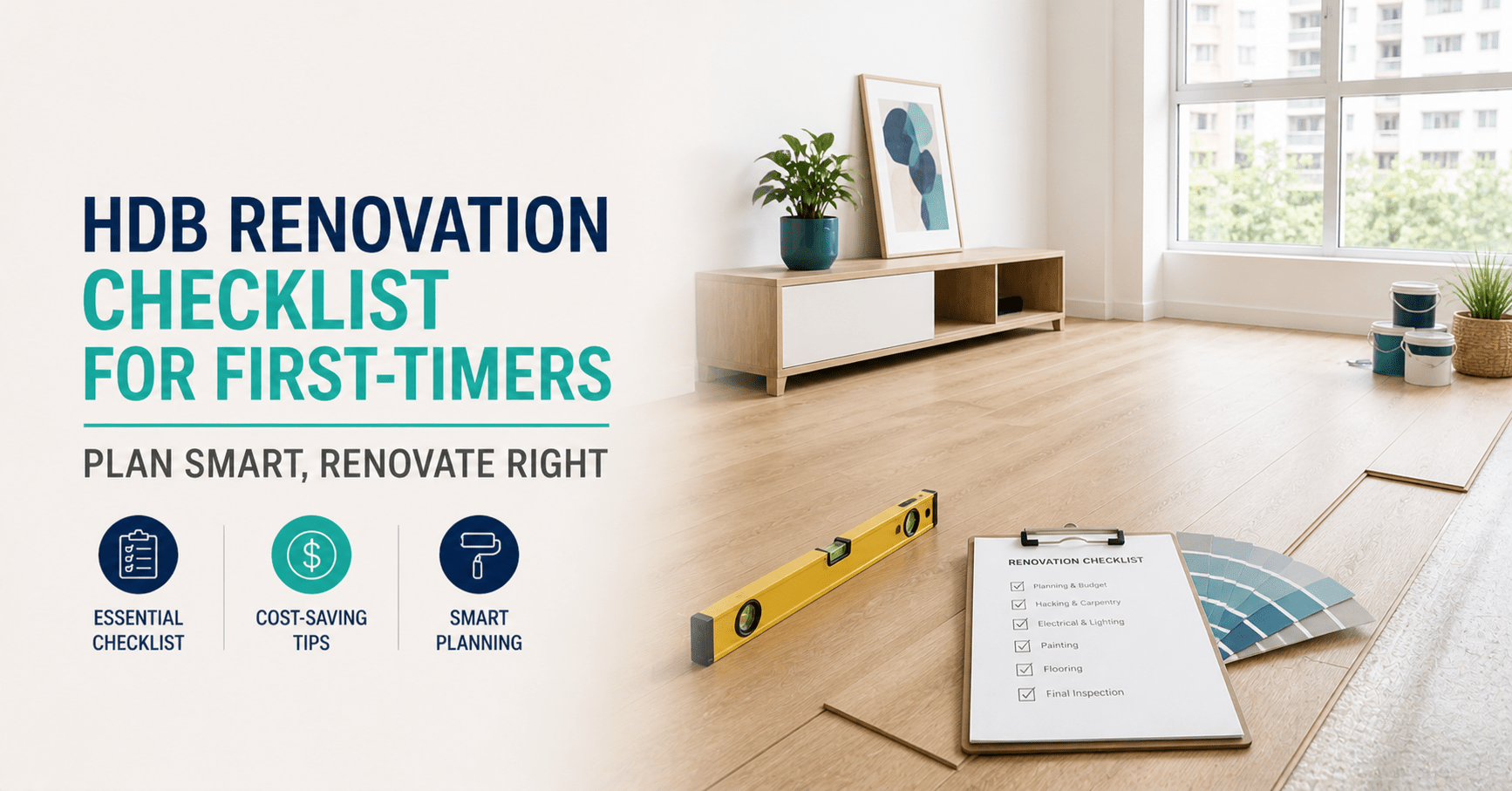
Here is the complete HDB renovation checklist for Singapore in 2026.
Why Sequence Matters in an HDB Renovation
Before the checklist, a short note on why order matters.
HDB renovations are not like painting a room. Hacking, electrical work, plumbing, carpentry, tiling, painting, and installation all have dependencies — each stage needs to be complete before the next one begins, and some trades need to coordinate timing. Start tiling before the waterproofing has cured and you will be retiling in six months. Install your carpentry before the aircon trunking is done and the carpenter has to redo sections.
The sequence I have laid out below is the standard flow used by most reputable Singapore contractors. Deviating from it is sometimes necessary — but it should always be a deliberate decision, not an oversight.
The Complete HDB Renovation Checklist
Stage 1 — Before You Sign Anything (Weeks 1–4)
This stage happens before you engage a contractor or spend a single dollar on renovation. Most people skip or rush it. Most people also regret that later.
Collect keys and do the defects inspection immediately. HDB’s defects liability period covers the first year after key collection for BTO flats. Any defects — cracks, uneven flooring, faulty fittings, water seepage — must be reported to HDB within this window. Do the inspection before any renovation work begins. Once your contractor starts work, distinguishing pre-existing defects from renovation-caused damage becomes nearly impossible — and HDB’s liability ends.
Walk through every room. Check every tap, every socket, every window latch, every floor tile. Photograph everything that looks wrong and log it formally through the HDB portal. Do not skip this step in the excitement of key collection.
Understand what HDB permits and prohibits. Not all renovation work requires HDB approval — but the work that does includes: hacking of walls (especially load-bearing ones), electrical rewiring beyond the existing circuit layout, installation of window grilles or window replacement, waterproofing works in wet areas, and any structural changes. Submitting work that required approval without getting it is a civil violation and can require you to reinstate the original condition at your own cost.
Download the HDB renovation guidelines from the HDB InfoWEB portal before engaging any contractor. Know what you are allowed to do before you agree to any scope.
Set a realistic budget — with contingency. The most common renovation budgeting mistake in Singapore is planning to spend exactly what you have. Renovation costs consistently run over — not because contractors are dishonest, but because walls reveal surprises when hacked, and specifications change once homeowners see the actual space.
A practical rule: budget your planned spend, then add 15–20% as a contingency reserve. For a 4-room HDB renovation targeting $60,000, that means keeping $9,000–$12,000 in reserve. If you do not need it, it rolls into furniture. If you do need it — and most renovations of meaningful scope will need some of it — you are not scrambling.
Use CPF Ordinary Account funds if applicable. CPF OA funds can be used toward HDB renovation loans (through HDB’s renovation loan scheme) for certain renovation categories. Check your eligibility and limits on the CPF Board website before finalising your budget. This does not change what you plan to spend — but it affects your cash flow planning, which matters when contractors invoice in progress payments.
Stage 2 — Selecting and Vetting Your Contractor (Weeks 3–6)
Only engage HDB-licensed renovation contractors. This is non-negotiable. Only contractors registered under HDB’s Renovation Contractor Registration Scheme are permitted to carry out renovation works in HDB flats. If your contractor is not on the list, HDB will not approve the works permit. You can verify a contractor’s licence status directly on the HDB InfoWEB portal.
Beyond the licence, check: how long the contractor has been operating, whether they carry public liability insurance (required for HDB works), and whether the company name on the quote matches the registered entity. A contractor operating under a trading name that differs from their registered company name is worth questioning.
Get at minimum three quotations — and read what is in them. Three quotations is the minimum. Not to simply pick the cheapest, but to understand what a fair scope looks like and what each contractor is including or excluding. Quotations that are significantly below the others often exclude something — haul-away, tiling grout, electrical points, or floor preparation. Get line-item quotes, not lump-sum figures.
When comparing quotes, check specifically: whether hacking and disposal are included, what tile brand and grade is specified, whether the electrical work includes a new DB box if needed, and what the carpentry material and finish grade is. Vague quotations produce disputes.
Check references and visit past projects if possible. Ask every shortlisted contractor for two or three references from completed HDB projects — not interior design showcases, actual client contacts. Call them. Ask specifically: did the project finish on time, were there cost overruns, how did the contractor handle problems when they arose, and would you use them again.
If the contractor has a showroom or can arrange a site visit to a recently completed project, take it. Seeing the quality of their tile work and carpentry finish in person tells you more than any photo.
Understand the payment schedule before signing. Reputable Singapore renovation contractors typically structure payments in three to four tranches: a deposit (typically 10–20% of contract value), one or two progress payments tied to specific milestones, and a final payment on completion and sign-off. Be wary of contractors requesting more than 30–40% upfront. The final payment retention — withheld until defects are addressed — gives you leverage to ensure the job is completed properly.
Stage 3 — HDB Approval and Permits (Weeks 5–7)
Submit the renovation permit application. Your contractor should handle this — but you should verify it is done. HDB requires a renovation permit before certain works can commence. The application is submitted by the licensed contractor through the HDB InfoWEB portal. Processing takes approximately three to seven working days.
Works that require a permit include: hacking of non-load-bearing walls, new electrical points, waterproofing of wet areas, installation of window grilles, and any structural work. Works that typically do not require a permit include: painting, basic carpentry installation (wardrobes, cabinets), and light fixture replacement within the existing circuit.
Confirm the approved renovation hours. HDB-approved renovation hours in Singapore are: Monday to Friday, 9am–6pm; Saturday, 9am–1pm. No renovation works — including hacking, drilling, or any noise-generating activity — are permitted on Sundays and public holidays under the Environmental Protection and Management Act. Your contractor must comply. If they propose weekend or after-hours work for noisy trades, that is a flag worth raising.
Notify your neighbours. This is not legally required, but it is practically important. Inform the households directly above, below, and on either side of your flat before hacking begins. Give them a rough timeline of the noisy works. Goodwill here costs nothing and prevents disputes and noise complaints that can slow your renovation down.
Stage 4 — The Renovation Sequence (Weeks 6–16, varies by scope)
This is the core of the renovation. The sequence below reflects standard Singapore contractor practice for a full-scope renovation.
Step 1 — Hacking and demolition. Existing tiles, old fixtures, false ceilings, and any walls being removed come down first. All debris is disposed of. This is the messiest and noisiest phase and should be completed before any other trades begin.
Step 2 — Structural and masonry works. Any new walls, wall modifications, or structural changes are completed after hacking, while the space is still raw.
Step 3 — Plumbing rough-in. New water supply and drainage pipe routes are installed before any walls are plastered or tiled. The plumber needs access to the bare wall and floor cavities.
Step 4 — Electrical rough-in. Conduit and wiring for new electrical points, light positions, and aircon power supply are installed before wall plastering and ceiling boarding. The electrical contractor and the plumber sometimes need to coordinate — their pipe and conduit routes can conflict in tight HDB wall cavities.
Step 5 — Waterproofing. Wet area waterproofing — bathroom floors and walls up to the required height, kitchen floor, any balcony or open area — is applied after rough-in and before tiling. HDB requires waterproofing in all wet areas. After application, waterproofing must cure for a minimum of 24–48 hours before tiling proceeds.
DLCuration Tip: Ask your contractor to conduct a flood test on the bathroom waterproofing before tiling. Block the floor drain, fill the floor area with water to a depth of 25mm, and leave it for 24 hours. Check the ceiling below for any seepage. This test costs nothing and will save you from discovering a failed waterproofing job under your new tiles six months later.
Step 6 — Plastering and screeding. Walls are plastered and floors are screeded (levelled with a mortar bed) before tiling. If your floor level requires significant raising or levelling — common in older HDB flats where previous floor layers have been built up — this is done at this stage.
Step 7 — Tiling. Floor tiles and wall tiles are laid in wet areas and any other tiled spaces after screeding and plastering are fully cured. Tile adhesive and grout cure times vary by product — your contractor should not rush this stage.
Step 8 — Carpentry and joinery. Built-in wardrobes, kitchen cabinets, TV feature walls, shoe cabinets, and any custom joinery are installed after tiling and plastering are complete. Installing carpentry before tiling means the tiler works around the carpentry — which creates gaps, uneven edges, and future maintenance problems.
Step 9 — False ceilings and cornices. Gypsum board or calcium silicate false ceilings — including aircon trunking concealment — are installed after tiling and before painting.
Step 10 — Painting. Walls, ceilings, and any paintable surfaces are painted after all hard works are complete. Two coats minimum — three coats if going from a dark base colour to a light one. Painting is the second-to-last major trade on site.
Step 11 — Electrical final fix and aircon installation. Light fittings, switch plates, socket covers, and aircon outdoor and indoor units are installed after painting is complete, so paint does not get on fittings. Your aircon contractor and electrical contractor should coordinate installation timing.
Step 12 — Sanitaryware, fixtures, and appliances. Toilet bowls, wash basins, shower screens, tap fittings, kitchen sink, hob, hood, oven, and dishwasher are installed last — after all other works are complete. This protects them from construction damage.
Stage 5 — Final Checks Before Handover (Weeks 14–18)
Conduct a thorough defects inspection with your contractor. Walk through the entire flat with your contractor before making the final payment. Bring a torch, a damp cloth, and a coin for tapping tiles. Check: walls for cracks, uneven paint, or paint holidays; tiles for hollow spots (tap each one — a hollow sound indicates poor adhesion); carpentry for alignment, smooth drawer and door operation, and clean edges; electrical points and light fittings for operation; plumbing for leaks under sinks and at all connection points; and aircon for cooling performance and drainage.
Log every defect in writing — photograph and timestamp each one. Give your contractor a formal defect list and agree a timeline for rectification before final payment is released.
Do not release final payment until defects are rectified. This is the most important leverage point in the entire renovation process. Once final payment is made, your contractor’s urgency to return and fix outstanding issues drops significantly. Hold the retention — typically 5–10% of contract value — until every item on the defect list is addressed to your satisfaction.
Test every system before the contractor leaves site. Run every tap. Flush every toilet. Test every electrical point with a plug-in tester. Operate every light switch. Run the aircon in every room and confirm it reaches the set temperature and drains correctly. Check every window and door for smooth operation. Do this before the contractor and their workers are off site and dispersed.
Stage 6 — After Renovation (Ongoing)
Keep all documentation. Retain: the signed renovation contract, all payment receipts, the HDB-approved renovation permit, the electrical wiring certificate (issued by the licensed electrical worker), the waterproofing warranty (if provided), and all appliance warranty cards and manuals. Store these together — physically or digitally. You will need the permit documentation if you sell the flat, and you will need the warranty cards if appliances fail.
Register your renovation with HDB if required. Certain renovation works — particularly structural changes and window modifications — require a final inspection by HDB before the permit is closed. Your contractor should advise you on this. If an inspection is required and not completed, the permit remains open on HDB’s records, which can complicate future resale.
Allow time for off-gassing before moving in. New carpentry, paint, adhesives, and flooring materials release VOCs (volatile organic compounds) for weeks after installation. Before sleeping in a freshly renovated flat, ventilate thoroughly — open all windows and run the aircon with the fan mode for several days to cycle the air. An air purifier with an activated carbon filter running continuously for the first two to four weeks significantly accelerates off-gassing clearance.
Renovation Timeline Overview
| Stage | What Happens | Typical Duration |
|---|---|---|
| Pre-renovation | Keys, defects check, budgeting, contractor selection | Weeks 1–6 |
| HDB approval | Permit application, confirmation | Weeks 5–7 |
| Hacking and demolition | Existing works removed | 3–7 days |
| Structural and masonry | New walls, modifications | 3–5 days |
| Plumbing and electrical rough-in | Pipes and conduit installed | 3–7 days |
| Waterproofing | Wet area waterproofing + cure time | 3–5 days |
| Plastering and screeding | Walls and floors levelled | 5–10 days |
| Tiling | Floors and wet area walls | 5–14 days |
| Carpentry | Built-ins and joinery installed | 7–21 days |
| False ceilings | Gypsum boarding and aircon trunking | 3–7 days |
| Painting | Two to three coats | 5–10 days |
| Final fix and appliances | Fittings, fixtures, aircon, appliances | 5–10 days |
| Defects and handover | Inspection, rectification, sign-off | 1–3 weeks |
Total timeline for a full-scope 4-room HDB renovation: approximately 10–16 weeks from permit approval to handover. Rush jobs exist — but they typically produce more defects and more disputes.
Common HDB Renovation Mistakes to Avoid
Hiring the cheapest contractor without checking their licence. Price is a legitimate consideration. A contractor without a valid HDB licence is not.
Starting hacking before the permit is approved. HDB can and does issue stop-work orders. Reinstating hacked walls to their original condition at your own expense is one of the more expensive renovation lessons available.
Skipping the defects inspection at key collection. Pre-existing defects that you fail to report within the liability period become your problem, not HDB’s.
Releasing final payment before defects are rectified. This is the most common point at which homeowners lose their leverage entirely.
Underbudgeting and having no contingency. Walls that were supposed to be clean reveal decades-old concealed plumbing. Tiles ordered in the right quantity arrive with two boxes broken. Budget the contingency before you start.
Ignoring the renovation sequence. Carpentry before tiling, painting before electrical final fix, appliances before the rest of the wet works are complete — all of these produce rework costs.
Frequently Asked Questions
Do I need HDB approval before starting any renovation work?
Not for all works — but for a significant proportion of typical renovation scope. Works requiring HDB approval include: hacking of walls, new electrical points beyond existing layout, waterproofing works, window grille installation or window replacement, and any structural changes. Painting, basic carpentry installation, and like-for-like fixture replacement typically do not require a permit. Check the HDB renovation guidelines on the HDB InfoWEB portal before finalising your scope with a contractor. Starting approved-category works without a permit can result in a stop-work order and mandatory reinstatement.
How long does a full HDB renovation take in Singapore?
A full-scope renovation of a 4-room or 5-room HDB flat typically takes 10–16 weeks from permit approval to defect-free handover. Partial renovations — wet works only, or carpentry and painting without hacking — run six to 10 weeks. Timelines can extend due to material delays (tile stock, carpentry materials), contractor scheduling conflicts, or defect rectification. Build buffer into your move-in date — planning to move in the week of handover leaves no room for the delays that almost always occur.
How much does a full HDB renovation cost in Singapore in 2026?
A full renovation of a 3-room HDB flat typically runs $40,000–$65,000. A 4-room flat runs $55,000–$90,000. A 5-room flat or executive flat runs $70,000–$120,000. These ranges vary significantly based on material grade (basic homogeneous tile vs. imported marble), carpentry extent, and whether wet works are included. Renovating a BTO flat from bare is generally cheaper than a resale flat renovation, where hacking existing fixtures and dealing with older plumbing and electrical infrastructure adds cost and time.
What is the HDB renovation noise restriction rule?
Under Singapore’s Environmental Protection and Management Act, renovation works that generate noise — including hacking, drilling, sawing, and hammering — are restricted to: Monday to Friday, 9am–6pm, and Saturday, 9am–1pm. No noisy renovation works are permitted on Sundays or public holidays. Your contractor must comply. If they suggest weekend or after-hours work for noisy trades, this is a regulatory violation — not a scheduling convenience — and worth addressing directly.
Can I use CPF funds to pay for my HDB renovation?
CPF Ordinary Account funds can be used toward an HDB renovation loan — not to pay contractors directly, but through HDB’s renovation loan scheme for eligible works. The loan quantum and eligible works categories are set by HDB and change periodically. Check the current terms at cpf.gov.sg and hdb.gov.sg. For most homeowners, renovation is funded through a combination of cash savings and bank or HDB renovation loan — CPF use is a cash flow tool, not a source of additional renovation budget.
What should I look for when doing the final defects inspection?
Five key areas: (1) tiles — tap each floor and wall tile with a coin; hollow sounds indicate poor adhesion and future cracking risk; (2) carpentry — check drawer and door alignment, smooth operation, and clean edges where units meet walls and floors; (3) paint — look for drips, paint holidays (missed spots), uneven coverage, and paint on fittings; (4) wet works — run every tap, check under every sink for leaks, flush every toilet, and run the shower for two minutes while checking the floor drain; (5) electrical — test every socket with a plug-in device, operate every light switch, and confirm aircon units cool to the set temperature and drain correctly. Document everything photographically before releasing final payment.
Final Thoughts
A well-executed HDB renovation is a genuinely transformative experience. A poorly sequenced, under-budgeted, or contractor-rushed one is one of the more stressful things a Singapore homeowner goes through.
The difference between the two is almost always preparation — not money, and not luck. Knowing what HDB requires, vetting your contractor properly, sequencing the works correctly, and holding your final payment until the job is done to standard are the four things that determine whether you end up with a flat you love or a defect list you are still chasing six months later.
Use this checklist as a working document — not something you read once and set aside. Print it, annotate it, check items off as they happen. The renovation process has too many moving parts to track from memory.
Renovating your HDB flat? Share what stage you are at or drop your questions in the comments — I will do my best to help.
Continue reading: