

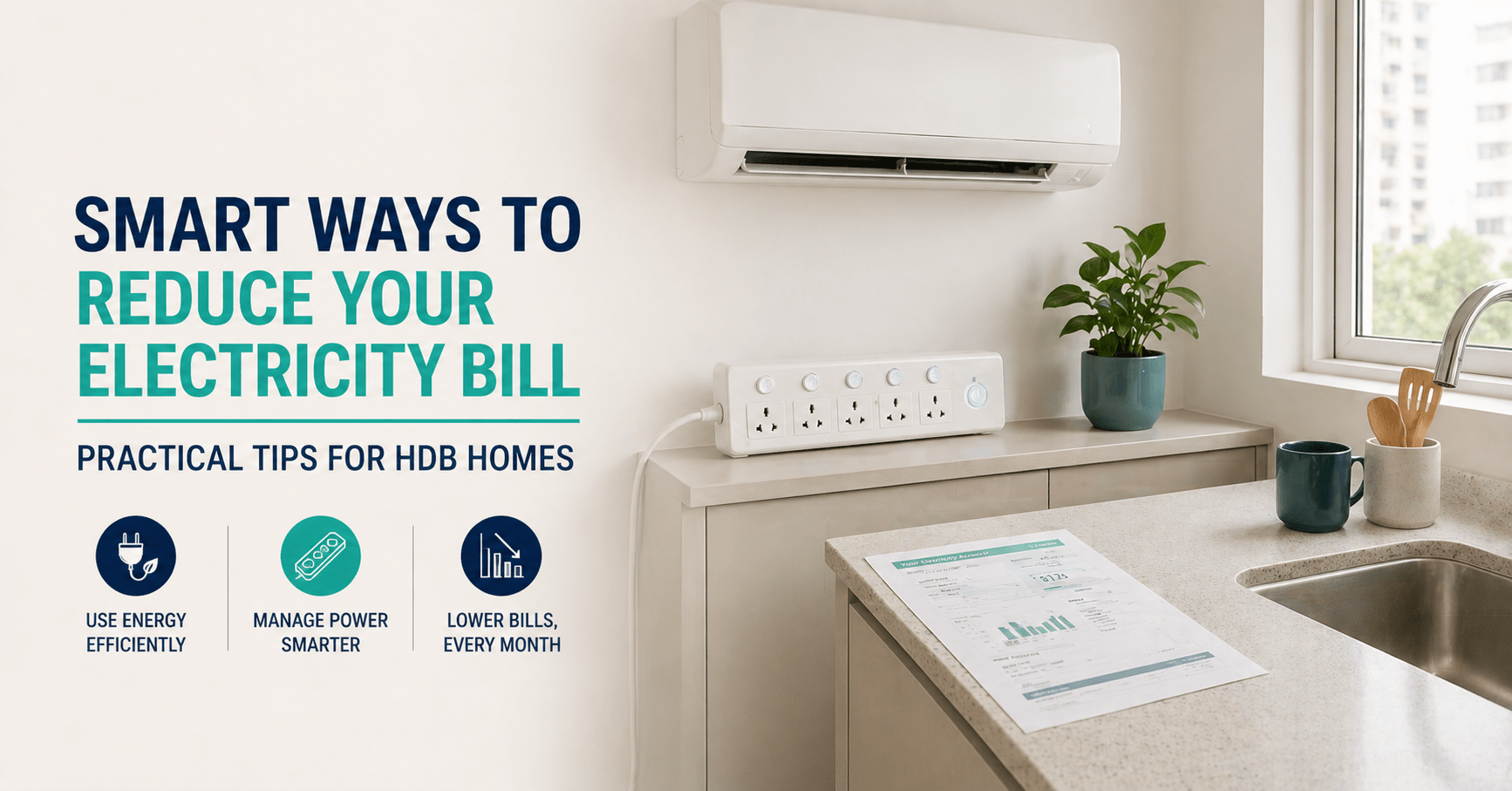
How to Lower Your Electricity Bill in Singapore (2026): 12 Practical Tips That Actually Work
Table of Contents
A typical 3-room HDB household in Singapore spends around $120 on electricity every month. A 5-room flat with two aircon units running nightly sits closer to $200. A condo with a storage water heater and a home office running full-time can push past $280.
None of those numbers are surprising. What is surprising is how much of each bill is avoidable — not through sacrificing comfort, but through a handful of fixable inefficiencies that most households have never looked at.
I went through the EMA data, the SP Group consumption breakdowns, and the practical reality of what actually drives bills in Singapore homes. Aircon and the water heater account for nearly half of the average household bill on their own. Everything else — the fridge, the lights, the phantom loads — fills in the rest.
Fix the big items first. The smaller ones compound.
This guide covers 12 ways to reduce your electricity bill in Singapore, ranked roughly by impact.
Where Your Electricity Bill Actually Goes
Before you fix the problem, know what you are paying for. According to Energy Market Authority data, the typical Singapore household electricity breakdown looks like this:
| Appliance / Use | Share of Bill | Avg Monthly Cost |
|---|---|---|
| Air conditioning | 30–40% | $40–$65 |
| Water heater | 15–20% | $20–$35 |
| Refrigerator | 10–15% | $15–$25 |
| Washing machine + dryer | 8–12% | $10–$20 |
| Lighting | 5–10% | $7–$15 |
| TV + entertainment | 4–8% | $6–$12 |
| Standby / phantom load | 5–10% | $7–$15 |
Aircon and the water heater together account for 45–60% of the bill. Any serious reduction starts there. Tackling the lighting or the TV before fixing your aircon habits is working in the wrong order.
12 Ways to Reduce Your Electricity Bill in Singapore
1. Set Your Aircon to 25°C — Not 16°C
This is the single highest-impact change for the majority of Singapore households. For every degree you raise the aircon setpoint, you save approximately 3–5% in cooling energy.
Running the unit at 16°C does not cool the room faster. It runs the compressor harder and longer, chasing a temperature the room will never reach in Singapore’s humidity. The NEA recommends 25°C as the comfortable baseline for Singapore homes. Most people find 24–26°C with a ceiling fan entirely liveable — including for sleep.
DLCuration Tip: Use the aircon’s built-in timer to switch off 30–45 minutes before you typically wake up. The room stays cool enough on residual cooling, and you stop paying for an hour of compressor work to an empty bed. For households running aircon nightly, this alone saves $10–$20 a month.
2. Service Your Aircon Every 3–4 Months
A clogged aircon filter forces the unit to push air through greater resistance — which means more electricity to deliver the same cooling output. Regular servicing keeps the unit operating at its rated efficiency.
Aircon servicing in Singapore runs $25–$50 per unit per session through reputable companies. Quarterly servicing costs $100–$200 per unit annually. A poorly maintained aircon can consume 20–30% more electricity than a clean one. On a $60/month aircon bill, that is $12–$18 wasted every month — or up to $216 a year. The servicing pays for itself within a few months.
3. Switch to an Instant Electric Water Heater
Storage water heaters — the tank units that keep a reservoir of hot water around the clock — draw electricity continuously to maintain temperature, even at 2am when nobody is showering.
Switching to an instant (on-demand) electric water heater eliminates standby losses entirely. It heats water only when the tap is running. Households that make this switch commonly report 30–50% savings on water heating electricity. Instant heater units cost $150–$400 (Joven, Rheem, and Ariston are all widely stocked in Singapore), and a licensed plumber installs them for $80–$150. The payback period for most Singapore households is under two years on electricity savings alone.
4. Replace Fluorescent Tubes with LED Lighting
If your home still runs fluorescent tube lights or incandescent bulbs, replacing them with LED equivalents is one of the fastest-payback upgrades available. LEDs use 60–80% less electricity than fluorescent equivalents for the same light output and last four to six times longer.
A home with 10 fluorescent tube lights spending $8/month on lighting drops to $1.60–$2.50 monthly after switching to LEDs. Each LED tube costs $8–$18 and pays itself off in under a year at Singapore electricity tariffs.
5. Eliminate Phantom Loads at the Socket
Phantom load — electricity drawn by devices in standby mode — accounts for 5–10% of the average Singapore household’s bill. Set-top boxes, desktop computers in sleep mode, chargers left plugged in with nothing attached, and microwave ovens with digital clocks all draw continuous power.
The fix is a switched extension strip with individual sockets — flip the switch for each bank of devices when not in use. A smart power strip with scheduling (available on Shopee for $15–$40) handles this automatically. Eliminating phantom loads saves $7–$15 a month. It costs nothing once the habit is set, and it compounds.
6. Wash Clothes in Cold Water with Full Loads Only
Washing machines consume most of their electricity heating water. Switching from warm to cold water washing reduces energy per cycle by 75–90% — with no meaningful impact on cleaning for typical Singapore laundry. Cold-water-optimised detergents are now standard in Singapore supermarkets.
Running full loads rather than half loads cuts the number of cycles per week directly. If you currently run seven half-loads a week, consolidating to four full loads saves three full cycles of electricity weekly.
7. Set Your Fridge to the Right Temperature and Check the Door Seal
The recommended refrigerator setting for Singapore homes is 3–4°C for the main compartment and -18°C for the freezer. Colder than this wastes electricity with no food safety benefit.
Check the door seal condition. A degraded seal — test by closing the door on a piece of paper and pulling it out; if it slides free easily, the seal is weak — allows cold air to leak continuously and forces the compressor to run more often. Replacement seals for major refrigerator brands cost $20–$60 from appliance repair shops in Singapore.
DLCuration Tip: Leave at least 5–10cm of clearance behind and around your fridge. The condenser coils at the back need airflow to dissipate heat. A fridge pushed hard against the wall or enclosed in a cabinet runs hotter and longer. This is among the most common oversights in compact HDB kitchens.
8. Run the Aircon and Ceiling Fan Together — Then Raise the Setpoint
A ceiling fan costs $0.02–$0.03 per hour to run. An aircon unit costs $0.25–$0.45 per hour. Running both together lets you raise the aircon setpoint by 2–3°C while feeling equally comfortable — moving air increases perceived cooling without lowering the actual temperature.
At 25°C with a ceiling fan versus 22°C without one, most people report the same comfort level. You have saved 9–15% in aircon electricity. The ceiling fan’s cost is negligible against that saving.
9. Choose 4-Tick or 5-Tick Appliances When Replacing
Singapore’s NEA runs the Mandatory Energy Labelling Scheme (MELS) for major appliances — air conditioners, refrigerators, clothes dryers, TVs, and more. The tick rating runs from one to five ticks. A 5-tick aircon uses approximately 30–40% less electricity than a 1-tick unit of equivalent cooling capacity.
When an appliance reaches end of life, replacing it with a 4-tick or 5-tick equivalent is worth the upfront consideration. A household replacing a 10-year-old 2-tick aircon with a modern 5-tick inverter unit commonly recoups a significant portion of the purchase price through electricity savings over three to four years of Singapore use.
10. Switch to an Open Electricity Market Retailer
Singapore’s Open Electricity Market (OEM), live since 2019, allows households to buy electricity from licensed retailers at negotiated rates rather than SP Group’s regulated quarterly tariff. Retailers including Geneco, iSwitch, Sembcorp, and Tuas Power offer fixed-rate, discount, and renewable energy plans.
A fixed-rate plan locks your price per kWh for 12–24 months — protecting you from SP Group tariff increases. Savings of 5–15% on the electricity component of your bill are achievable depending on plan timing.
Important: Always compare available OEM plan rates against the current SP Group tariff before signing. Use the EMA’s comparison tool at ema.gov.sg. A plan that looked competitive 12 months ago may not be today. Switching requires no physical changes to your home and takes about 15 minutes online.
11. Measure Before You Assume — Use a Smart Plug or Energy Monitor
Most households assume they know which appliances drive their bill. Most are wrong about at least one.
A smart plug with energy monitoring — TP-Link Kasa EP25 or Meross smart plugs are both available in Singapore for $25–$40 — shows real-time and cumulative kWh consumption per device. Plug one into your fridge circuit, entertainment unit, or home office setup and check the actual numbers over a week. The results often surprise.
The NEA also offers free home energy auditing kit loans through selected community clubs — worth checking if you want a full-home audit before spending anything.
12. Read Your SP Group Bill — and Flag Anomalies
This sounds obvious. Most people skip it entirely.
Your SP Group utilities statement shows consumption in kWh by billing period, a comparison to the previous month, and the tariff rate applied. If consumption has jumped unexpectedly, the itemisation tells you which period the spike occurred — useful for tracing a faulty appliance or a change in household habits.
Billing errors are uncommon but do occur, particularly around meter reading estimates versus actual reads. If a bill looks anomalous against your prior months with no lifestyle change to explain it, contact SP Group and request a meter re-read before paying.
How Much Can You Realistically Save?
| Action | Est. Monthly Saving | One-Time Cost | Effort |
|---|---|---|---|
| Raise aircon to 25°C + timer | $10–$25 | $0 | Low |
| Regular aircon servicing | $8–$18 | $100–$200/yr | Low |
| Switch to instant water heater | $8–$15 | $230–$550 installed | Medium |
| LED lighting throughout | $5–$12 | $80–$180 (10 units) | Low |
| Eliminate phantom loads | $7–$15 | $15–$40 | Low |
| Cold water washing + full loads | $4–$8 | $0 | Low |
| Ceiling fan + raised aircon setpoint | $8–$20 | $80–$250 (fan) | Low |
| Switch to OEM electricity retailer | $6–$15 | $0 | Low |
Implementing all zero-cost or near-zero-cost changes — aircon temperature, phantom loads, cold washing, OEM switch, LED lighting — realistically saves $30–$60 a month. Adding the water heater replacement and quarterly aircon servicing pushes annual savings to $600–$1,000 for a typical HDB household.
Frequently Asked Questions
What is the average electricity bill in Singapore for a 3-room HDB flat?
The average monthly electricity bill for a 3-room HDB flat is approximately $100–$140. A 4-room flat with regular aircon use runs $130–$180. 5-room flats and condos with multiple aircon units commonly exceed $200. SP Group publishes average consumption benchmarks by flat type — compare your bill against those figures before assuming yours is abnormal.
How much does running the aircon add to my electricity bill in Singapore?
A 1.0 HP aircon unit running eight hours a night costs approximately $35–$45 per month at Singapore’s electricity tariff. A 1.5 HP unit running the same hours costs $50–$65 per month. Households running two units nightly can attribute $80–$120 of their monthly bill to aircon alone. Raising the setpoint from 22°C to 25°C and using the timer reduces that figure by 15–25%.
Is the Open Electricity Market worth switching to in Singapore?
It depends on current plan rates versus the SP Group regulated tariff at the time you are considering. When fixed OEM plan rates sit below SP Group’s tariff, switching is straightforward and the savings are real. When the regulated tariff drops below available OEM fixed plans, the SP Group rate becomes the better deal. Always compare using the EMA’s live tool at ema.gov.sg before committing to any plan.
Does leaving devices on standby make a meaningful difference to my electricity bill?
Yes — more than most people expect. A set-top box draws $3–$6 per month even when appearing off. A desktop in sleep mode adds $2–$4. A microwave with a digital clock runs continuously. Across a typical Singapore household with five to eight always-plugged-in devices, standby loads commonly add $10–$18 a month. Switched extension strips eliminate this entirely for a one-time cost of $15–$40.
How do I know if my aircon is running inefficiently and costing me more than it should?
Four signs to watch for: your electricity bill has increased without a clear change in usage habits; the unit takes noticeably longer to reach the set temperature than it used to; there is a musty smell when the unit runs; or the compressor runs almost continuously without the room reaching the setpoint. Any one of these signals it is time to service the unit. If servicing does not resolve the issue, a refrigerant top-up or — for units over 10 years old — replacement with a higher-tick model may be the more cost-effective path.
What is the single fastest, cheapest change I can make today to cut my electricity bill?
Raise your aircon setpoint to 25°C and enable the timer to switch off 30 minutes before you wake up. This costs nothing, takes two minutes to configure, and saves $10–$25 a month immediately for households running aircon nightly. The second-fastest change is plugging every always-on device into a switched extension strip — another $7–$15 a month in savings for a one-time cost of $15–$40.
Final Thoughts
The fastest wins on a Singapore electricity bill require no spending at all.
Raise the aircon to 25°C. Switch devices off at the socket. Run full loads in cold water. Those three changes take about ten minutes to implement and realistically cut $20–$40 off your monthly bill — permanently.
From there, the LED lighting switch and the instant water heater replacement involve some upfront cost but pay back within months. The OEM retailer switch takes 15 minutes online and requires no physical changes to your home. And if you have not read your SP Group bill in detail recently — open the last three months and compare your kWh consumption period by period. The numbers will tell you exactly where to look next.
You do not need to implement all 12 tips at once. Pick the three that apply most to your household. Start this week. The savings compound faster than you expect.
Have you tried any of these and seen a noticeable drop in your bill? Share what worked in the comments — I read every one.
Continue reading:


3 Comments