
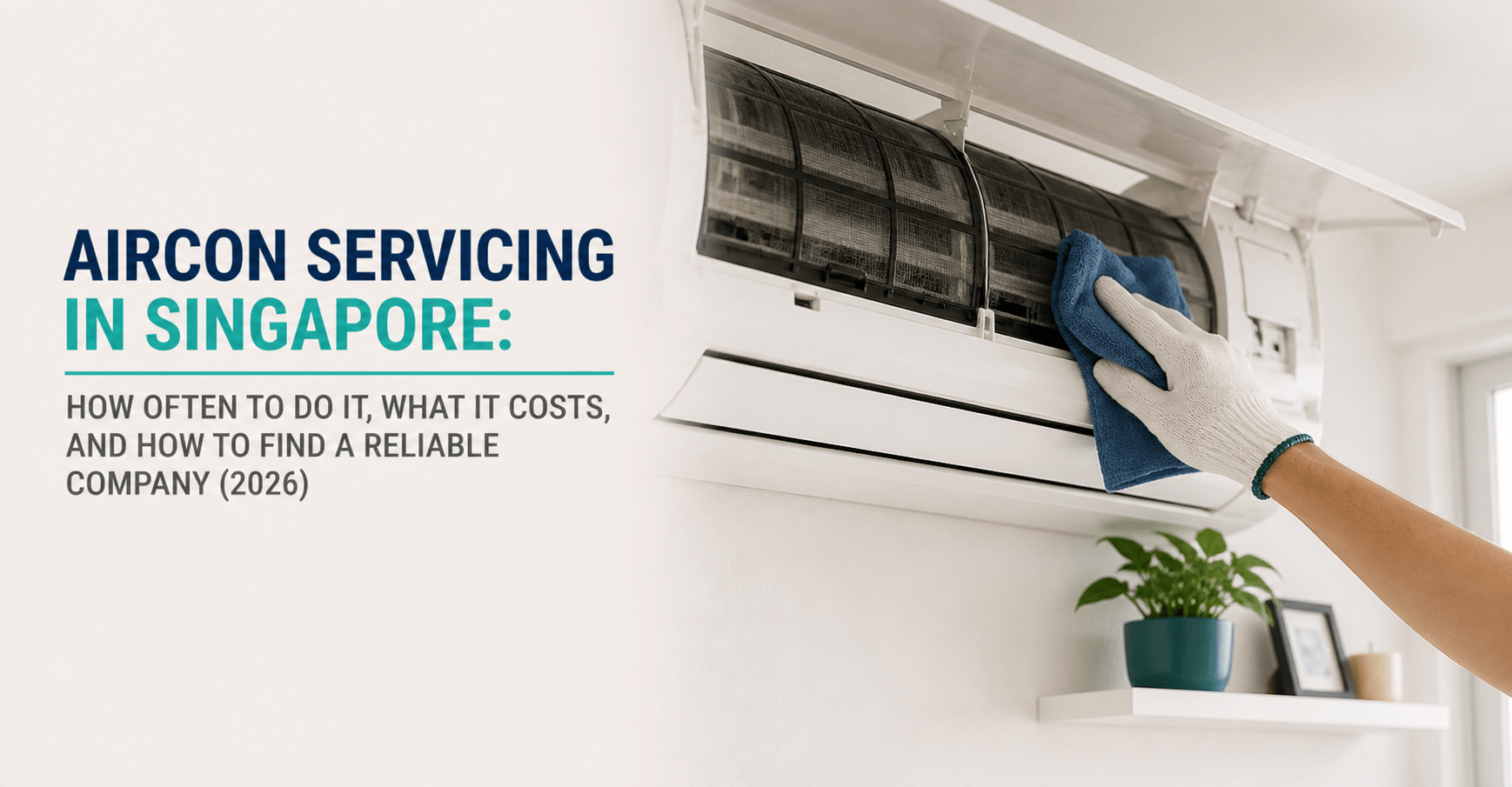
Aircon Servicing in Singapore: How Often to Do It, What It Costs, and How to Find a Reliable Company (2026)
Table of Contents
Most Singapore households fall into one of two groups when it comes to aircon servicing.
The first group services every three months without fail — not because they understand what that interval is based on, but because a technician told them to and they never questioned it. Some of them are paying for chemical washes on units that do not need them, and signing annual contracts that include more visits than their usage warrants.
The second group services once a year if they remember, or waits until the unit stops blowing cold air before calling anyone. By that point, the filters are clogged past the point of basic cleaning, the drainage line is blocked, and what could have been a $50 service call has become a $180 repair.
Neither approach is right. The correct servicing frequency depends on how often you use the unit, how many people and pets are in the home, and whether your flat is near construction dust or road-facing. Understanding what each type of service actually involves — and what it does not — tells you exactly what you need and when.
This guide covers the honest aircon servicing schedule for Singapore homes, what each service type should cost in 2026, what to ask before signing a contract, and how to find a company worth calling back.
Why Aircon Servicing Matters More in Singapore Than Almost Anywhere Else
Singapore’s climate creates conditions that degrade aircon performance faster than temperate climates.
Units run year-round — not seasonally. A typical Singapore HDB household runs the bedroom aircon six to eight hours a night, sometimes longer during haze season. That is 2,000–2,900 hours of annual operation, compared to 500–800 hours in a European or North American home with seasonal use. More operating hours mean faster filter clogging, faster drainage build-up, and faster evaporator coil contamination.
The humidity compounds this. At 80–85% average relative humidity, Singapore’s air carries significantly more moisture than most climates. Aircon units working to dehumidify as well as cool collect water in their drainage trays continuously. A drainage line that goes uncleaned for six months in Singapore’s humidity will develop algae and biofilm growth — which blocks the drain, causes water to overflow from the unit, and can drip through the ceiling into the unit below in a multi-storey HDB building.
A blocked drainage line is the single most common cause of aircon water leakage in Singapore. It is entirely preventable with basic servicing. It costs almost nothing to clear during a routine service call. It can cost several hundred dollars to repair once it causes water damage to the unit or the room below.
Regular servicing in Singapore is not optional maintenance hygiene — it is the minimum required to keep a unit operating efficiently in conditions it is working against continuously.
The Four Types of Aircon Service in Singapore
Understanding what each service type covers — and what it does not — prevents you from paying for things you do not need.
General servicing (basic service)
This is the standard maintenance visit. A general service covers:
- Removing and cleaning the air filters (the mesh filters that catch dust and particles)
- Cleaning the front panel and louvres
- Checking and clearing the drainage tray and drainage pipe
- Checking the remote control operation and thermostat response
- Checking for any obvious leaks or abnormal sounds
What general servicing does not cover: cleaning the evaporator coil (the internal heat exchange component behind the filter), cleaning the fan coil, or chemical treatment of any components. It is surface-level maintenance — essential and frequent, but limited in scope.
Cost in Singapore (2026): $25–$50 per unit for a standalone call. $80–$150 per unit per year under a quarterly servicing contract (four visits, one unit).
Chemical wash (chemical cleaning)
A chemical wash is a deeper clean of the indoor unit. It covers:
- Removing the indoor unit from the wall bracket
- Chemical cleaning of the evaporator coil — removing accumulated dirt, mould, and biofilm from the coil surface
- Chemical cleaning of the drainage tray and drainage pipe
- Cleaning the fan blower wheel (which accumulates thick layers of dust and mould that general servicing cannot reach)
- Flushing and testing drainage after cleaning
- Reassembly and function test
A chemical wash addresses the build-up that accumulates inside the unit over months of operation — the contamination that reduces cooling efficiency, causes musty odours when the unit starts, and eventually restricts airflow. It is meaningfully more involved than a general service and produces a noticeable improvement in unit performance when the unit has been running for 12–18 months without one.
Cost in Singapore (2026): $80–$150 per unit. Avoid companies quoting below $60 — at that price point the wash is rushed or incomplete.
Chemical overhaul
A chemical overhaul is the most thorough service available without replacement. It includes everything in a chemical wash, plus:
- Full disassembly of the indoor unit
- Individual cleaning of all internal components including the fan coil assembly
- Inspection of the electrical components and connections
- Checking refrigerant gas level (top-up is separate if required)
- Full reassembly and extended function test
A chemical overhaul is appropriate for units that have not been properly maintained for several years, units with persistent musty odour after a chemical wash, or units purchased second-hand with unknown maintenance history.
Cost in Singapore (2026): $150–$250 per unit.
Gas top-up (refrigerant recharge)
If your aircon is running but not cooling effectively — the unit blows air but the air is not cold — the issue is often low refrigerant gas rather than a dirty unit. Gas leaks slowly over time through micro-leaks in the refrigerant lines and connections.
A gas top-up involves connecting gauges to the refrigerant lines, confirming the gas pressure is low, and topping up with the appropriate refrigerant type (R410A for most modern Singapore units, R22 for older pre-2010 units). The technician should also check for the source of the leak — a unit that loses gas frequently needs a leak repair, not just repeated top-ups.
Cost in Singapore (2026): $60–$120 per unit for a standard R410A top-up. R22 top-up (for older units) runs higher due to phase-out pricing.
How Often Should You Service Your Aircon in Singapore?
The right servicing frequency is based on usage hours and environment — not a one-size-fits-all quarterly schedule.
| Usage Pattern | Recommended Service Frequency |
|---|---|
| Bedroom unit, 6–8 hours nightly, 1–2 people, no pets | General service every 3–4 months |
| Living room unit, heavy daytime use, family household | General service every 2–3 months |
| Any unit in a home with pets (hair and dander) | General service every 2 months |
| Any unit near construction or dusty road-facing | General service every 6–8 weeks |
| Chemical wash | Every 12–18 months for well-maintained units |
| Chemical overhaul | Every 2–3 years, or when chemical wash does not resolve issues |
DLCuration Tip: The simplest way to check whether your unit needs servicing is to remove the air filter and hold it up to the light. If you cannot see light through it, it is overdue for cleaning. A heavily clogged filter forces the unit to work harder, reduces airflow, drops cooling efficiency, and increases electricity consumption — exactly what quarterly general servicing prevents.
What Aircon Servicing Should Cost in Singapore (2026)
The Singapore aircon servicing market has significant price variation. Here is a realistic price range for standard residential work.
| Service Type | Per Unit (One-Off) | Annual Contract (Per Unit) |
|---|---|---|
| General service | $25–$50 | $80–$150 (4 visits/year) |
| Chemical wash | $80–$150 | Typically add-on to contract |
| Chemical overhaul | $150–$250 | N/A — one-off as needed |
| Gas top-up (R410A) | $60–$120 | N/A — as needed |
| Gas top-up (R22) | $100–$180 | N/A — as needed |
| Repair (fault diagnosis + repair) | $80–$250+ | Depends on fault |
What drives price differences:
- Number of units — companies discount significantly for multi-unit contracts. Three units serviced together by one company will cost less per unit than three separate calls.
- Contract vs. one-off — annual contracts price per-visit lower than one-off calls. If you have two or more units in regular use, a contract is almost always better value.
- Unit type — ceiling cassette units and ducted systems are more involved to service than standard wall-mounted split units and cost more per service visit.
- Company overhead — large national companies with advertising spend pass costs on. Smaller independent contractors often price 15–25% lower for identical work.
Red Flags When Hiring an Aircon Servicing Company
The aircon servicing industry in Singapore has a significant number of reliable, professional operators — and a meaningful number of companies that upsell aggressively, do poor-quality work, or both. Knowing what to watch for protects you.
Recommending a chemical wash at every visit. A general service is appropriate for most units at the quarterly interval. A technician who recommends a chemical wash every visit — or on the first visit without examining the unit’s service history — is almost certainly upselling. Chemical washes are warranted every 12–18 months for normal household use, not every quarter.
Unable to explain what work was done. After any service visit, the technician should be able to tell you what they cleaned, whether the drainage was clear, whether they found any issues, and what the unit’s condition looks like. A technician who finishes in 10 minutes and cannot answer basic questions about the unit’s condition did not do the work thoroughly.
No itemised quote before starting work. Any work beyond a standard general service — chemical wash, gas top-up, replacement parts — should be quoted and approved before it starts. Companies that call you mid-visit to inform you the unit “needs” additional services costing hundreds of dollars, without a prior written quote, are a flag.
Excessively cheap quotes. A general service for $15–$18 per unit sounds like a deal. At that price, the technician is typically spending five to eight minutes per unit — enough to wipe down the front panel and claim the filters were cleaned, but not enough to clear the drainage properly or do anything useful. You get the invoice, not the service.
No verifiable company details. Check that the company has a registered business address in Singapore (not just a WhatsApp number), has verifiable Google reviews, and can provide a job sheet or receipt after the service. Fly-by-night operators exist in this industry and leave homeowners with no recourse when work is done poorly.
How to Find a Reliable Aircon Servicing Company in Singapore
The most reliable method remains word-of-mouth from neighbours or colleagues in the same HDB estate — local knowledge of a technician who has serviced similar units in the same building is worth more than any online review.
For households without a referral, here is how to vet a company:
Check Google reviews — look at the negative ones specifically. A company with 200 reviews at 4.5 stars is less informative than how they respond to the 15 one-star reviews. Companies that acknowledge complaints and resolve them professionally are meaningfully better than companies that dispute every negative review.
Ask for a job sheet after every visit. A professional company provides a written record of what was serviced, what was found, and what was done. This protects you and creates a service history for the unit — useful if you sell the flat or the unit has a warranty claim.
Avoid companies that require large upfront payment for annual contracts. A reputable company charges per visit or invoices after the service. Requiring six to 12 months of contract payment upfront before any work has been done is unnecessary and limits your recourse if service quality drops.
Test with a single service call before committing to a contract. Book one general service visit with a new company before signing an annual contract. Evaluate the technician’s thoroughness, communication, and whether they can answer questions about your unit’s condition clearly.
DLCuration Tip: Keep a simple log of your aircon service dates — a note on your phone or a piece of paper in the household folder — including what service was done and what the technician noted. This prevents you from being upsold on work that was done six weeks ago, and gives you a reference point if the same issue recurs.
Common Aircon Problems in Singapore and What They Signal
| Problem | Likely Cause | Service Required |
|---|---|---|
| Unit blows warm air or not cold | Low refrigerant gas | Gas top-up + leak check |
| Water dripping from indoor unit | Blocked drainage line | General service or chemical wash |
| Musty or mouldy smell when unit starts | Mould on evaporator coil or fan blower | Chemical wash |
| Unit runs but room does not cool adequately | Clogged filter or dirty evaporator coil | General service, then chemical wash if no improvement |
| Unusual rattling or vibration noise | Loose fan blade or debris in unit | Inspection and repair |
| Ice forming on indoor unit or pipes | Low refrigerant gas or severely restricted airflow | Gas top-up or filter/coil clean |
| Remote control unresponsive | Battery or PCB fault | Battery replacement or PCB inspection |
| Unit switches off automatically | Thermal protection triggering due to overheating | Clean filters and check drainage |
Frequently Asked Questions
How often should I service my aircon in Singapore?
For a standard HDB bedroom unit running six to eight hours nightly with one to two occupants and no pets, general servicing every three to four months is appropriate. For living room units with heavier daytime use, or any unit in a household with pets, every two to three months is more suitable. A chemical wash every 12–18 months addresses the deeper internal cleaning that general servicing cannot reach. There is no universal quarterly rule that applies to all units — base it on actual usage and what the filter looks like when you check it.
What is the difference between a general service and a chemical wash for an aircon in Singapore?
A general service cleans the air filters, drainage tray, and external surfaces — it takes 20–40 minutes and handles surface-level maintenance. A chemical wash is a deeper clean that involves removing the indoor unit and chemically treating the evaporator coil, fan blower wheel, and drainage components — it takes 60–90 minutes and addresses the internal contamination that builds up over 12–18 months of operation. General servicing is more frequent and lower cost. Chemical wash is periodic and produces a more significant performance improvement when the unit needs it.
Why is my aircon not cold even after servicing?
The most common cause of inadequate cooling after a service is low refrigerant gas — a general service does not check or top up gas levels. The next most common cause is a dirty evaporator coil that was not addressed by a general service — if the filter cleaning and drainage clearing did not restore performance, a chemical wash targeting the coil is the logical next step. If the coil is clean and gas is at the correct level and the unit is still not cooling effectively, the compressor may be failing — this warrants a diagnostic inspection.
Is an aircon annual contract worth it in Singapore?
For households with two or more units in regular use, an annual contract is almost always better value than individual call-outs — the per-visit cost under contract is typically 20–30% lower, and the scheduling is handled by the company rather than by you each time. For a single unit used occasionally, an annual contract may not be cost-effective depending on how it is priced. The key is ensuring the contract specifies exactly what each visit covers — number of units, service type included, and whether chemical wash is included or an add-on.
What should a basic aircon service cost in Singapore in 2026?
A standalone one-off general service visit for a standard wall-mounted split unit should cost $25–$50 per unit. Under an annual contract covering four quarterly visits, the effective per-visit cost typically falls to $20–$37 per unit depending on the number of units contracted. Quotes significantly below this range usually reflect rushed work. Quotes significantly above this range for a standard general service — not a chemical wash or overhaul — are worth questioning.
How do I know if my aircon needs a gas top-up versus a service?
The clearest sign of low refrigerant gas is an aircon that runs continuously but does not cool the room to the set temperature — the air coming from the unit is not cold, even with clean filters and clear drainage. Ice forming on the indoor unit or the refrigerant pipes is another indicator of low gas. A general service addresses airflow and drainage but does not affect gas levels. If general servicing and filter cleaning do not restore cooling performance, a gas check and top-up is the appropriate next step.
Final Thoughts
Aircon servicing in Singapore is not complicated — but the industry makes it easy to either under-maintain or overpay, and both outcomes cost you.
The practical approach: service the bedroom unit every three to four months with a basic general service, get a chemical wash done every 12–18 months per unit, and call for a gas check if cooling performance drops despite clean filters. That is the complete maintenance picture for most Singapore households.
Find one reliable company, stick with them, and ask for a job sheet after every visit. The service history protects you, and the relationship with a technician who knows your units is worth more than shopping for the lowest quote every time.
Your electricity bill will reflect a well-maintained aircon. Your sleep quality will too.
Have a reliable aircon servicing company in Singapore that you have used for years? Drop them in the comments — recommendations from actual homeowners are the most useful ones.
Continue reading: