
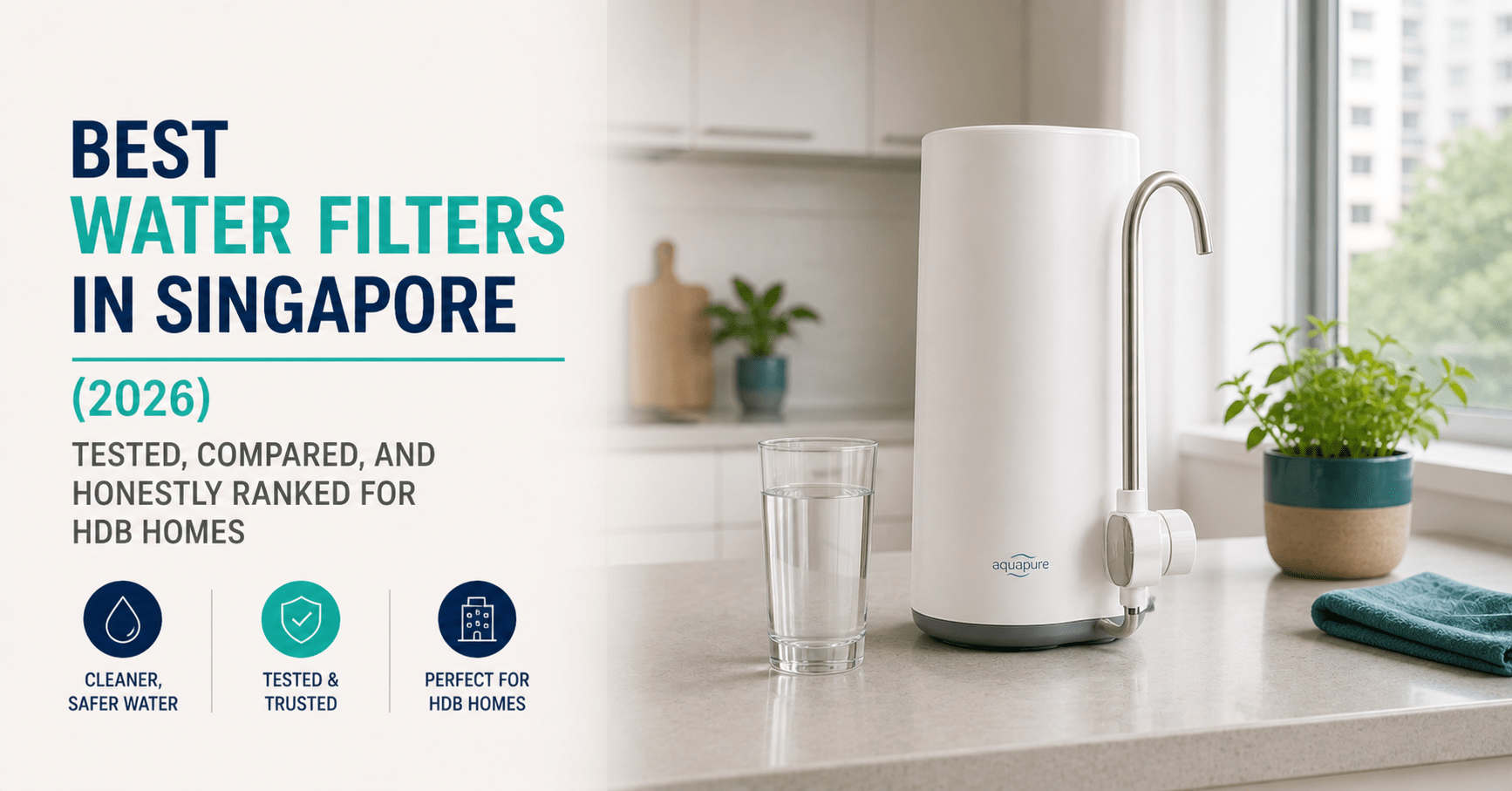
Best Water Filters in Singapore (2026): Tested, Compared, and Honestly Ranked for HDB Homes
Table of Contents
Singapore tap water is technically safe to drink straight from the tap.
PUB (Public Utilities Board) treats it to WHO drinking water standards, and it has consistently passed independent safety tests for decades. If you told someone in Jakarta or Manila that Singaporeans filter water they could drink unfiltered, they would think you were wasting money.
But there is a gap between safe and good. Chlorine — used to disinfect water through the distribution network — leaves a taste and smell that most people find off-putting. Older HDB buildings with ageing internal pipes can introduce sediment, rust particles, and biofilm between the water main and your tap. And for households with infants, elderly members, or immunocompromised individuals, the margin between technically safe and genuinely comfortable widens.
The market for home water filters in Singapore is large, poorly regulated in terms of marketing claims, and full of systems priced far beyond what the filtration technology warrants. I went through the main filter types, the actual filtration specs that matter, and the real cost of ownership — including replacement filters and installation — to identify what is genuinely worth buying.
Here are the six best water filters in Singapore in 2026.
What to Look For in a Home Water Filter for Singapore
Filtration type determines what actually gets removed
Not all filters do the same job. The four main types used in Singapore homes are:
Activated carbon filters remove chlorine, chloramines, and organic compounds — including the taste and odour that most Singapore households find objectionable. They do not remove dissolved minerals, heavy metals, or bacteria. They are the most common filter type in countertop and faucet-mount units.
Reverse osmosis (RO) systems force water through a semi-permeable membrane that removes dissolved solids, heavy metals, nitrates, fluoride, and most bacteria and viruses. RO produces the cleanest water of any home filtration method — but wastes two to four litres of water per litre produced, and strips beneficial minerals along with contaminants.
Ultrafiltration (UF) systems use a hollow fibre membrane to remove bacteria, cysts, and particulates — but not dissolved chemicals or heavy metals. They do not waste water. They sit between activated carbon and RO in terms of filtration thoroughness.
Ceramic filters remove bacteria and sediment through a porous ceramic medium. Common in gravity-fed countertop units. Slow flow rate, effective for particulates, not effective for chemicals or dissolved solids.
For most Singapore households using PUB water in a post-2000 building, an activated carbon filter handles the primary concern — taste and chlorine removal — at the lowest cost and complexity. For households in older buildings with visible rust or sediment, a multi-stage system with a sediment pre-filter and activated carbon is the practical step up. RO is warranted for households with specific water quality concerns or a strong preference for near-pure water.
Filter lifespan and replacement cost — the real cost of ownership
The purchase price of a water filter is almost irrelevant compared to the cost of replacement filters over three to five years of ownership. A $300 unit with $90 replacement filters every three months costs $660 in filters alone in the first year. A $500 RO system with $60 annual filter replacement costs is cheaper over five years.
Always calculate the annual filter replacement cost before comparing unit prices.
Installation requirements
Countertop and gravity filters require no installation. Faucet-mount filters install in minutes. Under-sink and RO systems require cutting into the cold water supply pipe — either DIY (if you are comfortable) or through a licensed plumber ($60–$120 for installation in Singapore). Some under-sink systems also require a separate tap drilled through the countertop.
Flow rate
Filters slow water flow. The best units in this comparison deliver 1.5–2.5 litres per minute on filtered output — fast enough for comfortable daily use. Very cheap carbon filters can drop below 0.5 litres per minute, which most households find unusable at the kitchen sink.
The 6 Best Water Filters in Singapore (2026)
| Model | Type | Best For | Filter Lifespan | Starting Price |
|---|---|---|---|---|
| Coway P-250N | Under-sink multi-stage | Best overall — most HDB households | 6–12 months | ~$399 |
| 3M AP2-C405SG | Under-sink single stage | Clean HDB water, chlorine removal | 12 months | ~$219 |
| Novita NP310 | Countertop RO | Near-pure water without plumbing | 6–12 months | ~$699 |
| Doulton Ultracarb | Countertop gravity | No electricity, chemical-free filtration | 12 months | ~$180 |
| Panasonic TK-CS20 | Faucet-mount | Renters, minimal installation | 3–4 months | ~$79 |
| Hydroviv Under-Sink | Under-sink carbon | Older HDB pipes, sediment + chlorine | 12 months | ~$299 |
1. Coway P-250N — Best Overall for Most Singapore HDB Households
If I had to recommend one water filter for the widest range of Singapore households without knowing anything else about their home, it would be the Coway P-250N.
It is a four-stage under-sink system — sediment pre-filter, activated carbon block, hollow fibre UF membrane, and a final carbon post-filter — that handles the full spectrum of concerns relevant to Singapore tap water: sediment from older pipes, chlorine taste and odour, and bacterial filtration through the UF membrane. The flow rate is strong at approximately two litres per minute, and the separate filtered water tap is clean and well-finished.
Coway is a South Korean brand with a well-established presence in Singapore — service centres, local warranty, and replacement filters are all available through their Singapore distributor and on Lazada. That supply chain reliability matters for a product you will own for five or more years.
What the Coway P-250N is great at:
- Four-stage filtration covers sediment, chlorine, and bacteria in one system — the most comprehensive non-RO option in this comparison
- Strong 2 L/min flow rate — no waiting at the kitchen sink
- Coway Singapore has local service support and readily available replacement filters
- Clean separate tap design that mounts through the countertop without major modification to existing fixtures
Where it falls short:
- Under-sink installation requires tapping into the cold water supply line — either DIY or a plumber call-out at $60–$120
- The countertop tap drilling requires one hole in the countertop — not ideal for renters without landlord permission
- At $399, it is not the cheapest entry point for water filtration
- UF membrane does not remove dissolved heavy metals or nitrates — for those concerns, step up to an RO system
Pricing:
- Unit: ~$399 (Lazada / Coway Singapore official)
- Sediment filter replacement: ~$15 every six months
- Carbon block + UF filter replacement: ~$55–$70 every six to 12 months
- Annual filter cost: approximately $85–$120
Bottom line: The Coway P-250N is the unit I recommend for 3-room to 5-room HDB households that want comprehensive filtration without committing to a full RO system. The four-stage setup handles every real-world water quality concern in Singapore’s distribution network.
2. 3M AP2-C405SG — Best for Clean HDB Water with Simple Installation
The 3M AP2-C405SG is the most straightforward under-sink filter for Singapore households living in post-2000 HDB buildings with no visible water quality issues beyond chlorine taste.
It is a single-stage activated carbon block filter — no membrane, no multi-stage complexity — certified to NSF/ANSI 42 and 53 standards, which means it has been independently tested and verified for chlorine reduction, taste improvement, and cyst removal. 3M’s filtration spec is consistent and reliable. The flow rate at 1.9 L/min is close to the Coway without the additional filter stages.
For Singapore households that simply want the chlorine taste gone and nothing more, this is the cleanest, most cost-effective solution — and the 12-month filter replacement interval is among the best in this class.
What the 3M AP2-C405SG is great at:
- NSF/ANSI 42 and 53 certified — independently verified filtration claims, not just marketing
- 12-month filter lifespan is the longest in this comparison for an under-sink unit
- Simple single-stage system means fewer components to maintain and replace
- 3M Singapore has strong local availability for replacement filters at major retailers and online
Where it falls short:
- Single-stage carbon filtration does not remove sediment, bacteria, or dissolved metals — limited to chlorine and organic chemical reduction
- No filtration of biological contaminants — not suitable for households with very old internal building pipes
- Like all under-sink systems, requires cold water line tap and countertop tap installation
Pricing:
- Unit: ~$219 (Lazada / authorised retailers)
- Replacement cartridge: ~$55–$65 every 12 months
- Annual filter cost: approximately $55–$65
Bottom line: For a newer HDB flat with good-quality internal pipes and no concerns beyond taste and chlorine, the 3M AP2-C405SG is the most cost-effective under-sink solution I tested. Simple, certified, and low-maintenance.
3. Novita NP310 — Best Countertop RO for Near-Pure Water Without Fixed Plumbing
→ Check price on Novita Singapore
The Novita NP310 is the unit for households that want RO-quality water — the closest thing to pure H2O available through a home filter — without committing to a fixed under-sink installation.
It connects directly to the kitchen faucet via a diverter valve with no permanent plumbing modification. The RO membrane removes dissolved solids, heavy metals, nitrates, and most bacteria and viruses — producing water that reads below 20 ppm TDS (total dissolved solids) compared to Singapore tap water’s typical 100–150 ppm. For households with infants, elderly members on restricted sodium diets, or simply a strong preference for the cleanest possible water, RO filtration is the meaningful step up from carbon or UF systems.
Novita is a Singapore brand with local service centres and replacement filters available through their own retail stores and authorised retailers. That matters for an RO system, which has more components — membrane, pre-filter, post-filter — that need periodic replacement.
What the Novita NP310 is great at:
- RO membrane filtration — the most thorough home water purification available short of distillation
- Countertop design connects to existing tap via diverter — no plumbing works, no countertop drilling
- Novita Singapore has local retail presence, service support, and filter availability
- Suitable for renters — fully removable and transferable with no permanent modifications
Where it falls short:
- RO wastes approximately two to three litres of water per litre of filtered output — a real consideration at Singapore’s water pricing
- At ~$699, this is the most expensive unit in this comparison
- RO strips beneficial minerals along with contaminants — the filtered water is very soft and tastes noticeably different from mineral water
- Filter replacement involves three components (pre-filter, membrane, post-filter) at different intervals — more ongoing maintenance than simpler systems
- Flow rate is slower than under-sink non-RO systems — approximately 0.3–0.5 L/min for filtered output
Pricing:
- Unit: ~$699 (Novita Singapore official / Lazada)
- Pre-filter replacement: ~$25–$35 every six months
- RO membrane replacement: ~$80–$100 every 18–24 months
- Post-filter replacement: ~$35–$45 every 12 months
- Annual filter cost: approximately $105–$145
Bottom line: If you want the cleanest water possible without permanent installation, the Novita NP310 is the right choice. The RO water quality is meaningfully better than any carbon or UF system — and the countertop form factor means renters can take it when they move.
4. Doulton Ultracarb — Best Gravity Filter for No-Electricity, Chemical-Free Filtration
→ Check price on Shopee Singapore
The Doulton Ultracarb is a ceramic gravity filter — water pours through a ceramic candle element by gravity alone, requiring no electricity, no installation, and no connection to the water supply. It sits on the countertop, you pour tap water into the top chamber, and filtered water collects in the bottom chamber.
The ceramic element removes bacteria, cysts, turbidity, and sediment to a high level. The Ultracarb variant adds an activated carbon core inside the ceramic element that handles chlorine, taste, and organic compounds as well. It does not remove dissolved metals, nitrates, or viruses — and it does not require electricity to do what it does.
For households that are suspicious of the complexity and ongoing costs of modern multi-stage systems, or for households in transitional living situations (furnished rentals, serviced apartments, short-term stays), the Doulton is the no-fuss option with a long history of reliable performance.
What the Doulton Ultracarb is great at:
- Zero electricity required — works by gravity alone
- No installation, no connection to plumbing — place it on the counter and use it
- Ceramic element is cleanable — brush clean under running water to restore flow rate rather than replacing immediately
- Long service life — the ceramic element typically lasts 12 months before the carbon core needs replacement
- British brand with a 180-year manufacturing history in ceramic filtration
Where it falls short:
- Slow — gravity filtration produces approximately 1.5–2 litres per hour, not per minute
- Capacity is limited to the size of the bottom chamber — typically three to eight litres
- Does not remove dissolved heavy metals, nitrates, fluoride, or viruses
- Countertop footprint is larger than most users expect — the two-chamber gravity system takes up meaningful bench space
- Not suitable as the sole water supply for a large household — the slow fill rate becomes frustrating
Pricing:
- Unit: ~$180 (Shopee / authorised importers)
- Ceramic element replacement: ~$50–$65 every 12 months
- Annual filter cost: approximately $50–$65
Bottom line: The Doulton Ultracarb is the right choice for households that want no electricity dependency, no installation complexity, and a simple and proven filtration method. It is not fast enough to be the primary drinking water source for a family of four — but for one to two people or as a dedicated filtered water station, it delivers.
→ Get the Doulton Ultracarb here
5. Panasonic TK-CS20 — Best Faucet-Mount Filter for Renters
The Panasonic TK-CS20 is the lowest-friction water filter available for Singapore renters — it threads directly onto the existing kitchen tap, no tools required, and adds activated carbon filtration with a simple switch between filtered and unfiltered modes.
It removes chlorine, taste, odour, and some sediment through an activated carbon ceramic composite filter. It does not filter bacteria, dissolved metals, or viruses. The flow rate in filtered mode is approximately one litre per minute — noticeably slower than an under-sink system but workable for filling a glass or kettle.
For renters who cannot drill countertops, tap into supply lines, or make any permanent modification to the kitchen fixtures, the Panasonic TK-CS20 is the practical answer.
What the Panasonic TK-CS20 is great at:
- No installation required — threads onto standard Singapore tap fittings in under two minutes
- Bypasses easily to unfiltered mode for washing dishes and cooking — only filters when needed, extending filter life
- Panasonic replacement cartridges are widely available at Cold Storage, NTUC, Harvey Norman, and online
- The most affordable path to filtered drinking water in this comparison
Where it falls short:
- Filter lifespan of three to four months is the shortest in this comparison — the highest frequency of replacement for the category
- Adds visible bulk to the kitchen tap — aesthetically intrusive in a minimalist kitchen
- Activated carbon only — does not address bacteria, heavy metals, or dissolved solids
- Flow rate in filtered mode is noticeably reduced compared to an open tap
Pricing:
- Unit: ~$79 (Lazada / major electronics retailers)
- Replacement cartridge: ~$18–$25 every three to four months
- Annual filter cost: approximately $55–$100
Bottom line: For renters, the Panasonic TK-CS20 is the obvious recommendation — it requires nothing permanent, costs under $80, and delivers the core benefit most households want from a filter: removing chlorine taste from drinking water.
→ Get the Panasonic TK-CS20 here
6. Hydroviv Under-Sink Filter — Best for Older HDB Buildings with Pipe Concerns
The Hydroviv under-sink filter takes a different approach from the other units in this comparison. Rather than a one-size-fits-all filter configuration, Hydroviv custom-builds each filter cartridge based on your specific local water quality data — including heavy metal content, chlorine levels, and known contaminants for your area.
For Singapore’s context, Hydroviv’s multi-stage activated carbon system is particularly relevant for households in older HDB buildings — pre-1990 blocks — where internal pipe corrosion can introduce lead, copper, and sediment that does not appear in PUB’s bulk water quality reports. The filtration spec includes activated carbon block, KDF media for heavy metal reduction, and a sediment pre-filter.
Hydroviv ships to Singapore (check current availability at their website) and the filter cartridges are designed for 12-month replacement cycles.
What the Hydroviv is great at:
- Filter cartridges are customised to your water quality data — more targeted than generic off-the-shelf filtration
- KDF media provides heavy metal reduction (lead, copper, mercury) beyond what activated carbon alone delivers
- 12-month filter replacement cycle — same as the 3M at roughly comparable cost
- Strong independent NSF certifications for heavy metal reduction specifically
Where it falls short:
- International brand with no local Singapore retail presence — replacement filters ordered from overseas, with lead times to factor in
- Higher unit cost than the 3M at comparable single-stage simplicity
- Overkill for households in post-2000 HDB buildings with no pipe quality concerns
- No local warranty or service support if the unit has an issue
Pricing:
- Unit: ~$299 (Hydroviv.com — shipping to Singapore)
- Replacement filter: ~$75–$85 every 12 months (includes international shipping)
- Annual filter cost: approximately $75–$85 plus shipping
Bottom line: If you live in a pre-1990 HDB block and have any concern about lead or copper from ageing internal pipes, the Hydroviv’s customised heavy metal filtration is the specific solution for that specific problem. For everyone else, the Coway or 3M is the more practical choice.
How to Choose the Right Water Filter for Your Singapore Home
The decision is simpler than the market makes it look. Here is how I would frame it.
If you live in a post-2000 HDB flat with no visible water quality issues → Start with the 3M AP2-C405SG. Chlorine removal, 12-month filter life, certified specs, lowest long-term cost. Most Singapore households need nothing more.
If you want comprehensive multi-stage filtration — sediment, chlorine, and bacteria — without going full RO → Coway P-250N. The four-stage setup handles the full realistic range of Singapore water quality concerns. This is the unit for households that want thoroughness without overthinking it.
If you want the cleanest water possible and are willing to pay for it → Novita NP310. RO filtration removes what no other system in this list touches. For households with infants, immunocompromised members, or a genuine preference for near-pure water, this is the appropriate step up.
If you rent and cannot modify the kitchen fixtures → Panasonic TK-CS20 for a faucet-mount, or Novita NP310 if you want RO quality and can use the tap-diverter installation.
If you want zero electricity dependency and simple operation → Doulton Ultracarb. Not for a high-volume household — but for one to two people wanting genuinely simple filtration, it is the honest recommendation.
If you live in a pre-1990 HDB block with old pipes → Hydroviv. The heavy metal filtration is purpose-built for this concern. The supply chain is less convenient than locally available brands, but the filtration spec is specifically what older-building households need.
Is Singapore Tap Water Safe Without a Filter?
The short answer is yes. PUB’s treated tap water consistently meets WHO drinking water guidelines. Independent testing by consumer organisations in Singapore has found no significant safety concerns with tap water at the source.
The practical reasons most households filter anyway:
- Chlorine taste and smell — noticeable in freshly poured tap water, particularly in areas closer to water treatment plants
- Ageing building pipes — the water leaving PUB’s treatment facilities is clean; what it picks up in older internal building plumbing is less certain
- Taste preference — filtered water simply tastes better for most people, regardless of safety
- Peace of mind — for households with infants, elderly members, or immunocompromised individuals, the additional filtration margin is worth the cost
A water filter in Singapore is a comfort and taste upgrade for most households. For a subset with genuine pipe concerns, it is also a practical safety measure.
Frequently Asked Questions
Is Singapore tap water safe to drink unfiltered?
Yes — PUB-treated tap water meets WHO drinking water standards and has consistently passed independent safety testing. The primary reasons most Singapore households filter are taste (chlorine), odour, and concern about older building pipes rather than a genuine safety risk with the source water itself. A water filter in most Singapore homes is a meaningful quality upgrade rather than a safety necessity.
What is the best water filter type for a Singapore HDB flat?
For most HDB flats in post-2000 buildings, an activated carbon under-sink or countertop filter removes chlorine taste and odour — the primary concern — at the lowest cost and complexity. For older buildings with pipe concerns, a multi-stage system adding a sediment pre-filter and UF membrane (like the Coway P-250N) is the practical step up. RO is warranted for households wanting near-pure water for specific health reasons or strong taste preferences.
How often do I need to replace water filter cartridges in Singapore?
Replacement frequency varies by filter type and usage volume. As a general guide: faucet-mount carbon filters (Panasonic) every three to four months; under-sink carbon filters (3M, Hydroviv) every 12 months; multi-stage systems (Coway) with multiple filter stages every six to 12 months depending on the stage; RO systems every six months for pre-filters, 18–24 months for the membrane, 12 months for the post-filter. Always follow the manufacturer’s indicator light or replacement schedule — extending filter life beyond the recommended interval reduces filtration effectiveness and can introduce bacterial growth in the filter media.
Do I need a plumber to install a water filter in Singapore?
Faucet-mount filters require no plumbing — they thread onto the existing tap fittings. Gravity countertop filters require no installation. Under-sink and RO systems require tapping into the cold water supply line. This is a straightforward DIY task for anyone comfortable with basic plumbing — a push-fit connector on the cold water inlet, no soldering or specialist tools required. If you are not comfortable doing it yourself, a licensed plumber in Singapore charges $60–$120 for a typical under-sink filter installation call-out.
Does reverse osmosis water taste different from regular filtered water?
Yes — noticeably. RO water has a TDS (total dissolved solids) reading typically below 20 ppm, compared to Singapore tap water’s 100–150 ppm. The absence of dissolved minerals gives RO water a flat, slightly hollow taste that many people describe as “too clean” or “empty” compared to mineral water. Some RO systems include a remineralisation stage that adds back calcium and magnesium — this improves taste significantly. If you are sensitive to taste, try RO water before committing to a system.
What is the annual cost of running a water filter in Singapore?
Annual filter replacement costs range significantly by system type. A faucet-mount Panasonic cartridge costs $55–$100 annually (replaced every three to four months). An under-sink 3M system costs $55–$65 annually. A multi-stage Coway system costs $85–$120 annually. A Novita RO system costs $105–$145 annually. Factor in the unit purchase cost amortised over five years when comparing total cost of ownership — a more expensive unit with lower annual filter costs often works out cheaper over five years than a cheap unit with expensive frequent replacements.
Final Verdict
For most Singapore households in post-2000 HDB flats, the question is not whether to filter — it is which system fits the specific home, household size, and budget.
The 3M AP2-C405SG is the right starting point for households that want certified, low-maintenance chlorine removal at the lowest five-year cost. The Coway P-250N is the step up for households that want multi-stage filtration covering sediment and bacteria as well. The Novita NP310 is for households that want the cleanest water available without permanent plumbing.
For renters who cannot modify fixtures, the Panasonic TK-CS20 is the obvious choice. For older-building households concerned about pipe quality, the Hydroviv addresses that specific concern directly. And for anyone who wants zero complexity and zero electricity dependency, the Doulton Ultracarb remains a solid, proven option.
The market for home water filters in Singapore contains a lot of noise. The six units above represent what I would actually buy — or recommend to someone I know — for their specific home and circumstances.
Which water filter are you currently using at home, or what question do you have before buying? Drop it in the comments and I will do my best to help.
Continue reading: