

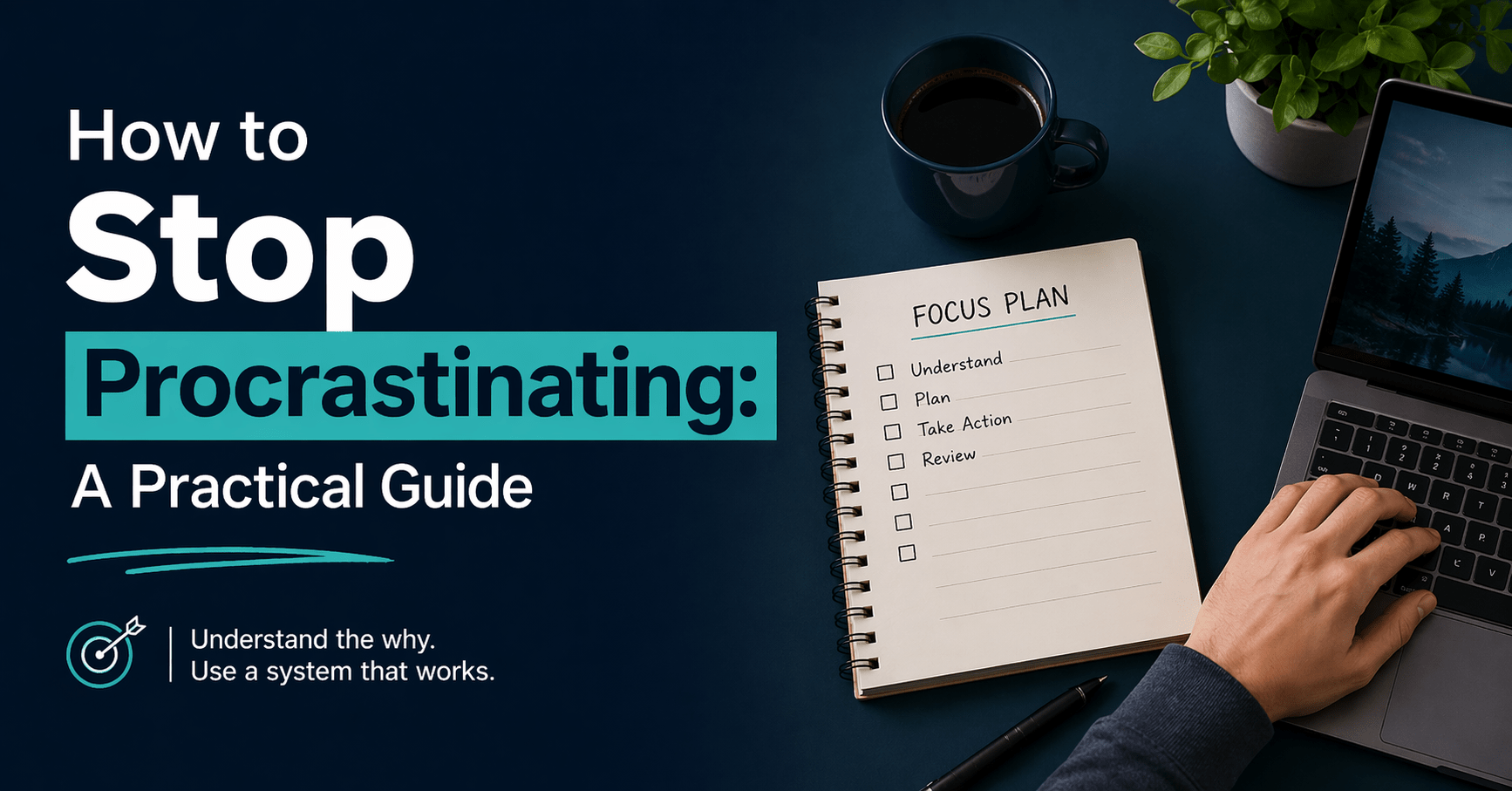
How to Stop Procrastinating: A Practical, Science-Backed Guide
Table of Contents
A 30-minute task sits on your to-do list for three days. You open the tab, close it, open it again. You make coffee. You reorganize your desktop. You tell yourself you’ll do it when you’re “in the right headspace.”
Sound familiar?
The standard advice — break tasks into smaller pieces, use a timer, reward yourself — gives you tactics that work for about a day before the same avoidance pattern returns. That’s because most anti-procrastination advice treats procrastination as a time management problem.
It isn’t.
Research from Dr. Fuschia Sirois at Durham University and Dr. Timothy Pychyl at Carleton University — two of the most cited researchers on the topic — consistently frames procrastination as an emotion regulation problem. You don’t avoid tasks because you’re bad at managing time. You avoid them because the task triggers a negative emotional state — anxiety, boredom, self-doubt, resentment — and your brain reaches for relief.
That reframe changes everything. Because once you understand what’s actually driving the avoidance, you can address it directly — not just work around it with productivity hacks that collapse under pressure.
Here is the complete system.
Why Most People Approach Procrastination Wrong
The typical approach is to add structure: to-do lists, time blocks, accountability partners, app blockers. These are not useless — they reduce friction and create helpful constraints. But they treat the behavior, not the cause.
The result is predictable. The structure works when motivation is high. The moment a task feels threatening — when there are real stakes, ambiguity, or risk of failure attached — the same avoidance pattern returns, and the structure collapses with it.
The core mistake is believing that the solution to “I don’t want to do this” is “do it anyway.” Sometimes that works. But for persistent, recurring procrastination — the kind that follows you from job to job, project to project — forcing compliance without addressing the underlying emotional response is a short-term fix that creates long-term exhaustion.
The principle this system is built on: reduce the emotional cost of starting, not just the practical friction of the task.
Why You Actually Procrastinate: The Real Mechanisms
Before the system, it’s worth naming what’s actually happening. Procrastination on specific tasks typically traces back to one of five emotional triggers.
Anxiety about the outcome. The task feels high-stakes — a difficult conversation, a creative project being judged, work that connects to your sense of competence. Avoidance protects you from the discomfort of potentially failing or being evaluated negatively.
Ambiguity about the next step. The task is too vague. “Work on the proposal” is not a task — it’s a category. Your brain resists starting because there is no clear first action. The task isn’t hard; it’s undefined.
Resentment or low intrinsic value. You’re doing it for someone else, under conditions you didn’t choose, with no meaning attached. Procrastination here is your brain’s quiet protest.
Perfectionism. Starting means producing something imperfect. Not starting preserves the possibility of perfect. The task stays undone because done means done imperfectly.
Stimulation deficit. The task is boring and your brain is under-stimulated. It seeks novelty — email, social media, anything with variable reward. This is especially common in open-plan offices and during the afternoon energy dip.
Knowing which trigger applies to a specific task is the first diagnostic step. The fix for anxiety is different from the fix for ambiguity.
The Tools and Resources You Need
This system requires no paid software. Everything runs on one principle — lowering the emotional cost of starting — applied through a small set of techniques.
A task list that lives outside your head — any app or paper system works. The point is externalizing tasks so your working memory isn’t carrying them. Todoist (free tier) is the cleanest digital option. A notebook works equally well.
A timer — any timer. The built-in timer on your phone is enough. You’ll use it differently than you’re used to.
A “parking document” — a single open document (Notes, Google Docs, anything) for capturing intrusive thoughts during focus sessions. This eliminates one of the biggest concentration killers.
Optional: Freedom ($3.33/month) — a website and app blocker for creating enforced focus windows. Not necessary, but removes one category of friction for people whose avoidance involves screen-switching.
Total cost of the system: $0 to $3.33/month.
The Full System: Step by Step
Step 1 — Diagnose the trigger before the session (2 minutes)
Before starting any task you’ve been avoiding, ask one question: Why don’t I want to do this right now?
Write down the honest answer. Not the surface answer (“I don’t have time”) — the real one. “I’m not sure it’ll be good enough.” “I don’t know where to start.” “I don’t care about this task.” “I’ll have to deal with conflict once it’s done.”
This step takes two minutes and does more than any productivity hack, because it makes the emotional cost visible. Avoidance thrives in the gap between feeling uncomfortable and not knowing why. Naming the trigger closes that gap.
What you end up with: A specific diagnosis — anxiety, ambiguity, resentment, perfectionism, or boredom — that tells you which technique to apply next.
Step 2 — Apply the right intervention for the trigger (5 minutes)
If the trigger is anxiety: Use implementation intentions — a specific if/then commitment. Instead of “I’ll work on the report today,” write: “When I sit down at 10AM, I will open the document and write the first section heading.” This specificity reduces the cognitive load of starting and has strong research support for reducing avoidance. Pair this with a two-minute reminder that imperfect work submitted is worth more than perfect work withheld.
If the trigger is ambiguity: Spend three minutes converting the vague task into a first physical action. “Write the proposal” becomes “Open a blank document and write the section headings.” “Sort out the taxes” becomes “Find last year’s documents and put them on the desk.” The task doesn’t get smaller — the entry point gets clearer.
If the trigger is resentment: This one requires honesty. If the task is genuinely not worth doing, the right answer may be to remove it from your list entirely. If it must be done, pair it with something that adds meaning — do it while listening to something you enjoy, set a firm end time so the resentment has a boundary, or connect it to a downstream outcome you do care about.
If the trigger is perfectionism: Use the “bad first draft” permission structure. Tell yourself explicitly: the goal of this session is to produce something bad. Not good, not polished — just existing. A bad draft is infinitely more useful than a blank page, and producing it removes the perfectionism block in a way that “just start” never does.
If the trigger is boredom: Change the environment or the format. Move to a different location. Add a constraint — write for 25 minutes straight, or set a word-count floor, not a ceiling. Give your brain a low-stimulation soundtrack (brown noise, lo-fi, silence). Sometimes a stimulation deficit just needs a different input channel.
What you end up with: A specific, matched intervention ready to deploy before you open the task.
Step 3 — Use the two-minute rule for low-resistance entry (2 minutes)
David Allen’s two-minute rule from Getting Things Done carries a productivity insight worth applying here in a specific way: if a task takes less than two minutes, do it immediately. But for larger tasks you’ve been avoiding, the rule applies differently — commit to working on the task for exactly two minutes, after which you’re allowed to stop.
This sounds almost insultingly simple. It works because the emotional cost of “starting a two-minute session” is much lower than the emotional cost of “starting a three-hour project.” And the consistent research finding — replicated by Pychyl and colleagues — is that once people start a task, they continue. The discomfort that drove the avoidance was anticipated, not actual.
The two-minute entry is a mechanism to get past the anticipation. Most of the time, you will not stop after two minutes.
What you end up with: Task initiated. The hardest part — starting — is done.
Step 4 — Work in protected sessions with a parking document (25–90 minutes)
Once started, the next enemy is task-switching — the pull toward email, messages, and anything with a notification badge. This is where structure tools help.
Work in a closed session: one task, no other tabs, phone face-down or in another room. Use the parking document actively. Every time an unrelated thought arrives — “I need to email someone,” “I should check that thing,” “did I reply to that?” — write it in the parking document and return to the task. This isn’t about willpower. It’s about giving the thought somewhere to go so your brain stops looping on it.
Session length: 25 minutes is the classic Pomodoro unit and works well for most tasks. For deep, complex work, 45–90 minute sessions with a proper break between them often produce better output. The right length is whichever you can sustain without your attention fragmenting.
What you end up with: A completed session of genuine focused work — not the distracted half-work that most people mistake for productivity.
Step 5 — Close the session and reset (5 minutes)
At the end of a session, do three things: note exactly where you stopped (so resuming tomorrow has a clear entry point), process the parking document (add items to your task list or delete them), and disconnect from the work entirely for at least 10 minutes before starting the next session.
The reset matters because cognitive fatigue accumulates invisibly. Skipping the break and immediately starting the next task means the second session runs on degraded attention — you’re physically present but not fully focused.
What you end up with: A clear handoff to your future self. The task is easier to resume tomorrow because you know exactly where to start.
The Full Time Breakdown
| Step | Old pattern | This system |
|---|---|---|
| Pre-task (deciding to start) | 20–60 mins avoidance | 2 mins diagnosis |
| Entry (getting into the work) | 15–30 mins resistance | 2 mins two-minute rule |
| Focus (actual working time) | 90 mins, constant interruptions | 25–90 mins protected session |
| Recovery (close and reset) | Unmanaged, repeats constantly | 5 mins structured close |
| Total elapsed for 60-min task | Often 3–4 hours | 60–90 mins |
What This System Cannot Do
It cannot fix structural problems. If you’re procrastinating because a job is genuinely wrong for you, because a relationship is causing avoidance, or because burnout has depleted your baseline energy — a productivity system is the wrong tool. These require a different kind of attention.
It cannot replace rest. Procrastination rates are significantly higher when people are sleep-deprived or running on an energy deficit. If the system is failing consistently, check sleep and recovery first.
It cannot override every anxiety response. Severe anxiety around performance or evaluation — the kind that produces paralysis rather than just delay — is beyond what a productivity technique should be managing. That’s a conversation for a therapist or psychologist, not a to-do list.
It will not work if you skip Step 1. Every method in this guide requires two minutes of pre-task diagnosis. That step can feel unnecessary when you’re already frustrated. It is not. Skipping it and going straight to the timer almost always produces the same avoidance pattern.
Tips to Get Better Results
Name the trigger out loud. Speaking the diagnosis — “I’m avoiding this because I’m afraid it won’t be good enough” — is more effective than writing it silently. Verbalizing reduces the emotional charge.
Shrink the first session deliberately. On tasks you’ve been avoiding for more than a week, set the first session to 10 minutes, not 25. The goal is a completed session and a broken avoidance pattern, not maximum output.
Review your parking document at end of day, not during sessions. Mid-session processing is a form of task-switching. Save it for the five-minute close.
Change your environment when the trigger is boredom. Working in the same chair at the same desk every day is a reliable stimulation deficit for many people. A library, a coffee shop, a different room — the novelty of a new environment often provides just enough stimulation to close the gap.
Don’t grade sessions by output. Grade them by the quality of your attention. A 25-minute session where you were genuinely focused but produced one paragraph is more valuable than 90 minutes of distracted typing that produced 800 words you’ll delete.
Stack easy wins on hard days. On days when the emotional cost of starting is unusually high, start with a task you’re confident about completing — not the hardest item on your list. The psychological momentum from a completed task genuinely reduces procrastination on the next one.
Frequently Asked Questions
Why do I keep procrastinating even when I want to do the task?
Wanting to complete a task and experiencing the emotional cost of starting it are two separate things. Even tasks you care about can trigger anxiety, ambiguity, or perfectionism that drives avoidance. The desire to finish doesn’t eliminate the negative feeling attached to starting. That’s why the diagnostic step — identifying the specific trigger before you begin — is more useful than motivation-based advice.
Does the Pomodoro Technique actually work for procrastination?
Pomodoro helps with the task-switching and distraction side of procrastination — it creates a protected time window that reduces interruptions. But it doesn’t address the emotional trigger that causes the delay in starting. If you’re using Pomodoro but still spending 40 minutes avoiding the first session, the technique is not the right first tool. Diagnosis comes before structure.
How is this different from just “eating the frog” — doing the hardest task first?
Eating the frog is a scheduling principle: prioritize the most important task at the start of the day. It’s useful but incomplete. It tells you when to do the hard thing, not how to handle the emotional resistance that makes it hard. Someone who procrastinates on their most important task will still procrastinate on it whether it’s scheduled first or last. The how-to-start question is a different problem from the when-to-schedule question.
What’s the best app for beating procrastination?
No app fixes procrastination on its own. The most useful tools are ones that reduce friction at the entry point — a simple task manager like Todoist for clarity, a distraction blocker like Freedom for focus windows, and a timer for session structure. The system matters more than the software. Use the simplest tools you’ll actually maintain, not the most feature-rich ones you’ll spend three days setting up and then abandon.
Can procrastination be a sign of something else?
Yes. Persistent, pervasive procrastination — across almost all areas of life, not just specific task types — can be associated with ADHD, depression, anxiety disorders, and burnout. If the system in this guide makes logical sense but consistently fails to produce any change, it’s worth exploring whether a deeper pattern is at play. A GP or psychologist is the right starting point, not a new productivity app.
Does this system work for creative work, not just tasks?
Yes, with one modification. Creative work carries a heavier perfectionism trigger than most other task types, because the output is an expression of judgment and taste. The “bad first draft” permission structure in Step 2 is particularly important here. Give yourself explicit permission to produce something you’d be embarrassed to show anyone — then produce it. The editing phase is separate from the creation phase, and conflating them is the single most common reason creative procrastination persists.
Final Verdict
Procrastination is not a discipline problem. It is an emotional response to tasks that feel threatening, undefined, meaningless, or insufficiently stimulating — and no amount of scheduling or timer apps addresses it at that level.
The system in this guide does one thing differently from most productivity advice: it asks you to name what’s actually happening before reaching for a tactic. That two-minute diagnostic step is the highest-leverage point in the entire framework.
The steps:
- Diagnose the trigger before every avoided task
- Apply the matched intervention — anxiety, ambiguity, resentment, perfectionism, and boredom each have a different fix
- Use the two-minute entry rule to lower the emotional cost of starting
- Work in protected sessions with a parking document for intrusive thoughts
- Close the session properly so tomorrow’s start has a clear entry point
Do that consistently for two weeks and the pattern changes — not because you became more disciplined, but because you stopped fighting the wrong enemy.
Real-life DLC for your daily living.
Continue reading:


One Comment