

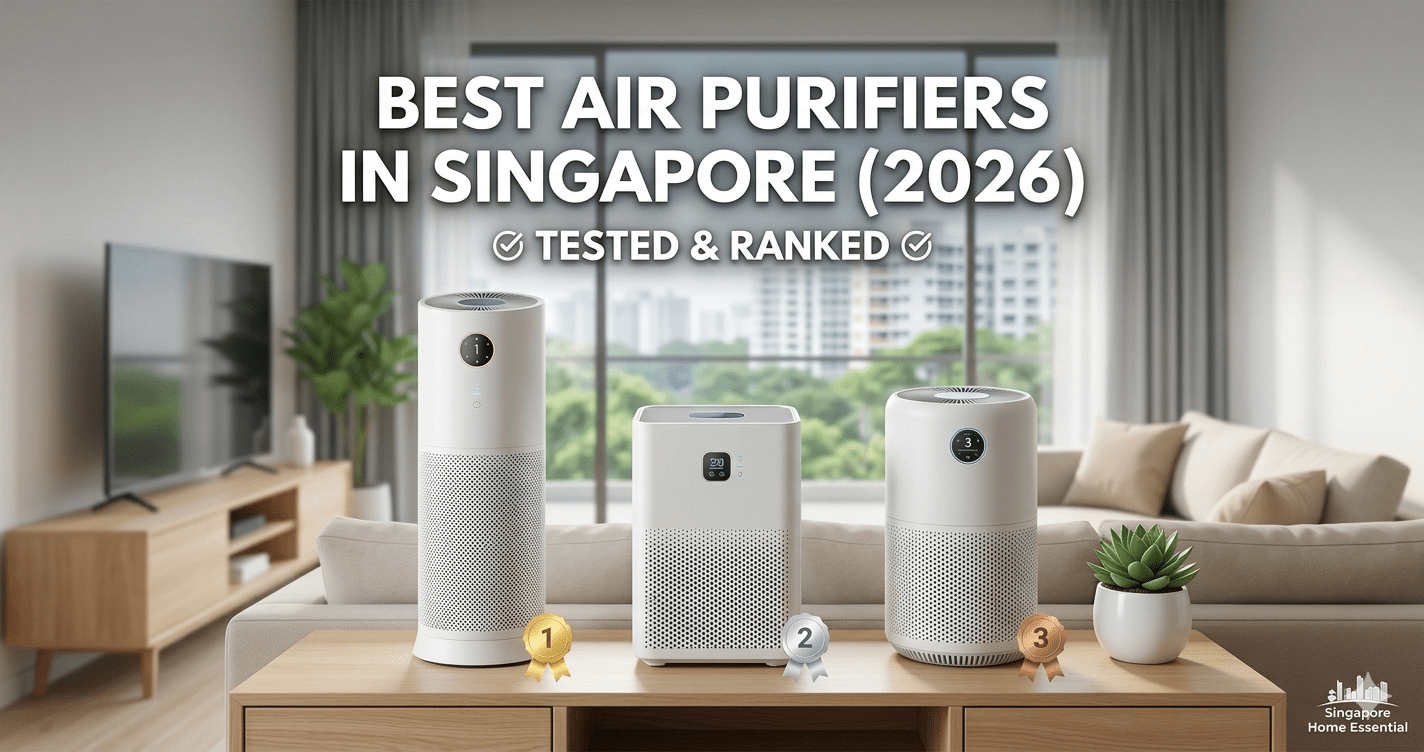
Best Air Purifiers in Singapore (2026): Tested & Ranked
Table of Contents
Singapore’s air is, for the most part, decent. But haze season, cooking smells locked into HDB corridors, dust from perpetual construction nearby, and the general humidity all add up. If you’ve been sneezing more than usual at home or waking up with a dry throat, an air purifier is one of the more impactful things you can add to your space.
The problem is that the market is cluttered with models that look identical and vary wildly in actual performance. This guide cuts through that.
We looked at filtration specs, actual CADR ratings against room sizes common in Singapore homes, noise levels (important if you’re running it overnight), energy consumption, and long-term filter costs. Here’s what held up.
What to look for in an air purifier for Singapore homes
Before the recommendations, a quick framework — because the right answer depends heavily on your space.
Room size and CADR rating
CADR (Clean Air Delivery Rate) tells you how fast a unit cleans a room. A higher CADR is better, but what you need depends on your room size. A rough rule: your CADR should be at least two-thirds of your room’s square footage (in sq ft). For a typical HDB bedroom of around 120 sq ft, a CADR of 80+ is sufficient. For an open-concept living and dining area of 400–600 sq ft, you want 250–400.
Filtration type
True HEPA (H13 standard) is the baseline worth paying for. It captures 99.97% of particles down to 0.3 microns — that includes dust mites, pollen, PM2.5, and most airborne bacteria. Some units add an activated carbon pre-filter for odours and VOCs. Ionic and UV-C additions are largely marketing; the core HEPA layer is what matters.
Noise levels
Singapore apartments are compact. If your air purifier sounds like a desk fan on full blast, you won’t use it at night — which is when it matters most. Look for models that run below 35 dB on their lowest sleep setting.
Filter replacement costs
The unit price is only half the equation. Some brands sell replacement filters at $60–$120 per set, required every 6–12 months. Factor that into your annual cost of ownership.
Best air purifiers in Singapore (2026 picks)
1. Xiaomi Smart Air Purifier 4 Pro — Best overall for most Singapore homes
Best for: HDB living rooms, bedrooms, open-plan studios Room coverage: Up to 60 m² CADR: 500 m³/h Noise (sleep mode): 33 dB Filter replacement cost: ~$45–$55 per set Approximate price: $199–$249
The Xiaomi 4 Pro has become a go-to recommendation in Singapore for good reason. Its CADR of 500 m³/h handles most standard HDB room configurations with headroom to spare. The app integration via Xiaomi Home is genuinely useful — you can schedule it to ramp up during cooking hours and back down overnight without thinking about it.
Filter costs are among the most reasonable in this class. At $45–$55 per replacement set (available readily on Lazada and Shopee), it doesn’t sting the way some premium brands do six months in.
Honest caveat: the build feels plasticky compared to models twice the price, and the laser particle sensor placement can occasionally read cooking steam as pollution. If you’re cooking with the unit nearby, expect it to go into overdrive briefly.
Verdict: Strong performance-to-cost ratio. Our top pick for most homes.
2. Dyson Purifier Cool Gen1 TP10 — Best for combined cooling and purification
Best for: Bedrooms, living rooms, year-round use Room coverage: Whole room (Dyson’s auto mode adjusts) CADR: Not officially published; independent tests suggest ~360–400 m³/h equivalent Noise (sleep mode): 34 dB Filter replacement cost: ~$80–$100 per set Approximate price: $699–$799
If you want one device that handles both air circulation and purification, the Dyson TP10 makes a reasonable case. Its 350° oscillation covers a room well, and the HEPA+activated carbon combined filter handles particulates and odours in one pass.
The trade-off is cost — both upfront and ongoing. At $699+, you’re paying a significant premium. The filter replacements at $80–$100 are on the higher end, and Dyson recommends annual replacement.
That said, for Singapore’s climate — where a fan-equivalent function means the unit genuinely earns its keep year-round — the dual use does justify part of the premium for the right buyer.
Verdict: Premium pick with genuine dual-use value. Hard to justify on purification alone, but worth it if the fan function matters to you.
3. Philips Series 3000i AC3033 — Best for allergy sufferers
Best for: Bedrooms, nurseries, households with allergy or asthma concerns Room coverage: Up to 95 m² CADR: 400 m³/h Noise (sleep mode): 33 dB Filter replacement cost: ~$70–$85 per set Approximate price: $399–$449
The Philips 3000i consistently performs well in third-party HEPA filtration tests, particularly for fine particle capture at the lower end of the PM spectrum. For households where someone has diagnosed allergies, asthma, or is immunocompromised, the reliability of its filtration is worth paying for over cheaper options.
Its auto mode is well-calibrated — it responds to air quality changes without wildly overcorrecting the way some budget units do. The VitaShield IPS filter is also available in Singapore through official Philips channels, which matters for consistency.
Noise at sleep mode is genuinely quiet. Running it overnight in a bedroom is unobtrusive.
Honest caveat: The app (Philips Air+) is functional but not elegant. If smart home integration is important to you, the Xiaomi ecosystem is smoother.
Verdict: Best filtration reliability in the mid-range. Our pick for health-priority households.
4. Levoit Core 300S — Best for small rooms and bedrooms on a budget
Best for: Single bedrooms, home offices, studies Room coverage: Up to 19 m² CADR: 141 m³/h Noise (sleep mode): 24 dB Filter replacement cost: ~$28–$38 per set Approximate price: $99–$129
If your priority is a bedroom or home office under 20 m² and you don’t want to spend $200+, the Levoit Core 300S is the sensible choice. It’s compact, quiet (among the quietest in its class at 24 dB on sleep mode), and the 360° air intake works well in a bedroom corner.
It won’t scale to larger spaces — don’t put it in an open-plan living area and expect results. But for what it is, it does the job cleanly.
Filter costs are low and the replacement filters are stocked reliably online in Singapore.
Verdict: Best entry-level pick. Right-sized for small rooms, genuinely quiet at night.
5. Coway Airmega 150 — Best compact option for consistent all-day use
Best for: Bedrooms, small living rooms, rental units Room coverage: Up to 20 m² CADR: 152 m³/h Noise (sleep mode): 27 dB Filter replacement cost: ~$40–$55 per set Approximate price: $149–$189
Coway has a strong track record in Singapore, and the Airmega 150 sits neatly between the Levoit entry-level and the Xiaomi mid-range. The filter indicator is reliable, the unit is compact enough for rental flats where space is premium, and it runs quietly.
It doesn’t have Wi-Fi connectivity, which some find freeing (one less thing to set up) and others find limiting. If app control matters to you, go Xiaomi. If you want plug-and-play simplicity with solid build quality, the Coway is very capable.
Verdict: Solid mid-tier pick, especially for renters and smaller spaces.
Quick comparison table
| Model | Room size | CADR | Sleep noise | Annual filter cost | Price |
|---|---|---|---|---|---|
| Xiaomi 4 Pro | Up to 60 m² | 500 m³/h | 33 dB | ~$50–$60 | $199–$249 |
| Dyson TP10 | Whole room | ~360–400 | 34 dB | ~$80–$100 | $699–$799 |
| Philips 3000i | Up to 95 m² | 400 m³/h | 33 dB | ~$75–$90 | $399–$449 |
| Levoit Core 300S | Up to 19 m² | 141 m³/h | 24 dB | ~$30–$40 | $99–$129 |
| Coway Airmega 150 | Up to 20 m² | 152 m³/h | 27 dB | ~$45–$55 | $149–$189 |
How to choose based on your home type
HDB flat (3-room or larger): The Xiaomi 4 Pro handles most living spaces. Get one for the living room and a Levoit Core 300S for the master bedroom if budget allows.
Condo with open plan: The Philips 3000i or a second Xiaomi unit placed centrally. Don’t rely on one unit to cover a large open space from a corner.
Rental unit or small room: Levoit Core 300S or Coway Airmega 150. No reason to over-spec for a space under 20 m².
Household with allergy or asthma concerns: Philips 3000i. The reliability of its filtration and the local availability of genuine replacement filters makes it the safer long-term choice.
Frequently asked questions
Do I really need an air purifier in Singapore?
Singapore’s baseline air quality is generally acceptable, but haze events (typically August to October, originating from Sumatra) push PSI into unhealthy ranges. Separately, indoor air quality in sealed, air-conditioned apartments can be worse than outdoor — cooking VOCs, dust, and mould spores accumulate. An air purifier is most useful if you cook daily, have allergies, have young children, or live near a construction site.
Where should I place my air purifier?
Elevated off the floor if possible (a shelf or table), with at least 20 cm clearance around the intake. Avoid corners — the unit needs to draw and expel air freely. In a bedroom, near the foot of the bed works well without directing airflow directly at you.
How often should I replace the filter?
Most manufacturers recommend every 6–12 months depending on usage and air quality. In Singapore during haze season, err toward the shorter end. Most modern units have filter life indicators — trust those over the calendar.
Are ionisers and UV-C air purifiers worth it?
Ionisers can produce trace ozone, which is an irritant at higher levels. UV-C features add cost without proportional benefit in a home setting. Stick with a true HEPA unit and skip the extras.
What does CADR mean and how do I use it to choose the right unit?
CADR stands for Clean Air Delivery Rate — it measures how quickly an air purifier cleans a room, expressed in m³/h. As a rule of thumb, your purifier’s CADR should equal at least two-thirds of your room’s volume in cubic metres per hour. For a typical HDB bedroom of 15 m² with a 2.7m ceiling (40.5 m³), a CADR of at least 27 m³/h is the floor — though 80–150 m³/h gives meaningful headroom for haze days.
Is it safe to run an air purifier overnight while sleeping?
Yes — this is actually when air purifiers provide the most benefit. You’re in the room for 7–8 hours breathing the air continuously. Run the unit on its lowest (sleep) setting to keep noise below 30–35 dB. All five models recommended here are specifically tested for overnight bedroom use.
The bottom line
For most Singapore households, the Xiaomi Smart Air Purifier 4 Pro is the right call — it covers typical HDB room sizes, runs quietly overnight, and doesn’t require expensive filter replacements. If you have allergy concerns, step up to the Philips 3000i. If budget is tight and you need it for a single bedroom, the Levoit Core 300S does the job without fuss.
The most important thing is choosing a CADR rating that actually matches your room size. An undersized unit running on max all day is noisier, burns through filters faster, and still doesn’t clean your air properly.
Buy right for the space. Run it consistently. That’s it.
Related Guides on DLCuration
- How to Lower Your Electricity Bill in Singapore
- Best Robot Vacuums in Singapore (2026)
- HDB Small Living Room Storage Ideas
2 Comments