
How to Build a Morning Routine That Actually Sticks
Table of Contents
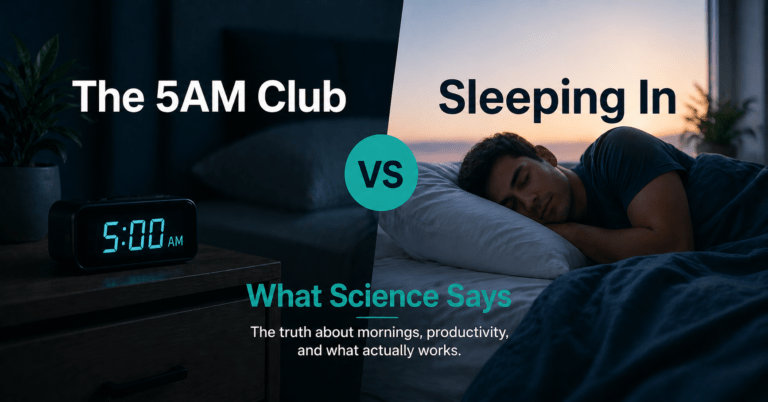
Few productivity ideas have been sold as hard as the early wake-up. Successful CEOs tweet about their 4:30AM starts. Robin Sharma built an entire bestselling book around a 5AM alarm. Instagram is full of grey-dawn workout photos with captions about “owning the morning.”
The message is consistent: the earlier you wake up, the more productive, disciplined, and successful you will be.
There’s just one problem. For a large portion of the population, this advice is not only unhelpful — it may actively make them less productive. And the reason comes down to something most productivity advice completely ignores: your chronotype.
What the 5AM Club Actually Claims
Robin Sharma’s The 5AM Club centers on a concept called the “Victory Hour” — the 60 minutes from 5AM to 6AM, split into three 20-minute blocks: 20 minutes of exercise, 20 minutes of reflection or journalling, and 20 minutes of learning. Sharma’s argument is that this hour, taken before the world wakes up and distractions begin, is when personal growth compounds fastest.
The appeal is real. Waking before anyone else means silence, no notifications, no demands from other people. You get to start your day on your terms. For many people who’ve tried it, the feeling of having already exercised and planned before 7AM is genuinely energizing.
The problem isn’t the concept. It’s the assumption that 5AM works the same way for everyone.
The Science of Chronotypes: You’re Not Lazy, You’re Wired Differently
Your chronotype is your biological preference for sleep and wake timing — and it is largely determined by genetics, not willpower. Sleep specialist Dr. Michael Breus has identified four primary chronotypes, each with different peak performance windows.
- Lions (15% of people) — Natural early risers. Most productive from dawn to noon. Energy drops sharply in the afternoon. These are the people who genuinely thrive at 5AM — and for whom all the early-rising productivity advice was essentially written.
- Bears (40–55% of people) — The majority. Sleep and wake patterns follow the sun. Most productive between roughly 10AM and 2PM. Can function well at 7AM, but not particularly suited to 5AM without sleep trade-offs.
- Wolves (15–30% of people) — Classic night owls. Peak cognitive performance arrives in the late afternoon and evening. Forcing a Wolf chronotype to operate at 5AM doesn’t transform them into a Lion — it just gives them a Lion’s schedule on a Wolf’s biology, which tends to mean sleep deprivation.
- Dolphins (15% of people) — Light, irregular sleepers who often struggle with insomnia. No consistent peak window; tend to do focused work in short bursts throughout the day.
The key insight: your chronotype isn’t something you chose, and for most people, it isn’t something you can permanently override. Genetics influence roughly 50% of your chronotype, and while you can nudge your schedule earlier or later by 30–60 minutes with consistent effort, forcing a Wolf to live on a Lion’s timetable is a recipe for chronic tiredness — not peak performance.
What Actually Happens When Night Owls Wake at 5AM
Here’s what the research shows happens when people with evening chronotypes force early wake-up times.
Sleep debt accumulates. If a Wolf’s natural sleep onset is 1AM and they’re forcing a 5AM wake-up, they’re sleeping four hours when their body wants eight. Over days and weeks, this sleep debt compounds. Cognitive performance — attention, working memory, decision-making — degrades measurably with even moderate sleep restriction.
Peak hours shift, not disappear. A Wolf who wakes at 5AM doesn’t suddenly have a productive morning. Their cognitive peak still arrives in the late afternoon and evening. They’ve simply added several hours of suboptimal function to the front of their day and removed sleep-recovery time from the back.
The “discipline” reading is misleading. When someone with an evening chronotype struggles to maintain a 5AM routine, the standard productivity response is that they need more discipline. Chronobiology researcher Till Roenneberg frames this differently — he calls it “social jetlag”: the misalignment between your biological clock and your socially imposed schedule. It isn’t a character flaw. It’s a mismatch.
Where the 5AM Crowd Gets It Right
Before dismissing early rising entirely, it’s worth being precise about what it actually offers — because for the right person, the benefits are real.
Silence and protected time
The genuine productivity advantage of waking at 5AM isn’t the hour itself — it’s the absence of interruptions. Email, messages, and demands from other people typically don’t start before 8AM. For anyone with a Lion or Bear chronotype whose mornings are naturally alert, waking early creates a window of protected focus time that’s genuinely hard to replicate later in the day.
Consistency signals
Research consistently shows that stable sleep timing — waking at the same time every day — is one of the most reliable predictors of sleep quality and daytime alertness. In this sense, the 5AM club’s core habit isn’t the specific hour, it’s the consistency. A Bear who wakes at 7AM every day will likely outperform a Bear who wakes at 5AM three days a week and 8AM the other four.
Cortisol alignment for Lions
Early risers naturally experience their cortisol peak — the hormone that drives alertness and motivation — in the early morning. For Lions, 5AM to 8AM genuinely is a peak performance window. The advice works because it was written by and for this chronotype. Research suggests the brain reaches its cognitive peak roughly three hours after waking — for someone who rises at 5AM, that’s around 9AM, perfectly aligned with a traditional workday.
The Real Question: What’s Your Actual Peak Window?
Rather than asking whether to join the 5AM club, a more useful question is: when does your brain actually work best?
There are a few practical ways to figure this out.
The free day test
On a day with no obligations — no alarm, no commitments — note when you naturally fall asleep and when you naturally wake up. The midpoint of that sleep window is a reliable indicator of your chronotype. If you naturally sleep from midnight to 8AM, your midpoint is 4AM, placing you firmly in Bear or Wolf territory. If you naturally sleep from 10PM to 6AM, you’re likely a Bear or Lion.
Track your focus quality, not just your hours
For one week, rate your focus and cognitive sharpness on a simple 1–5 scale every two hours throughout the day. After a week, a pattern will emerge. Most people have two daily peaks — a primary one in the morning or late morning, and a secondary one in the late afternoon. The exact timing tells you when to schedule deep work.
Notice what you protect instinctively
Look at when you do your best work naturally — not when productivity advice says you should, but when you actually produce output you’re proud of. That self-knowledge is more reliable than any generic recommendation.
A Practical Framework Based on Your Chronotype
Once you know your type, here’s how to structure your day around it rather than against it.
If you’re a Lion (natural early riser)
The 5AM club advice is genuinely for you. Use 5–8AM for deep, focused work. Schedule creative and analytical tasks in the morning. Keep meetings and administrative tasks for the afternoon when your energy naturally dips. Be protective of your evening wind-down — you’ll struggle past 10PM regardless.
If you’re a Bear (the majority)
A 6:30–7AM wake-up is your natural sweet spot. Your best cognitive window runs from about 10AM to 2PM — protect this for focused work. Waking at 5AM isn’t catastrophic, but it costs you sleep without a corresponding productivity gain unless you’re also going to bed by 9PM. Use mornings for moderate tasks and save your prime window for work that actually matters.
If you’re a Wolf (night owl)
Stop trying to be a morning person. Your peak window is real — it just arrives later. If your job or life allows any schedule flexibility, shift your deep work to the afternoon and evening. If you’re constrained to a 9–5, prioritize getting your sleep need met over waking early. A Wolf running on full sleep at 7AM will outperform a Wolf running on sleep debt at 5AM every time.
If you’re a Dolphin (irregular sleeper)
Consistency of timing matters more than the specific hour. Pick a wake time and hold it — even on weekends — to stabilize your sleep pattern. Focus work in short 25–45 minute blocks throughout the day rather than trying to sustain long focus sessions, which tend to be harder for this chronotype.
The Schedule That Reflects Your Chronotype
| Chronotype | Natural wake time | Peak focus window | Best for deep work |
|---|---|---|---|
| Lion | 5:00–6:00AM | 8AM–12PM | Early morning |
| Bear | 6:30–7:30AM | 10AM–2PM | Mid-morning |
| Wolf | 7:30–9:00AM | 3PM–9PM | Afternoon/evening |
| Dolphin | Variable | Short bursts all day | Morning quiet periods |
Frequently Asked Questions
Is it actually better to wake up at 5AM?
It depends entirely on your chronotype. For early risers (Lions), waking at 5AM aligns naturally with their biology and produces genuine benefits. For the majority of people (Bears), 6:30–7AM is a more sustainable option with fewer sleep trade-offs. For night owls (Wolves), forcing a 5AM wake-up typically results in sleep debt and reduced performance — the opposite of the intended effect. The key is matching your wake time to your actual chronotype, not someone else’s ideal schedule.
What is a chronotype and how do I find mine?
A chronotype is your biological preference for when you sleep, wake, and perform at your best — largely shaped by genetics. The simplest way to identify yours is the free day test: on a day with no alarm or obligations, note when you naturally fall asleep and wake up. Your natural midpoint of sleep reflects your chronotype. Sleep specialist Dr. Michael Breus also offers a chronotype quiz that categorizes people into Lions, Bears, Wolves, and Dolphins.
Can I change my chronotype to become a morning person?
You can shift your sleep timing by 30–60 minutes with consistent effort — gradually moving your bedtime and wake time earlier over several weeks. However, your core chronotype is largely genetic and resistant to permanent change. Forcing a night owl to maintain a 5AM schedule long-term typically results in chronic sleep restriction rather than a genuine shift in biology. The more sustainable approach is to work with your chronotype, not against it.
What does Robin Sharma’s 5AM Club actually recommend?
The 5AM Club centers on Sharma’s “Victory Hour” — the first hour from 5AM to 6AM, divided into three 20-minute blocks: movement (exercise), mindfulness (reflection or meditation), and mastery (learning or reading). The core argument is that this pre-distraction window is where personal growth compounds fastest. While the 20/20/20 structure itself is reasonable, the 5AM timing is most beneficial for people whose natural chronotype already aligns with early rising.
What time should I wake up for maximum productivity?
Research suggests your brain reaches its cognitive peak roughly two to three hours after waking, regardless of the specific hour. For most people, protecting a 90–120 minute block of focused, uninterrupted work during your personal peak window — whether that’s 8AM, 10AM, or even 3PM for evening types — matters far more than the absolute wake time. Identify your peak window using a simple daily energy log, then schedule your most important work there.
Is sleeping in bad for productivity?
Sleeping in inconsistently — waking at 6AM on weekdays and 10AM on weekends — does disrupt your circadian rhythm and can reduce alertness and focus. This is sometimes called “social jetlag.” However, sleeping in to meet your actual sleep need (7–9 hours for most adults) is not the same as being lazy. Consistently getting enough sleep is one of the highest-leverage things you can do for cognitive performance. The problem is irregular timing, not meeting your sleep requirement.
Final Verdict
The productivity gains people attribute to the 5AM club are real — but they’re not coming from the specific hour. They come from three things: protected quiet time before the world demands your attention, consistent sleep timing that stabilizes your body clock, and front-loading the day with intentional work rather than reactive tasks.
All three of those are available at 6AM. At 7AM. Even at 9AM, if that’s when you can genuinely protect focused time.
The 5AM club is excellent advice for Lions who needed permission to act on their natural biology, and genuinely useful for Bears who can sustain early rising without accumulating sleep debt. For Wolves and Dolphins, the same principles applied one to three hours later will produce better results.
The question was never “should I wake up at 5AM?” The question is: when am I actually at my best — and am I protecting that time?
Answer that honestly and you’ll get more done than any alarm clock ever gave you.
Real-life DLC for your daily living.
3 Comments